

552
NUCLEOSIDES, NUCLEOTIDES AND NUCLEIC ACIDS
pentose
base (A)
phosphate
base (C)
pentose
phosphate
pentose
base (G)
phosphate
pentose
base (T)
portion of DNA chain
DNA chain components
the most abbreviated form just
indicates the base sequence in
the direction 5´ → 3´
A
C
G
T
the sugar−phosphate
chain is usually assumed
and indicated by the bold
line; the base sequence is
indicated
ACGT
O
P
O
O
CH 2
N
N
N
NH 2
N
N
NH
N
O
O
N
O
N
N
O
NH 2
O
N
NH
O
O
H 3 C
O
P
O
CH 2
O
P
O
CH 2
O
P
O
CH 2
O
P
O
adenine
cytosine
guanine
thymine
1´
2´
3´
4´
5´
1´
2´
3´
4´
5´
NH 2
O
OH
O
O
O
OH
OH
OH
O
OH
3´-end
5´-end
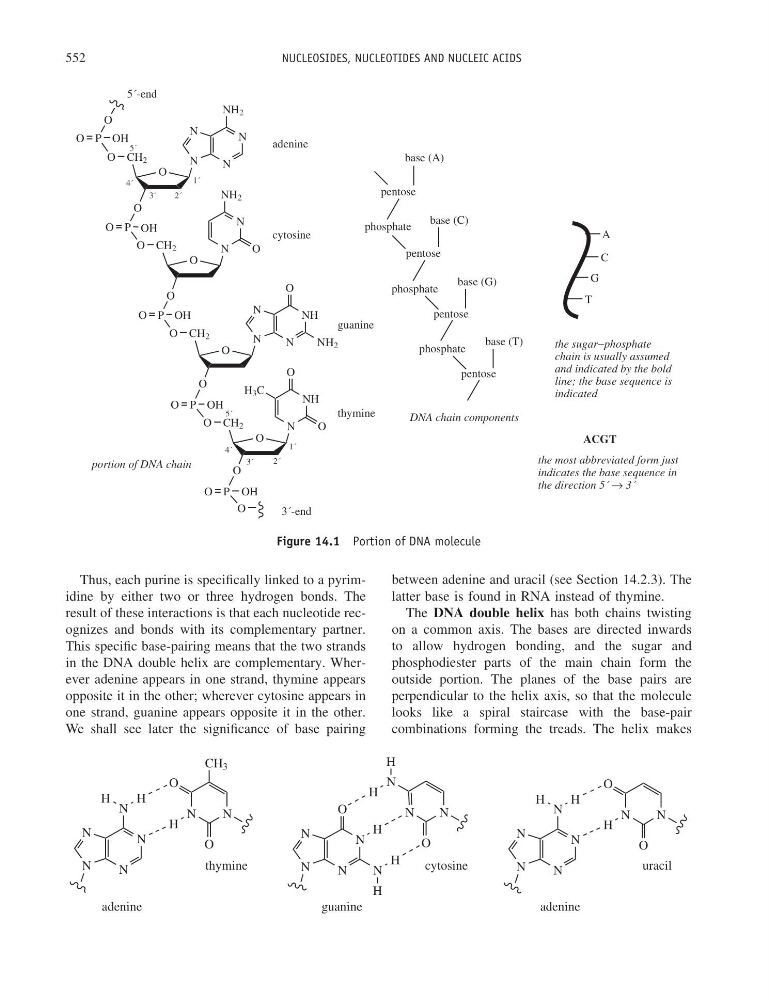
Figure 14.1 Portion of DNA molecule
Thus, each purine is specifically linked to a pyrimidine by either two or three hydrogen bonds. The
result of these interactions is that each nucleotide recognizes and bonds with its complementary partner.
This specific base-pairing means that the two strands
in the DNA double helix are complementary. Wherever adenine appears in one strand, thymine appears
opposite it in the other; wherever cytosine appears in
one strand, guanine appears opposite it in the other.
We shall see later the significance of base pairing
between adenine and uracil (see Section 14.2.3). The
latter base is found in RNA instead of thymine.
The DNA double helix has both chains twisting
on a common axis. The bases are directed inwards
to allow hydrogen bonding, and the sugar and
phosphodiester parts of the main chain form the
outside portion. The planes of the base pairs are
perpendicular to the helix axis, so that the molecule
looks like a spiral staircase with the base-pair
combinations forming the treads. The helix makes
N
N
N
O
N
N
N
N
N
N
N
N
N
O
N
N
N
O
O
CH 3
adenine
thymine
guanine
cytosine
H
H
H
H
H
H
H
H
N
N
N
N
N
N
N
O
O
adenine
uracil
H
H
H
NUCLEOSIDES, NUCLEOTIDES AND NUCLEIC ACIDS
pentose
base (A)
phosphate
base (C)
pentose
phosphate
pentose
base (G)
phosphate
pentose
base (T)
portion of DNA chain
DNA chain components
the most abbreviated form just
indicates the base sequence in
the direction 5´ → 3´
A
C
G
T
the sugar−phosphate
chain is usually assumed
and indicated by the bold
line; the base sequence is
indicated
ACGT
O
P
O
O
CH 2
N
N
N
NH 2
N
N
NH
N
O
O
N
O
N
N
O
NH 2
O
N
NH
O
O
H 3 C
O
P
O
CH 2
O
P
O
CH 2
O
P
O
CH 2
O
P
O
adenine
cytosine
guanine
thymine
1´
2´
3´
4´
5´
1´
2´
3´
4´
5´
NH 2
O
OH
O
O
O
OH
OH
OH
O
OH
3´-end
5´-end
Figure 14.1 Portion of DNA molecule
Thus, each purine is specifically linked to a pyrimidine by either two or three hydrogen bonds. The
result of these interactions is that each nucleotide recognizes and bonds with its complementary partner.
This specific base-pairing means that the two strands
in the DNA double helix are complementary. Wherever adenine appears in one strand, thymine appears
opposite it in the other; wherever cytosine appears in
one strand, guanine appears opposite it in the other.
We shall see later the significance of base pairing
between adenine and uracil (see Section 14.2.3). The
latter base is found in RNA instead of thymine.
The DNA double helix has both chains twisting
on a common axis. The bases are directed inwards
to allow hydrogen bonding, and the sugar and
phosphodiester parts of the main chain form the
outside portion. The planes of the base pairs are
perpendicular to the helix axis, so that the molecule
looks like a spiral staircase with the base-pair
combinations forming the treads. The helix makes
N
N
N
O
N
N
N
N
N
N
N
N
N
O
N
N
N
O
O
CH 3
adenine
thymine
guanine
cytosine
H
H
H
H
H
H
H
H
N
N
N
N
N
N
N
O
O
adenine
uracil
H
H
H