

NUCLEIC ACIDS
551
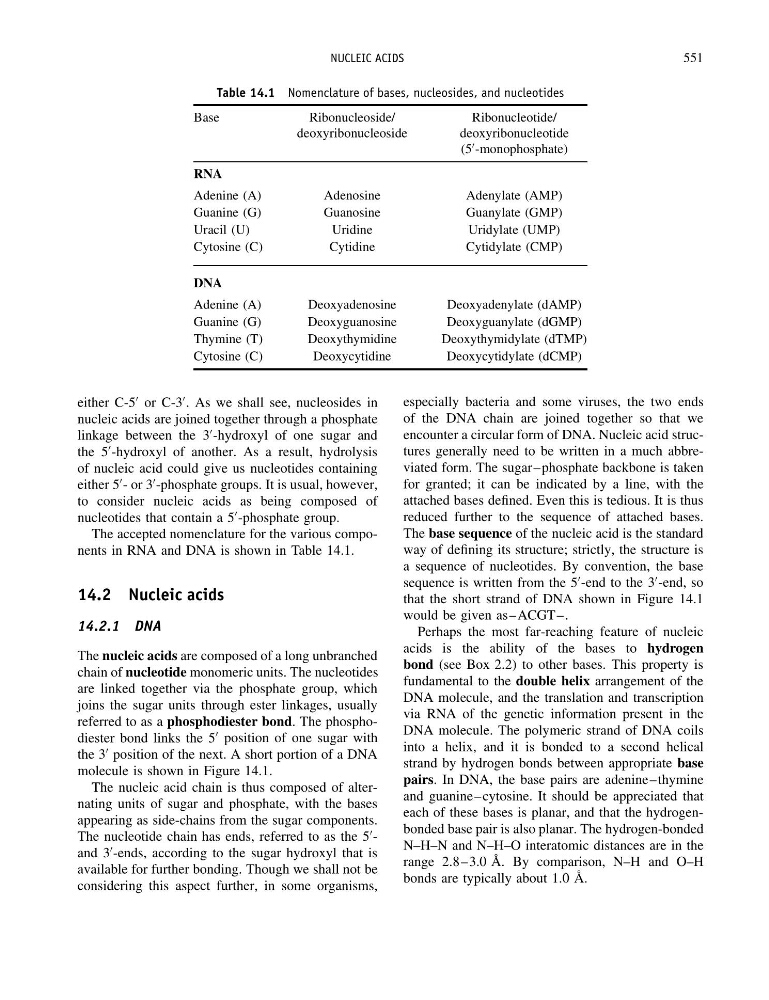
Table 14.1 Nomenclature of bases, nucleosides, and nucleotides
Base
Ribonucleoside/
deoxyribonucleoside
Ribonucleotide/
deoxyribonucleotide
(5
-monophosphate)
RNA
Adenine (A)
Adenosine
Adenylate (AMP)
Guanine (G)
Guanosine
Guanylate (GMP)
Uracil (U)
Uridine
Uridylate (UMP)
Cytosine (C)
Cytidine
Cytidylate (CMP)
DNA
Adenine (A)
Deoxyadenosine
Deoxyadenylate (dAMP)
Guanine (G)
Deoxyguanosine
Deoxyguanylate (dGMP)
Thymine (T)
Deoxythymidine
Deoxythymidylate (dTMP)
Cytosine (C)
Deoxycytidine
Deoxycytidylate (dCMP)
either C-5
or C-3
. As we shall see, nucleosides in
nucleic acids are joined together through a phosphate
linkage between the 3
-hydroxyl of one sugar and
the 5
-hydroxyl of another. As a result, hydrolysis
of nucleic acid could give us nucleotides containing
either 5
- or 3
-phosphate groups. It is usual, however,
to consider nucleic acids as being composed of
nucleotides that contain a 5
-phosphate group.
The accepted nomenclature for the various components in RNA and DNA is shown in Table 14.1.
14.2 Nucleic acids
14.2.1 DNA
The nucleic acids are composed of a long unbranched
chain of nucleotide monomeric units. The nucleotides
are linked together via the phosphate group, which
joins the sugar units through ester linkages, usually
referred to as a phosphodiester bond. The phosphodiester bond links the 5
position of one sugar with
the 3
position of the next. A short portion of a DNA
molecule is shown in Figure 14.1.
The nucleic acid chain is thus composed of alternating units of sugar and phosphate, with the bases
appearing as side-chains from the sugar components.
The nucleotide chain has ends, referred to as the 5
-
and 3
-ends, according to the sugar hydroxyl that is
available for further bonding. Though we shall not be
considering this aspect further, in some organisms,
especially bacteria and some viruses, the two ends
of the DNA chain are joined together so that we
encounter a circular form of DNA. Nucleic acid structures generally need to be written in a much abbreviated form. The sugar–phosphate backbone is taken
for granted; it can be indicated by a line, with the
attached bases defined. Even this is tedious. It is thus
reduced further to the sequence of attached bases.
The base sequence of the nucleic acid is the standard
way of defining its structure; strictly, the structure is
a sequence of nucleotides. By convention, the base
sequence is written from the 5
-end to the 3
-end, so
that the short strand of DNA shown in Figure 14.1
would be given as–ACGT–.
Perhaps the most far-reaching feature of nucleic
acids is the ability of the bases to hydrogen
bond (see Box 2.2) to other bases. This property is
fundamental to the double helix arrangement of the
DNA molecule, and the translation and transcription
via RNA of the genetic information present in the
DNA molecule. The polymeric strand of DNA coils
into a helix, and it is bonded to a second helical
strand by hydrogen bonds between appropriate base
pairs. In DNA, the base pairs are adenine–thymine
and guanine–cytosine. It should be appreciated that
each of these bases is planar, and that the hydrogenbonded base pair is also planar. The hydrogen-bonded
N–H–N and N–H–O interatomic distances are in the
range 2.8–3.0 ˚
A. By comparison, N–H and O–H
bonds are typically about 1.0 ˚
A.
551
Table 14.1 Nomenclature of bases, nucleosides, and nucleotides
Base
Ribonucleoside/
deoxyribonucleoside
Ribonucleotide/
deoxyribonucleotide
(5
-monophosphate)
RNA
Adenine (A)
Adenosine
Adenylate (AMP)
Guanine (G)
Guanosine
Guanylate (GMP)
Uracil (U)
Uridine
Uridylate (UMP)
Cytosine (C)
Cytidine
Cytidylate (CMP)
DNA
Adenine (A)
Deoxyadenosine
Deoxyadenylate (dAMP)
Guanine (G)
Deoxyguanosine
Deoxyguanylate (dGMP)
Thymine (T)
Deoxythymidine
Deoxythymidylate (dTMP)
Cytosine (C)
Deoxycytidine
Deoxycytidylate (dCMP)
either C-5
or C-3
. As we shall see, nucleosides in
nucleic acids are joined together through a phosphate
linkage between the 3
-hydroxyl of one sugar and
the 5
-hydroxyl of another. As a result, hydrolysis
of nucleic acid could give us nucleotides containing
either 5
- or 3
-phosphate groups. It is usual, however,
to consider nucleic acids as being composed of
nucleotides that contain a 5
-phosphate group.
The accepted nomenclature for the various components in RNA and DNA is shown in Table 14.1.
14.2 Nucleic acids
14.2.1 DNA
The nucleic acids are composed of a long unbranched
chain of nucleotide monomeric units. The nucleotides
are linked together via the phosphate group, which
joins the sugar units through ester linkages, usually
referred to as a phosphodiester bond. The phosphodiester bond links the 5
position of one sugar with
the 3
position of the next. A short portion of a DNA
molecule is shown in Figure 14.1.
The nucleic acid chain is thus composed of alternating units of sugar and phosphate, with the bases
appearing as side-chains from the sugar components.
The nucleotide chain has ends, referred to as the 5
-
and 3
-ends, according to the sugar hydroxyl that is
available for further bonding. Though we shall not be
considering this aspect further, in some organisms,
especially bacteria and some viruses, the two ends
of the DNA chain are joined together so that we
encounter a circular form of DNA. Nucleic acid structures generally need to be written in a much abbreviated form. The sugar–phosphate backbone is taken
for granted; it can be indicated by a line, with the
attached bases defined. Even this is tedious. It is thus
reduced further to the sequence of attached bases.
The base sequence of the nucleic acid is the standard
way of defining its structure; strictly, the structure is
a sequence of nucleotides. By convention, the base
sequence is written from the 5
-end to the 3
-end, so
that the short strand of DNA shown in Figure 14.1
would be given as–ACGT–.
Perhaps the most far-reaching feature of nucleic
acids is the ability of the bases to hydrogen
bond (see Box 2.2) to other bases. This property is
fundamental to the double helix arrangement of the
DNA molecule, and the translation and transcription
via RNA of the genetic information present in the
DNA molecule. The polymeric strand of DNA coils
into a helix, and it is bonded to a second helical
strand by hydrogen bonds between appropriate base
pairs. In DNA, the base pairs are adenine–thymine
and guanine–cytosine. It should be appreciated that
each of these bases is planar, and that the hydrogenbonded base pair is also planar. The hydrogen-bonded
N–H–N and N–H–O interatomic distances are in the
range 2.8–3.0 ˚
A. By comparison, N–H and O–H
bonds are typically about 1.0 ˚
A.