

550
NUCLEOSIDES, NUCLEOTIDES AND NUCLEIC ACIDS
N
N
N
NH 2
N
H
N
NH
N
O
N
H
NH 2
adenine, A
guanine, G
purines
N
H
N
O
NH 2
cytosine, C
N
H
NH
O
O
thymine, T
H 3 C
N
H
NH
O
O
uracil, U
pyrimidines
in DNA only
in RNA only
bases
in both DNA and RNA
1
2
3
4
5
6
7
8
9
1
2
3
4
5
6
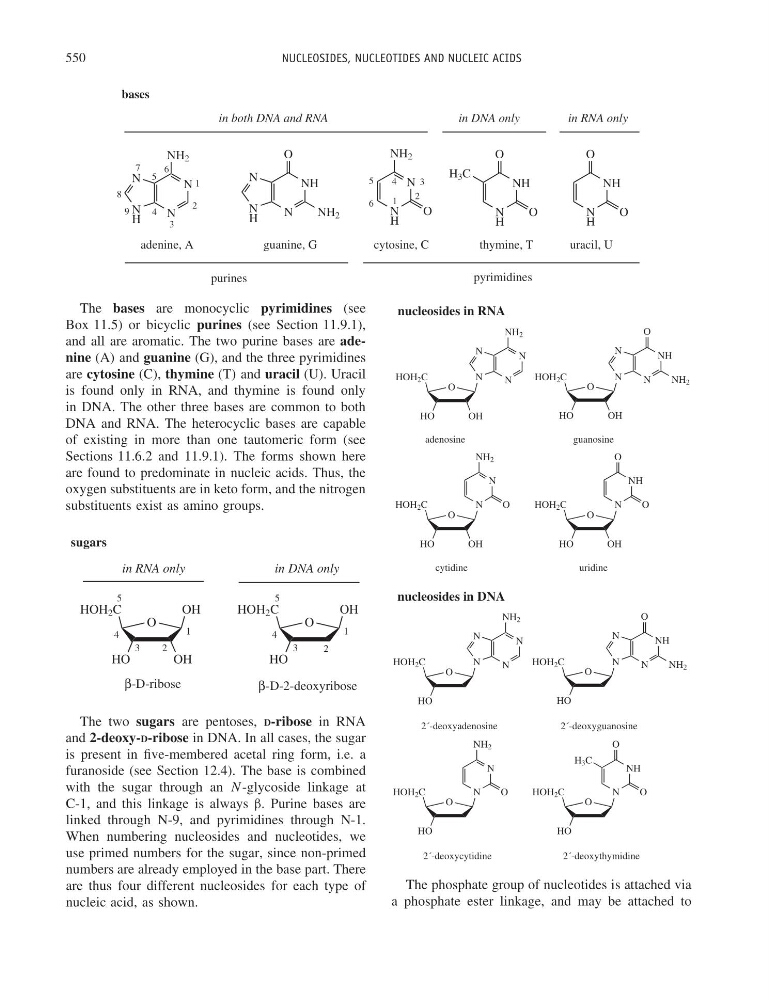
The bases are monocyclic pyrimidines (see
Box 11.5) or bicyclic purines (see Section 11.9.1),
and all are aromatic. The two purine bases are adenine (A) and guanine (G), and the three pyrimidines
are cytosine (C), thymine (T) and uracil (U). Uracil
is found only in RNA, and thymine is found only
in DNA. The other three bases are common to both
DNA and RNA. The heterocyclic bases are capable
of existing in more than one tautomeric form (see
Sections 11.6.2 and 11.9.1). The forms shown here
are found to predominate in nucleic acids. Thus, the
oxygen substituents are in keto form, and the nitrogen
substituents exist as amino groups.
O
HO
OH
HOH 2 C
1
2
3
4
5
β-D-ribose
OH
O
HO
HOH 2 C
1
2
3
4
5
β-D-2-deoxyribose
OH
in DNA only
in RNA only
sugars
The two sugars are pentoses, D-ribose in RNA
and 2-deoxy-D-ribose in DNA. In all cases, the sugar
is present in five-membered acetal ring form, i.e. a
furanoside (see Section 12.4). The base is combined
with the sugar through an N -glycoside linkage at
C-1, and this linkage is always β. Purine bases are
linked through N-9, and pyrimidines through N-1.
When numbering nucleosides and nucleotides, we
use primed numbers for the sugar, since non-primed
numbers are already employed in the base part. There
are thus four different nucleosides for each type of
nucleic acid, as shown.
N
N
N
NH 2
O
HO
OH
N
HOH 2 C
O
HO
OH
HOH 2 C
N
NH
N
O
N
NH 2
O
HO
OH
HOH 2 C
N
N
O
NH 2
N
N
N
NH 2
O
HO
N
HOH 2 C
O
HO
HOH 2 C
N
NH
N
O
N
NH 2
O
HO
HOH 2 C
N
N
O
NH 2
2´-deoxyadenosine
2´-deoxyguanosine
2´-deoxycytidine
adenosine
guanosine
cytidine
nucleosides in RNA
nucleosides in DNA
O
HO
OH
HOH 2 C
N
NH
O
O
uridine
O
HO
HOH 2 C
N
NH
O
O
H 3 C
2´-deoxythymidine
The phosphate group of nucleotides is attached via
a phosphate ester linkage, and may be attached to
NUCLEOSIDES, NUCLEOTIDES AND NUCLEIC ACIDS
N
N
N
NH 2
N
H
N
NH
N
O
N
H
NH 2
adenine, A
guanine, G
purines
N
H
N
O
NH 2
cytosine, C
N
H
NH
O
O
thymine, T
H 3 C
N
H
NH
O
O
uracil, U
pyrimidines
in DNA only
in RNA only
bases
in both DNA and RNA
1
2
3
4
5
6
7
8
9
1
2
3
4
5
6
The bases are monocyclic pyrimidines (see
Box 11.5) or bicyclic purines (see Section 11.9.1),
and all are aromatic. The two purine bases are adenine (A) and guanine (G), and the three pyrimidines
are cytosine (C), thymine (T) and uracil (U). Uracil
is found only in RNA, and thymine is found only
in DNA. The other three bases are common to both
DNA and RNA. The heterocyclic bases are capable
of existing in more than one tautomeric form (see
Sections 11.6.2 and 11.9.1). The forms shown here
are found to predominate in nucleic acids. Thus, the
oxygen substituents are in keto form, and the nitrogen
substituents exist as amino groups.
O
HO
OH
HOH 2 C
1
2
3
4
5
β-D-ribose
OH
O
HO
HOH 2 C
1
2
3
4
5
β-D-2-deoxyribose
OH
in DNA only
in RNA only
sugars
The two sugars are pentoses, D-ribose in RNA
and 2-deoxy-D-ribose in DNA. In all cases, the sugar
is present in five-membered acetal ring form, i.e. a
furanoside (see Section 12.4). The base is combined
with the sugar through an N -glycoside linkage at
C-1, and this linkage is always β. Purine bases are
linked through N-9, and pyrimidines through N-1.
When numbering nucleosides and nucleotides, we
use primed numbers for the sugar, since non-primed
numbers are already employed in the base part. There
are thus four different nucleosides for each type of
nucleic acid, as shown.
N
N
N
NH 2
O
HO
OH
N
HOH 2 C
O
HO
OH
HOH 2 C
N
NH
N
O
N
NH 2
O
HO
OH
HOH 2 C
N
N
O
NH 2
N
N
N
NH 2
O
HO
N
HOH 2 C
O
HO
HOH 2 C
N
NH
N
O
N
NH 2
O
HO
HOH 2 C
N
N
O
NH 2
2´-deoxyadenosine
2´-deoxyguanosine
2´-deoxycytidine
adenosine
guanosine
cytidine
nucleosides in RNA
nucleosides in DNA
O
HO
OH
HOH 2 C
N
NH
O
O
uridine
O
HO
HOH 2 C
N
NH
O
O
H 3 C
2´-deoxythymidine
The phosphate group of nucleotides is attached via
a phosphate ester linkage, and may be attached to