

14
Nucleosides, nucleotides
and nucleic acids
14.1 Nucleosides and nucleotides
The nucleic acids DNA (deoxyribonucleic acid) and
RNA (ribonucleic acid) are the molecules that play
a fundamental role in the storage of genetic information, and the subsequent manipulation of this information. They are polymers whose building blocks
are nucleotides, which are themselves combinations
of three parts: a heterocyclic base, a sugar, and
phosphate. The most significant difference in the
nucleotides comprising DNA and RNA is the sugar
unit, which is deoxyribose in DNA and ribose in
RNA. The term nucleoside is used to represent
a nucleotide lacking the phosphate group, i.e. the
base–sugar combination. The general structure of
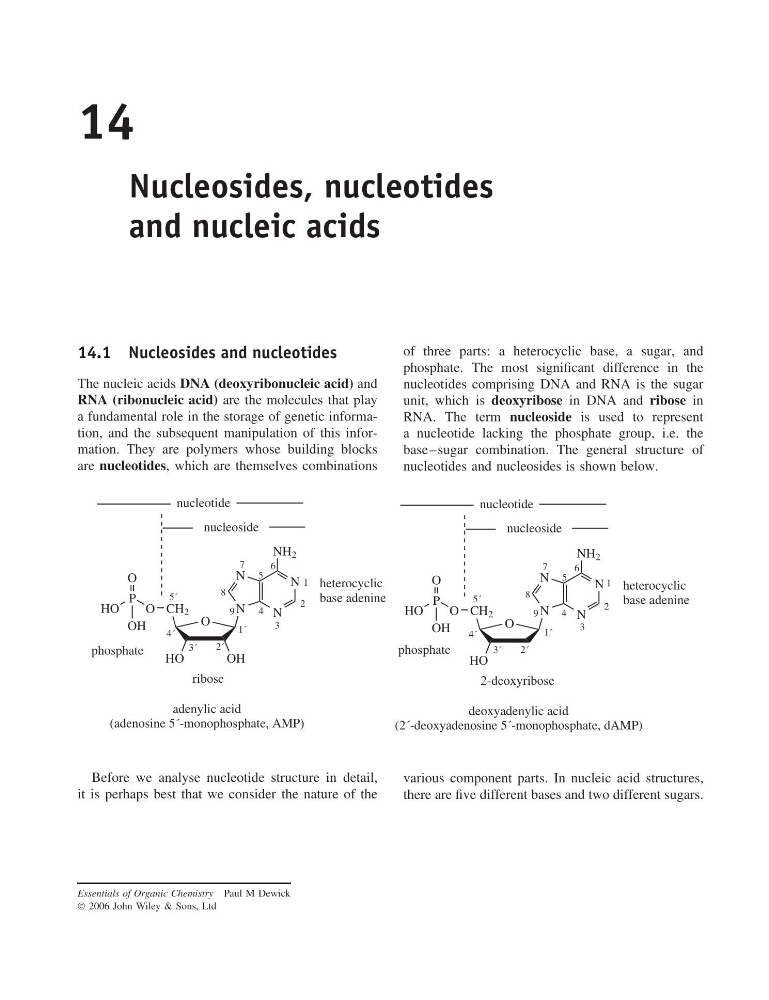
nucleotides and nucleosides is shown below.
N
N
N
NH 2
O
HO
OH
N
CH 2
adenylic acid
(adenosine 5´-monophosphate, AMP)
deoxyadenylic acid
(2´-deoxyadenosine 5´-monophosphate, dAMP)
1
2
3
4
5
6
7
8
9
1´
2´
3´
4´
5´
N
N
N
NH 2
O
HO
N
CH 2
1
2
3
4
5
6
7
8
9
1´
2´
3´
4´
5´
heterocyclic
base adenine
ribose
phosphate
heterocyclic
base adenine
2-deoxyribose
phosphate
nucleotide
nucleoside
nucleotide
nucleoside
O
P
HO
O
OH
O
P
HO
O
OH
Before we analyse nucleotide structure in detail,
it is perhaps best that we consider the nature of the
various component parts. In nucleic acid structures,
there are five different bases and two different sugars.
Essentials of Organic Chemistry Paul M Dewick
2006 John Wiley & Sons, Ltd
Nucleosides, nucleotides
and nucleic acids
14.1 Nucleosides and nucleotides
The nucleic acids DNA (deoxyribonucleic acid) and
RNA (ribonucleic acid) are the molecules that play
a fundamental role in the storage of genetic information, and the subsequent manipulation of this information. They are polymers whose building blocks
are nucleotides, which are themselves combinations
of three parts: a heterocyclic base, a sugar, and
phosphate. The most significant difference in the
nucleotides comprising DNA and RNA is the sugar
unit, which is deoxyribose in DNA and ribose in
RNA. The term nucleoside is used to represent
a nucleotide lacking the phosphate group, i.e. the
base–sugar combination. The general structure of
nucleotides and nucleosides is shown below.
N
N
N
NH 2
O
HO
OH
N
CH 2
adenylic acid
(adenosine 5´-monophosphate, AMP)
deoxyadenylic acid
(2´-deoxyadenosine 5´-monophosphate, dAMP)
1
2
3
4
5
6
7
8
9
1´
2´
3´
4´
5´
N
N
N
NH 2
O
HO
N
CH 2
1
2
3
4
5
6
7
8
9
1´
2´
3´
4´
5´
heterocyclic
base adenine
ribose
phosphate
heterocyclic
base adenine
2-deoxyribose
phosphate
nucleotide
nucleoside
nucleotide
nucleoside
O
P
HO
O
OH
O
P
HO
O
OH
Before we analyse nucleotide structure in detail,
it is perhaps best that we consider the nature of the
various component parts. In nucleic acid structures,
there are five different bases and two different sugars.
Essentials of Organic Chemistry Paul M Dewick
2006 John Wiley & Sons, Ltd