

546
AMINO ACIDS, PEPTIDES AND PROTEINS
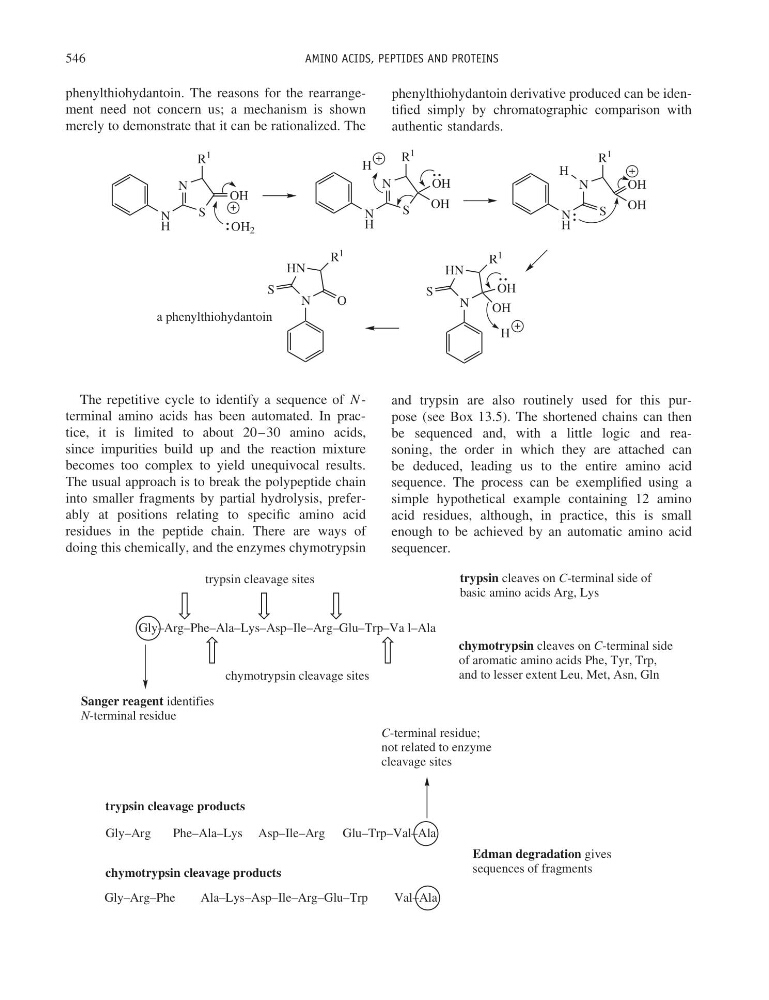
phenylthiohydantoin. The reasons for the rearrangement need not concern us; a mechanism is shown
merely to demonstrate that it can be rationalized. The
phenylthiohydantoin derivative produced can be identified simply by chromatographic comparison with
authentic standards.
N
HN
S
O
R
1
a phenylthiohydantoin
N
N
H
S
R
1
OH
OH 2
N
N
H
S
R
1
OH
OH
H
N
N
H
S
R
1
OH
OH
H
N
HN
S
R
1
OH
OH
H
The repetitive cycle to identify a sequence of N -
terminal amino acids has been automated. In practice, it is limited to about 20–30 amino acids,
since impurities build up and the reaction mixture
becomes too complex to yield unequivocal results.
The usual approach is to break the polypeptide chain
into smaller fragments by partial hydrolysis, preferably at positions relating to specific amino acid
residues in the peptide chain. There are ways of
doing this chemically, and the enzymes chymotrypsin
and trypsin are also routinely used for this purpose (see Box 13.5). The shortened chains can then
be sequenced and, with a little logic and reasoning, the order in which they are attached can
be deduced, leading us to the entire amino acid
sequence. The process can be exemplified using a
simple hypothetical example containing 12 amino
acid residues, although, in practice, this is small
enough to be achieved by an automatic amino acid
sequencer.
Gly–Arg–Phe–Ala–Lys–Asp–Ile–Arg–Glu–Trp–Va l–Ala
chymotrypsin cleavage sites
trypsin cleavage sites
chymotrypsin cleaves on C-terminal side
of aromatic amino acids Phe, Tyr, Trp,
and to lesser extent Leu, Met, Asn, Gln
trypsin cleaves on C-terminal side of
basic amino acids Arg, Lys
Gly–Arg
Sanger reagent identifies
N-terminal residue
Phe–Ala–Lys Asp–Ile–Arg Glu–Trp–Val–Ala
Edman degradation gives
sequences of fragments
Gly–Arg–Phe
chymotrypsin cleavage products
trypsin cleavage products
Ala–Lys–Asp–Ile–Arg–Glu–Trp
Val–Ala
C-terminal residue;
not related to enzyme
cleavage sites
AMINO ACIDS, PEPTIDES AND PROTEINS
phenylthiohydantoin. The reasons for the rearrangement need not concern us; a mechanism is shown
merely to demonstrate that it can be rationalized. The
phenylthiohydantoin derivative produced can be identified simply by chromatographic comparison with
authentic standards.
N
HN
S
O
R
1
a phenylthiohydantoin
N
N
H
S
R
1
OH
OH 2
N
N
H
S
R
1
OH
OH
H
N
N
H
S
R
1
OH
OH
H
N
HN
S
R
1
OH
OH
H
The repetitive cycle to identify a sequence of N -
terminal amino acids has been automated. In practice, it is limited to about 20–30 amino acids,
since impurities build up and the reaction mixture
becomes too complex to yield unequivocal results.
The usual approach is to break the polypeptide chain
into smaller fragments by partial hydrolysis, preferably at positions relating to specific amino acid
residues in the peptide chain. There are ways of
doing this chemically, and the enzymes chymotrypsin
and trypsin are also routinely used for this purpose (see Box 13.5). The shortened chains can then
be sequenced and, with a little logic and reasoning, the order in which they are attached can
be deduced, leading us to the entire amino acid
sequence. The process can be exemplified using a
simple hypothetical example containing 12 amino
acid residues, although, in practice, this is small
enough to be achieved by an automatic amino acid
sequencer.
Gly–Arg–Phe–Ala–Lys–Asp–Ile–Arg–Glu–Trp–Va l–Ala
chymotrypsin cleavage sites
trypsin cleavage sites
chymotrypsin cleaves on C-terminal side
of aromatic amino acids Phe, Tyr, Trp,
and to lesser extent Leu, Met, Asn, Gln
trypsin cleaves on C-terminal side of
basic amino acids Arg, Lys
Gly–Arg
Sanger reagent identifies
N-terminal residue
Phe–Ala–Lys Asp–Ile–Arg Glu–Trp–Val–Ala
Edman degradation gives
sequences of fragments
Gly–Arg–Phe
chymotrypsin cleavage products
trypsin cleavage products
Ala–Lys–Asp–Ile–Arg–Glu–Trp
Val–Ala
C-terminal residue;
not related to enzyme
cleavage sites