

DETERMINATION OF PEPTIDE SEQUENCE
545
After treatment of the peptide with the Sanger
reagent, all peptide bonds are then cleaved by
hydrolysis, giving a mixture of amino acids, with
the N -terminal one carrying a 2,4-dinitrophenyl
group. Being yellow, this compound is readily
detected and can be characterized easily by chromatographic comparison with standards. Although
2,4-dinitrofluorobenzene will also react with any free
amino group in an amino acid side-chain, e.g. that in
lysine, only the N -terminal amino acid will carry the
2,4-dinitrophenyl residue in its α-amino group.
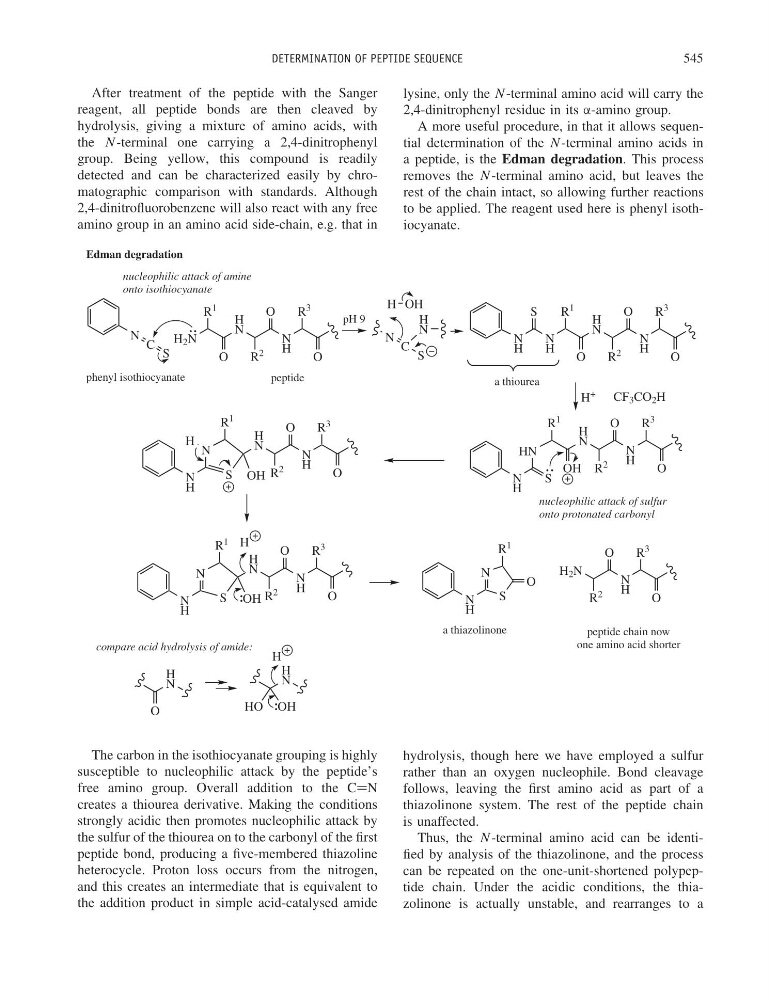
A more useful procedure, in that it allows sequential determination of the N -terminal amino acids in
a peptide, is the Edman degradation. This process
removes the N -terminal amino acid, but leaves the
rest of the chain intact, so allowing further reactions
to be applied. The reagent used here is phenyl isothiocyanate.
N
C S
phenyl isothiocyanate
H 2 N
H
N
N
H
O
O
O
R
1
R
2
R
3
peptide
N
H
H
N
N
H
O
O
O
R
1
R
2
R
3
N
H
S
pH 9
a thiourea
HN
H
N
N
H
OH
O
O
R 1
R 2
R 3
N
H
S
N
H
N
N
H
OH
O
O
R
1
R 2
R 3
N
H
S
H
N
H
N
N
H
OH
O
O
R 1
R 2
R 3
N
H
S
N
N
H
S
R 1
O
H 2 N
N
H
O
O
R 2
R 3
H +
H
peptide chain now
one amino acid shorter
a thiazolinone
CF 3 CO 2 H
Edman degradation
N
C
S
H
N
OH
H
nucleophilic attack of sulfur
onto protonated carbonyl
nucleophilic attack of amine
onto isothiocyanate
H
N
O
H
N
OH
HO
H
compare acid hydrolysis of amide:
The carbon in the isothiocyanate grouping is highly
susceptible to nucleophilic attack by the peptide’s
free amino group. Overall addition to the C=N
creates a thiourea derivative. Making the conditions
strongly acidic then promotes nucleophilic attack by
the sulfur of the thiourea on to the carbonyl of the first
peptide bond, producing a five-membered thiazoline
heterocycle. Proton loss occurs from the nitrogen,
and this creates an intermediate that is equivalent to
the addition product in simple acid-catalysed amide
hydrolysis, though here we have employed a sulfur
rather than an oxygen nucleophile. Bond cleavage
follows, leaving the first amino acid as part of a
thiazolinone system. The rest of the peptide chain
is unaffected.
Thus, the N -terminal amino acid can be identified by analysis of the thiazolinone, and the process
can be repeated on the one-unit-shortened polypeptide chain. Under the acidic conditions, the thiazolinone is actually unstable, and rearranges to a
545
After treatment of the peptide with the Sanger
reagent, all peptide bonds are then cleaved by
hydrolysis, giving a mixture of amino acids, with
the N -terminal one carrying a 2,4-dinitrophenyl
group. Being yellow, this compound is readily
detected and can be characterized easily by chromatographic comparison with standards. Although
2,4-dinitrofluorobenzene will also react with any free
amino group in an amino acid side-chain, e.g. that in
lysine, only the N -terminal amino acid will carry the
2,4-dinitrophenyl residue in its α-amino group.
A more useful procedure, in that it allows sequential determination of the N -terminal amino acids in
a peptide, is the Edman degradation. This process
removes the N -terminal amino acid, but leaves the
rest of the chain intact, so allowing further reactions
to be applied. The reagent used here is phenyl isothiocyanate.
N
C S
phenyl isothiocyanate
H 2 N
H
N
N
H
O
O
O
R
1
R
2
R
3
peptide
N
H
H
N
N
H
O
O
O
R
1
R
2
R
3
N
H
S
pH 9
a thiourea
HN
H
N
N
H
OH
O
O
R 1
R 2
R 3
N
H
S
N
H
N
N
H
OH
O
O
R
1
R 2
R 3
N
H
S
H
N
H
N
N
H
OH
O
O
R 1
R 2
R 3
N
H
S
N
N
H
S
R 1
O
H 2 N
N
H
O
O
R 2
R 3
H +
H
peptide chain now
one amino acid shorter
a thiazolinone
CF 3 CO 2 H
Edman degradation
N
C
S
H
N
OH
H
nucleophilic attack of sulfur
onto protonated carbonyl
nucleophilic attack of amine
onto isothiocyanate
H
N
O
H
N
OH
HO
H
compare acid hydrolysis of amide:
The carbon in the isothiocyanate grouping is highly
susceptible to nucleophilic attack by the peptide’s
free amino group. Overall addition to the C=N
creates a thiourea derivative. Making the conditions
strongly acidic then promotes nucleophilic attack by
the sulfur of the thiourea on to the carbonyl of the first
peptide bond, producing a five-membered thiazoline
heterocycle. Proton loss occurs from the nitrogen,
and this creates an intermediate that is equivalent to
the addition product in simple acid-catalysed amide
hydrolysis, though here we have employed a sulfur
rather than an oxygen nucleophile. Bond cleavage
follows, leaving the first amino acid as part of a
thiazolinone system. The rest of the peptide chain
is unaffected.
Thus, the N -terminal amino acid can be identified by analysis of the thiazolinone, and the process
can be repeated on the one-unit-shortened polypeptide chain. Under the acidic conditions, the thiazolinone is actually unstable, and rearranges to a