

544
AMINO ACIDS, PEPTIDES AND PROTEINS
The BOC protecting group is then removed from
the amino acid, allowing the next protected amino
acid to be bonded to the polymer-bound substrate via
the DCC coupling reaction. The processes of BOC
removal and DCC coupling are then repeated with as
many amino acid residues as required. This procedure
extends the chain by adding new amino acid residues
to the amino terminus. Finally, the polypeptide is
released from the polymer by treatment with HF.
All the steps are carried out without isolating any
intermediate. An early peptide synthesizer produced
the 125 amino acid protein ribonuclease in an overall
yield of 17%, a quite staggering achievement.
13.7 Determination of peptide
sequence
Chemical methods for determining the amino acid
sequence of a peptide or protein have been developed, and the normal approach is to exploit the
properties of the amino group at the N -terminus.
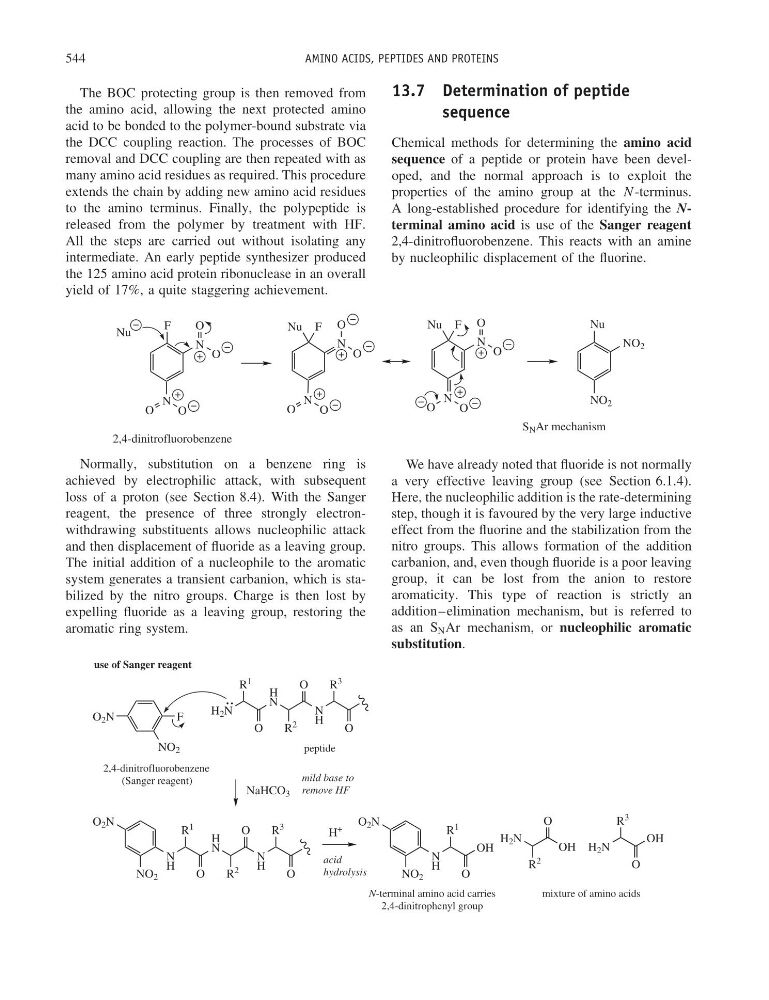
A long-established procedure for identifying the Nterminal amino acid is use of the Sanger reagent
2,4-dinitrofluorobenzene. This reacts with an amine
by nucleophilic displacement of the fluorine.
F
N
N
Nu
O
O
O
O
N
N
O
O
O
O
F
Nu
N
N
O
O
O
O
F
Nu
Nu
NO 2
NO 2
2,4-dinitrofluorobenzene
S N Ar mechanism
Normally, substitution on a benzene ring is
achieved by electrophilic attack, with subsequent
loss of a proton (see Section 8.4). With the Sanger
reagent, the presence of three strongly electronwithdrawing substituents allows nucleophilic attack
and then displacement of fluoride as a leaving group.
The initial addition of a nucleophile to the aromatic
system generates a transient carbanion, which is stabilized by the nitro groups. Charge is then lost by
expelling fluoride as a leaving group, restoring the
aromatic ring system.
We have already noted that fluoride is not normally
a very effective leaving group (see Section 6.1.4).
Here, the nucleophilic addition is the rate-determining
step, though it is favoured by the very large inductive
effect from the fluorine and the stabilization from the
nitro groups. This allows formation of the addition
carbanion, and, even though fluoride is a poor leaving
group, it can be lost from the anion to restore
aromaticity. This type of reaction is strictly an
addition–elimination mechanism, but is referred to
as an S N Ar mechanism, or nucleophilic aromatic
substitution.
F
NO 2
O 2 N
2,4-dinitrofluorobenzene
(Sanger reagent)
H 2 N
H
N
N
H
O
O
O
R 1
R 2
R 3
peptide
N
H
H
N
N
H
O
O
O
R 1
R
2
R 3
NO 2
O 2 N
acid
hydrolysis
NaHCO 3
mild base to
remove HF
H +
N
H
O
R 1
NO 2
O 2 N
OH
H 2 N
O
R 2
OH H 2 N
O
R
3
OH
mixture of amino acids
N-terminal amino acid carries
2,4-dinitrophenyl group
use of Sanger reagent
AMINO ACIDS, PEPTIDES AND PROTEINS
The BOC protecting group is then removed from
the amino acid, allowing the next protected amino
acid to be bonded to the polymer-bound substrate via
the DCC coupling reaction. The processes of BOC
removal and DCC coupling are then repeated with as
many amino acid residues as required. This procedure
extends the chain by adding new amino acid residues
to the amino terminus. Finally, the polypeptide is
released from the polymer by treatment with HF.
All the steps are carried out without isolating any
intermediate. An early peptide synthesizer produced
the 125 amino acid protein ribonuclease in an overall
yield of 17%, a quite staggering achievement.
13.7 Determination of peptide
sequence
Chemical methods for determining the amino acid
sequence of a peptide or protein have been developed, and the normal approach is to exploit the
properties of the amino group at the N -terminus.
A long-established procedure for identifying the Nterminal amino acid is use of the Sanger reagent
2,4-dinitrofluorobenzene. This reacts with an amine
by nucleophilic displacement of the fluorine.
F
N
N
Nu
O
O
O
O
N
N
O
O
O
O
F
Nu
N
N
O
O
O
O
F
Nu
Nu
NO 2
NO 2
2,4-dinitrofluorobenzene
S N Ar mechanism
Normally, substitution on a benzene ring is
achieved by electrophilic attack, with subsequent
loss of a proton (see Section 8.4). With the Sanger
reagent, the presence of three strongly electronwithdrawing substituents allows nucleophilic attack
and then displacement of fluoride as a leaving group.
The initial addition of a nucleophile to the aromatic
system generates a transient carbanion, which is stabilized by the nitro groups. Charge is then lost by
expelling fluoride as a leaving group, restoring the
aromatic ring system.
We have already noted that fluoride is not normally
a very effective leaving group (see Section 6.1.4).
Here, the nucleophilic addition is the rate-determining
step, though it is favoured by the very large inductive
effect from the fluorine and the stabilization from the
nitro groups. This allows formation of the addition
carbanion, and, even though fluoride is a poor leaving
group, it can be lost from the anion to restore
aromaticity. This type of reaction is strictly an
addition–elimination mechanism, but is referred to
as an S N Ar mechanism, or nucleophilic aromatic
substitution.
F
NO 2
O 2 N
2,4-dinitrofluorobenzene
(Sanger reagent)
H 2 N
H
N
N
H
O
O
O
R 1
R 2
R 3
peptide
N
H
H
N
N
H
O
O
O
R 1
R
2
R 3
NO 2
O 2 N
acid
hydrolysis
NaHCO 3
mild base to
remove HF
H +
N
H
O
R 1
NO 2
O 2 N
OH
H 2 N
O
R 2
OH H 2 N
O
R
3
OH
mixture of amino acids
N-terminal amino acid carries
2,4-dinitrophenyl group
use of Sanger reagent