

PEPTIDE SYNTHESIS
543
and often low yielding, since each intermediate needs
isolating and purifying at each stage of the synthesis.
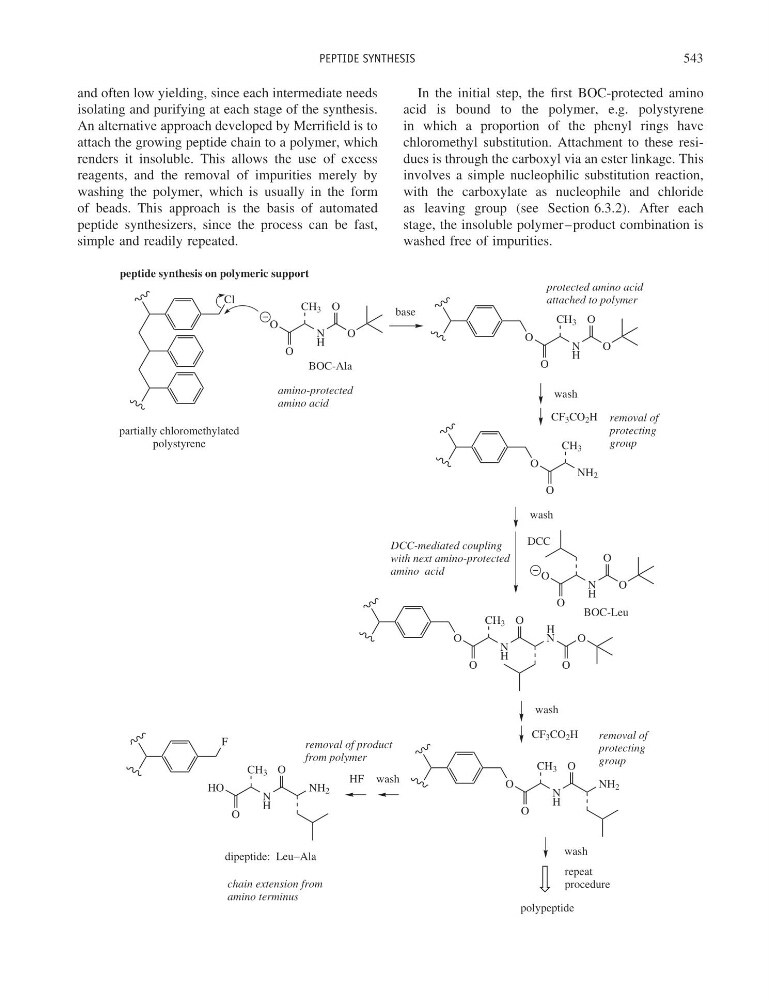
An alternative approach developed by Merrifield is to
attach the growing peptide chain to a polymer, which
renders it insoluble. This allows the use of excess
reagents, and the removal of impurities merely by
washing the polymer, which is usually in the form
of beads. This approach is the basis of automated
peptide synthesizers, since the process can be fast,
simple and readily repeated.
In the initial step, the first BOC-protected amino
acid is bound to the polymer, e.g. polystyrene
in which a proportion of the phenyl rings have
chloromethyl substitution. Attachment to these residues is through the carboxyl via an ester linkage. This
involves a simple nucleophilic substitution reaction,
with the carboxylate as nucleophile and chloride
as leaving group (see Section 6.3.2). After each
stage, the insoluble polymer–product combination is
washed free of impurities.
Cl
CH 3
N
H
O
O
O
O
BOC-Ala
partially chloromethylated
polystyrene
CH 3
N
H
O
O
O
O
base
CH 3
NH 2
O
O
removal of
protecting
group
amino-protected
amino acid
protected amino acid
attached to polymer
wash
CF 3 CO 2 H
wash
DCC
N
H
O
O
O
O
BOC-Leu
CH 3
N
H
O
O
H
N
O
O
O
DCC-mediated coupling
with next amino-protected
amino acid
removal of
protecting
group
wash
CF 3 CO 2 H
CH 3
N
H
O
O
NH 2
O
wash
repeat
procedure
HF
removal of product
from polymer
wash
polypeptide
CH 3
N
H
O
HO
NH 2
O
F
dipeptide: Leu−Ala
chain extension from
amino terminus
peptide synthesis on polymeric support
543
and often low yielding, since each intermediate needs
isolating and purifying at each stage of the synthesis.
An alternative approach developed by Merrifield is to
attach the growing peptide chain to a polymer, which
renders it insoluble. This allows the use of excess
reagents, and the removal of impurities merely by
washing the polymer, which is usually in the form
of beads. This approach is the basis of automated
peptide synthesizers, since the process can be fast,
simple and readily repeated.
In the initial step, the first BOC-protected amino
acid is bound to the polymer, e.g. polystyrene
in which a proportion of the phenyl rings have
chloromethyl substitution. Attachment to these residues is through the carboxyl via an ester linkage. This
involves a simple nucleophilic substitution reaction,
with the carboxylate as nucleophile and chloride
as leaving group (see Section 6.3.2). After each
stage, the insoluble polymer–product combination is
washed free of impurities.
Cl
CH 3
N
H
O
O
O
O
BOC-Ala
partially chloromethylated
polystyrene
CH 3
N
H
O
O
O
O
base
CH 3
NH 2
O
O
removal of
protecting
group
amino-protected
amino acid
protected amino acid
attached to polymer
wash
CF 3 CO 2 H
wash
DCC
N
H
O
O
O
O
BOC-Leu
CH 3
N
H
O
O
H
N
O
O
O
DCC-mediated coupling
with next amino-protected
amino acid
removal of
protecting
group
wash
CF 3 CO 2 H
CH 3
N
H
O
O
NH 2
O
wash
repeat
procedure
HF
removal of product
from polymer
wash
polypeptide
CH 3
N
H
O
HO
NH 2
O
F
dipeptide: Leu−Ala
chain extension from
amino terminus
peptide synthesis on polymeric support