

542
AMINO ACIDS, PEPTIDES AND PROTEINS
13.6.2 The dicyclohexylcarbodiimide coupling
reaction
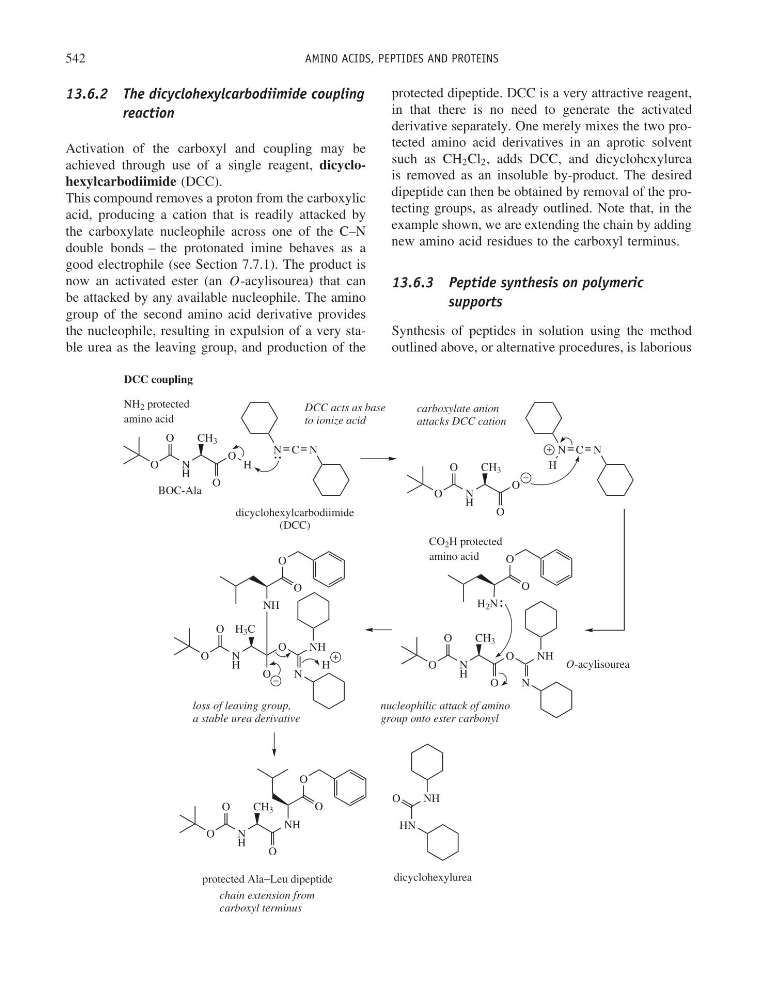
Activation of the carboxyl and coupling may be
achieved through use of a single reagent, dicyclohexylcarbodiimide (DCC).
This compound removes a proton from the carboxylic
acid, producing a cation that is readily attacked by
the carboxylate nucleophile across one of the C–N
double bonds – the protonated imine behaves as a
good electrophile (see Section 7.7.1). The product is
now an activated ester (an O-acylisourea) that can
be attacked by any available nucleophile. The amino
group of the second amino acid derivative provides
the nucleophile, resulting in expulsion of a very stable urea as the leaving group, and production of the
protected dipeptide. DCC is a very attractive reagent,
in that there is no need to generate the activated
derivative separately. One merely mixes the two protected amino acid derivatives in an aprotic solvent
such as CH 2 Cl 2 , adds DCC, and dicyclohexylurea
is removed as an insoluble by-product. The desired
dipeptide can then be obtained by removal of the protecting groups, as already outlined. Note that, in the
example shown, we are extending the chain by adding
new amino acid residues to the carboxyl terminus.
13.6.3 Peptide synthesis on polymeric
supports
Synthesis of peptides in solution using the method
outlined above, or alternative procedures, is laborious
CH 3
N
H
O
O
BOC-Ala
N C N
dicyclohexylcarbodiimide
(DCC)
O
O
H
CH 3
N
H
O
O
O
O
N C N
H
CH 3
N
H
O
O
O
O
N
NH
H 2 N
O
O
H 3 C
N
H
O
O
O
O
N
NH
NH
O
O
H
CH 3
N
H
O
O
O
NH
O
O
HN
NH
O
dicyclohexylurea
O-acylisourea
NH 2 protected
amino acid
DCC acts as base
to ionize acid
carboxylate anion
attacks DCC cation
CO 2 H protected
amino acid
nucleophilic attack of amino
group onto ester carbonyl
loss of leaving group,
a stable urea derivative
protected Ala−Leu dipeptide
chain extension from
carboxyl terminus
DCC coupling
AMINO ACIDS, PEPTIDES AND PROTEINS
13.6.2 The dicyclohexylcarbodiimide coupling
reaction
Activation of the carboxyl and coupling may be
achieved through use of a single reagent, dicyclohexylcarbodiimide (DCC).
This compound removes a proton from the carboxylic
acid, producing a cation that is readily attacked by
the carboxylate nucleophile across one of the C–N
double bonds – the protonated imine behaves as a
good electrophile (see Section 7.7.1). The product is
now an activated ester (an O-acylisourea) that can
be attacked by any available nucleophile. The amino
group of the second amino acid derivative provides
the nucleophile, resulting in expulsion of a very stable urea as the leaving group, and production of the
protected dipeptide. DCC is a very attractive reagent,
in that there is no need to generate the activated
derivative separately. One merely mixes the two protected amino acid derivatives in an aprotic solvent
such as CH 2 Cl 2 , adds DCC, and dicyclohexylurea
is removed as an insoluble by-product. The desired
dipeptide can then be obtained by removal of the protecting groups, as already outlined. Note that, in the
example shown, we are extending the chain by adding
new amino acid residues to the carboxyl terminus.
13.6.3 Peptide synthesis on polymeric
supports
Synthesis of peptides in solution using the method
outlined above, or alternative procedures, is laborious
CH 3
N
H
O
O
BOC-Ala
N C N
dicyclohexylcarbodiimide
(DCC)
O
O
H
CH 3
N
H
O
O
O
O
N C N
H
CH 3
N
H
O
O
O
O
N
NH
H 2 N
O
O
H 3 C
N
H
O
O
O
O
N
NH
NH
O
O
H
CH 3
N
H
O
O
O
NH
O
O
HN
NH
O
dicyclohexylurea
O-acylisourea
NH 2 protected
amino acid
DCC acts as base
to ionize acid
carboxylate anion
attacks DCC cation
CO 2 H protected
amino acid
nucleophilic attack of amino
group onto ester carbonyl
loss of leaving group,
a stable urea derivative
protected Ala−Leu dipeptide
chain extension from
carboxyl terminus
DCC coupling