

PEPTIDE SYNTHESIS
541
CH 3
H 2 N
CO 2 H
Ala
H 2 N
CO 2 H
CH 3
H 2 N
H
N
O
CO 2 H
Ala−Leu
Leu
protect
protect
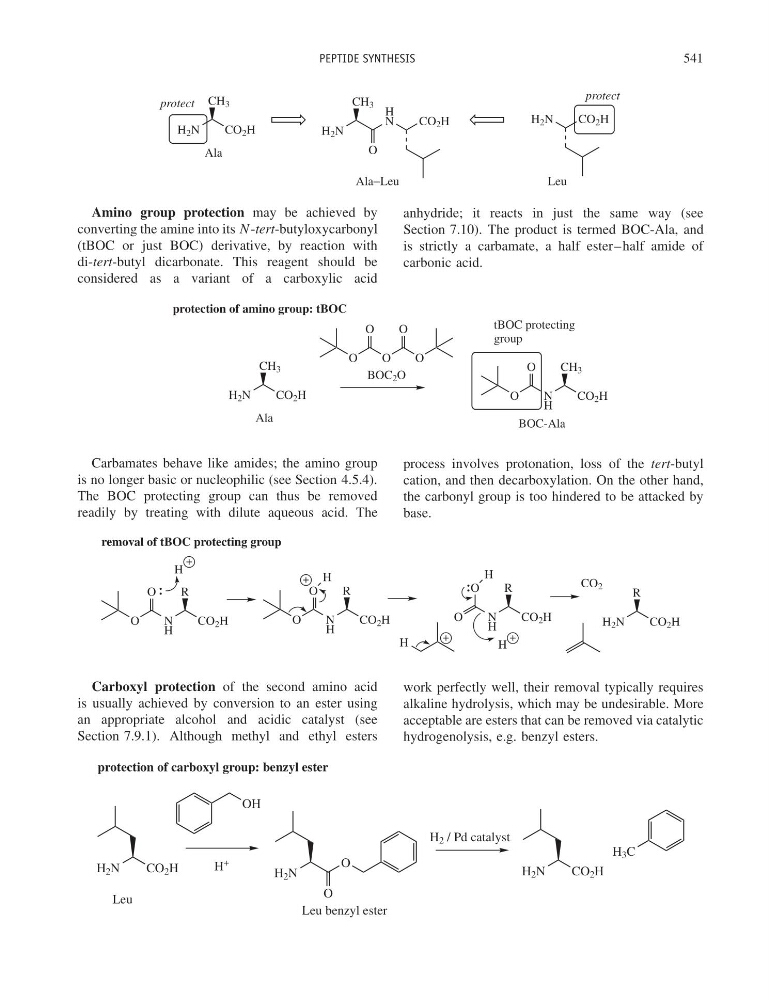
Amino group protection may be achieved by
converting the amine into its N -tert-butyloxycarbonyl
(tBOC or just BOC) derivative, by reaction with
di-tert-butyl dicarbonate. This reagent should be
considered as a variant of a carboxylic acid
anhydride; it reacts in just the same way (see
Section 7.10). The product is termed BOC-Ala, and
is strictly a carbamate, a half ester–half amide of
carbonic acid.
CH 3
H 2 N
CO 2 H
CH 3
N
H
CO 2 H
O
O
O
O
O
BOC 2 O
O
O
BOC-Ala
Ala
tBOC protecting
group
protection of amino group: tBOC
Carbamates behave like amides; the amino group
is no longer basic or nucleophilic (see Section 4.5.4).
The BOC protecting group can thus be removed
readily by treating with dilute aqueous acid. The
process involves protonation, loss of the tert-butyl
cation, and then decarboxylation. On the other hand,
the carbonyl group is too hindered to be attacked by
base.
R
N
H
CO 2 H
O
O
H
R
N
H
CO 2 H
O
O
H
R
N
H
CO 2 H
O
O
H
H
H
CO 2
R
H 2 N
CO 2 H
removal of tBOC protecting group
Carboxyl protection of the second amino acid
is usually achieved by conversion to an ester using
an appropriate alcohol and acidic catalyst (see
Section 7.9.1). Although methyl and ethyl esters
work perfectly well, their removal typically requires
alkaline hydrolysis, which may be undesirable. More
acceptable are esters that can be removed via catalytic
hydrogenolysis, e.g. benzyl esters.
H 2 N
CO 2 H
Leu
H
+
OH
H 2 N
O
O
H 2 N
CO 2 H
H 3 C
H 2 / Pd catalyst
Leu benzyl ester
protection of carboxyl group: benzyl ester
541
CH 3
H 2 N
CO 2 H
Ala
H 2 N
CO 2 H
CH 3
H 2 N
H
N
O
CO 2 H
Ala−Leu
Leu
protect
protect
Amino group protection may be achieved by
converting the amine into its N -tert-butyloxycarbonyl
(tBOC or just BOC) derivative, by reaction with
di-tert-butyl dicarbonate. This reagent should be
considered as a variant of a carboxylic acid
anhydride; it reacts in just the same way (see
Section 7.10). The product is termed BOC-Ala, and
is strictly a carbamate, a half ester–half amide of
carbonic acid.
CH 3
H 2 N
CO 2 H
CH 3
N
H
CO 2 H
O
O
O
O
O
BOC 2 O
O
O
BOC-Ala
Ala
tBOC protecting
group
protection of amino group: tBOC
Carbamates behave like amides; the amino group
is no longer basic or nucleophilic (see Section 4.5.4).
The BOC protecting group can thus be removed
readily by treating with dilute aqueous acid. The
process involves protonation, loss of the tert-butyl
cation, and then decarboxylation. On the other hand,
the carbonyl group is too hindered to be attacked by
base.
R
N
H
CO 2 H
O
O
H
R
N
H
CO 2 H
O
O
H
R
N
H
CO 2 H
O
O
H
H
H
CO 2
R
H 2 N
CO 2 H
removal of tBOC protecting group
Carboxyl protection of the second amino acid
is usually achieved by conversion to an ester using
an appropriate alcohol and acidic catalyst (see
Section 7.9.1). Although methyl and ethyl esters
work perfectly well, their removal typically requires
alkaline hydrolysis, which may be undesirable. More
acceptable are esters that can be removed via catalytic
hydrogenolysis, e.g. benzyl esters.
H 2 N
CO 2 H
Leu
H
+
OH
H 2 N
O
O
H 2 N
CO 2 H
H 3 C
H 2 / Pd catalyst
Leu benzyl ester
protection of carboxyl group: benzyl ester