

538
AMINO ACIDS, PEPTIDES AND PROTEINS
Box 13.11 (continued)
S
O
S
O
H 2 N
CO 2 H
H 2 N
SH
S
O
H 2 N
H 2 N
CO 2 H
O
H
N
NH
O
CO 2 H
SH
TE
release
ACV
A: adenylation domain
PCP: peptidyl carrier protein domain
C: condensation domain
E: epimerization domain (Val module only)
TE: thioesterase domain
A PCP C
A PCP C
Module 1
A PCP E
Module 2
Module 3
L-Cys
L-Val
L-α-aminoadipic acid
i
ii
peptide bond formation;
during assembly, the
L-valine residue is
epimerized to the
D-configuration
L
L
D
Medicinally useful penicillins are formed by replacing the acyl group of the side-chain amide in isopenicillin N
with an alternative acyl group. This is sometimes achieved biochemically in the fungal culture, but more frequently
it is accomplished through semi-synthetic procedures (see Box 7.20). Isopenicillin N is also the precursor of the
cephalosporins, formation of which requires a ring expansion. The five-membered thiazolidine ring of the penicillin
is expanded, taking in one of the methyl groups, to produce a six-membered heterocycle.
Box 13.12
Bacterial peptidoglycans: D-amino acids and the antibacterial action of penicillins
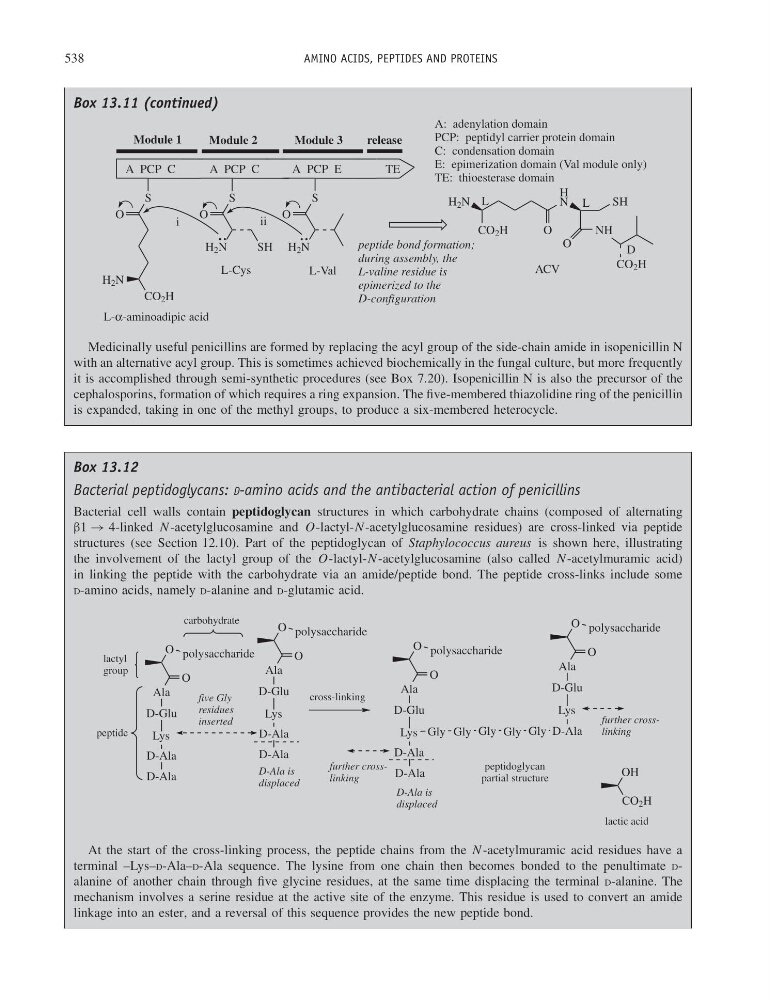
Bacterial cell walls contain peptidoglycan structures in which carbohydrate chains (composed of alternating
β1 → 4-linked N-acetylglucosamine and O-lactyl-N-acetylglucosamine residues) are cross-linked via peptide
structures (see Section 12.10). Part of the peptidoglycan of Staphylococcus aureus is shown here, illustrating
the involvement of the lactyl group of the O-lactyl-N-acetylglucosamine (also called N-acetylmuramic acid)
in linking the peptide with the carbohydrate via an amide/peptide bond. The peptide cross-links include some
D-amino acids, namely D-alanine and D-glutamic acid.
O
O
Ala
D-Glu
Lys
D-Ala
polysaccharide
D-Ala
O
O
Ala
D-Glu
Lys
D-Ala
polysaccharide
D-Ala
O
O
Ala
D-Glu
Lys
D-Ala
Gly
O
O
Ala
D-Glu
Lys
Gly Gly Gly Gly D-Ala
polysaccharide
polysaccharide
D-Ala
cross-linking
D-Ala is
displaced
five Gly
residues
inserted
further crosslinking
further crosslinking
D-Ala is
displaced
peptidoglycan
partial structure
carbohydrate
peptide
lactyl
group
OH
CO 2 H
lactic acid
At the start of the cross-linking process, the peptide chains from the N-acetylmuramic acid residues have a
terminal –Lys–D-Ala–D-Ala sequence. The lysine from one chain then becomes bonded to the penultimate Dalanine of another chain through five glycine residues, at the same time displacing the terminal D-alanine. The
mechanism involves a serine residue at the active site of the enzyme. This residue is used to convert an amide
linkage into an ester, and a reversal of this sequence provides the new peptide bond.
AMINO ACIDS, PEPTIDES AND PROTEINS
Box 13.11 (continued)
S
O
S
O
H 2 N
CO 2 H
H 2 N
SH
S
O
H 2 N
H 2 N
CO 2 H
O
H
N
NH
O
CO 2 H
SH
TE
release
ACV
A: adenylation domain
PCP: peptidyl carrier protein domain
C: condensation domain
E: epimerization domain (Val module only)
TE: thioesterase domain
A PCP C
A PCP C
Module 1
A PCP E
Module 2
Module 3
L-Cys
L-Val
L-α-aminoadipic acid
i
ii
peptide bond formation;
during assembly, the
L-valine residue is
epimerized to the
D-configuration
L
L
D
Medicinally useful penicillins are formed by replacing the acyl group of the side-chain amide in isopenicillin N
with an alternative acyl group. This is sometimes achieved biochemically in the fungal culture, but more frequently
it is accomplished through semi-synthetic procedures (see Box 7.20). Isopenicillin N is also the precursor of the
cephalosporins, formation of which requires a ring expansion. The five-membered thiazolidine ring of the penicillin
is expanded, taking in one of the methyl groups, to produce a six-membered heterocycle.
Box 13.12
Bacterial peptidoglycans: D-amino acids and the antibacterial action of penicillins
Bacterial cell walls contain peptidoglycan structures in which carbohydrate chains (composed of alternating
β1 → 4-linked N-acetylglucosamine and O-lactyl-N-acetylglucosamine residues) are cross-linked via peptide
structures (see Section 12.10). Part of the peptidoglycan of Staphylococcus aureus is shown here, illustrating
the involvement of the lactyl group of the O-lactyl-N-acetylglucosamine (also called N-acetylmuramic acid)
in linking the peptide with the carbohydrate via an amide/peptide bond. The peptide cross-links include some
D-amino acids, namely D-alanine and D-glutamic acid.
O
O
Ala
D-Glu
Lys
D-Ala
polysaccharide
D-Ala
O
O
Ala
D-Glu
Lys
D-Ala
polysaccharide
D-Ala
O
O
Ala
D-Glu
Lys
D-Ala
Gly
O
O
Ala
D-Glu
Lys
Gly Gly Gly Gly D-Ala
polysaccharide
polysaccharide
D-Ala
cross-linking
D-Ala is
displaced
five Gly
residues
inserted
further crosslinking
further crosslinking
D-Ala is
displaced
peptidoglycan
partial structure
carbohydrate
peptide
lactyl
group
OH
CO 2 H
lactic acid
At the start of the cross-linking process, the peptide chains from the N-acetylmuramic acid residues have a
terminal –Lys–D-Ala–D-Ala sequence. The lysine from one chain then becomes bonded to the penultimate Dalanine of another chain through five glycine residues, at the same time displacing the terminal D-alanine. The
mechanism involves a serine residue at the active site of the enzyme. This residue is used to convert an amide
linkage into an ester, and a reversal of this sequence provides the new peptide bond.