

PEPTIDE BIOSYNTHESIS
539
peptide
H
N
Me
H
N
Me
CO 2 H
O
O
Ser
OH
H
N
peptide
O
Ser
O
O
H 2 N
H
N
peptide
O
O
growing peptide chain:
peptide–D-Ala–D-Ala
N
H
Me
Me
peptide
O
peptide
O
cross-linked peptide chains:
peptide–D-Ala–Gly–peptide
nucleophilic attack of active site serine
group on enzyme hydrolyses amide bond
formation of new amide bond at
expense of ester hydrolysis
Enzyme
Enzyme
cross-linking in peptidoglycan biosynthesis:
Me
H
N
O
Ser
O
Enzyme
Ser
O
O
Me
Enzyme
NH
H
H
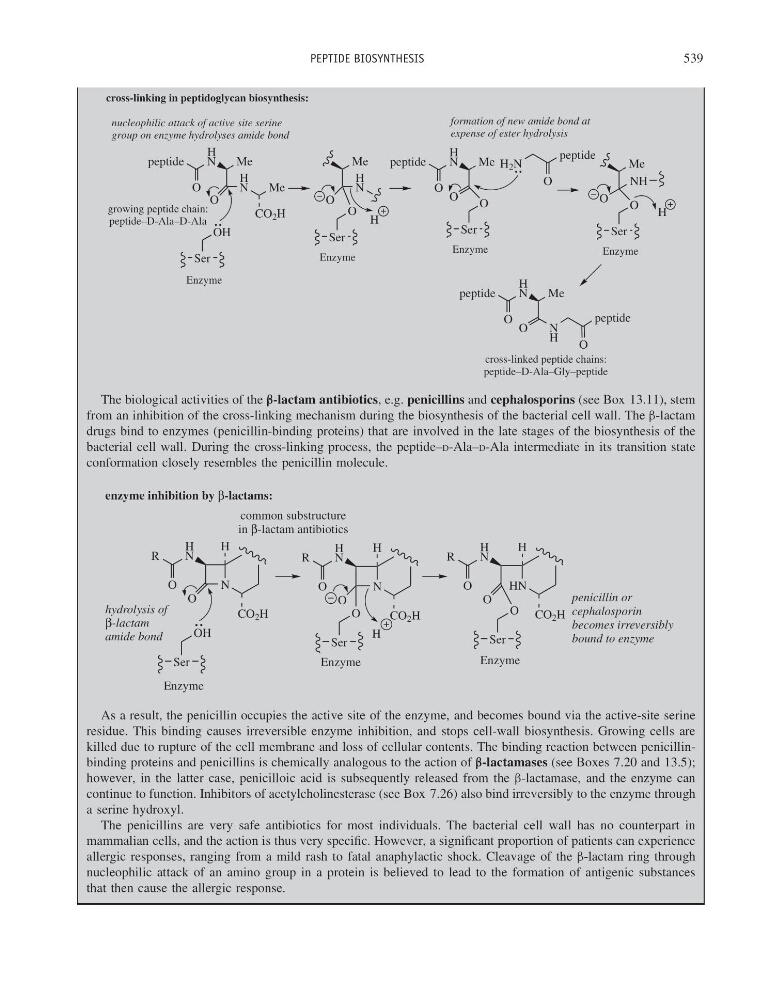
The biological activities of the β-lactam antibiotics, e.g. penicillins and cephalosporins (see Box 13.11), stem
from an inhibition of the cross-linking mechanism during the biosynthesis of the bacterial cell wall. The β-lactam
drugs bind to enzymes (penicillin-binding proteins) that are involved in the late stages of the biosynthesis of the
bacterial cell wall. During the cross-linking process, the peptide–D-Ala–D-Ala intermediate in its transition state
conformation closely resembles the penicillin molecule.
H
N
N
O
R
O
H
CO 2 H
Ser
OH
H
N
HN
O
R
O
H
CO 2 H
Ser
O
common substructure
in β-lactam antibiotics
hydrolysis of
β-lactam
amide bond
penicillin or
cephalosporin
becomes irreversibly
bound to enzyme
Enzyme
Enzyme
enzyme inhibition by β-lactams:
H
N
N
O
R
O
H
CO 2 H
Ser
O
Enzyme
H
As a result, the penicillin occupies the active site of the enzyme, and becomes bound via the active-site serine
residue. This binding causes irreversible enzyme inhibition, and stops cell-wall biosynthesis. Growing cells are
killed due to rupture of the cell membrane and loss of cellular contents. The binding reaction between penicillinbinding proteins and penicillins is chemically analogous to the action of β-lactamases (see Boxes 7.20 and 13.5);
however, in the latter case, penicilloic acid is subsequently released from the β-lactamase, and the enzyme can
continue to function. Inhibitors of acetylcholinesterase (see Box 7.26) also bind irreversibly to the enzyme through
a serine hydroxyl.
The penicillins are very safe antibiotics for most individuals. The bacterial cell wall has no counterpart in
mammalian cells, and the action is thus very specific. However, a significant proportion of patients can experience
allergic responses, ranging from a mild rash to fatal anaphylactic shock. Cleavage of the β-lactam ring through
nucleophilic attack of an amino group in a protein is believed to lead to the formation of antigenic substances
that then cause the allergic response.
539
peptide
H
N
Me
H
N
Me
CO 2 H
O
O
Ser
OH
H
N
peptide
O
Ser
O
O
H 2 N
H
N
peptide
O
O
growing peptide chain:
peptide–D-Ala–D-Ala
N
H
Me
Me
peptide
O
peptide
O
cross-linked peptide chains:
peptide–D-Ala–Gly–peptide
nucleophilic attack of active site serine
group on enzyme hydrolyses amide bond
formation of new amide bond at
expense of ester hydrolysis
Enzyme
Enzyme
cross-linking in peptidoglycan biosynthesis:
Me
H
N
O
Ser
O
Enzyme
Ser
O
O
Me
Enzyme
NH
H
H
The biological activities of the β-lactam antibiotics, e.g. penicillins and cephalosporins (see Box 13.11), stem
from an inhibition of the cross-linking mechanism during the biosynthesis of the bacterial cell wall. The β-lactam
drugs bind to enzymes (penicillin-binding proteins) that are involved in the late stages of the biosynthesis of the
bacterial cell wall. During the cross-linking process, the peptide–D-Ala–D-Ala intermediate in its transition state
conformation closely resembles the penicillin molecule.
H
N
N
O
R
O
H
CO 2 H
Ser
OH
H
N
HN
O
R
O
H
CO 2 H
Ser
O
common substructure
in β-lactam antibiotics
hydrolysis of
β-lactam
amide bond
penicillin or
cephalosporin
becomes irreversibly
bound to enzyme
Enzyme
Enzyme
enzyme inhibition by β-lactams:
H
N
N
O
R
O
H
CO 2 H
Ser
O
Enzyme
H
As a result, the penicillin occupies the active site of the enzyme, and becomes bound via the active-site serine
residue. This binding causes irreversible enzyme inhibition, and stops cell-wall biosynthesis. Growing cells are
killed due to rupture of the cell membrane and loss of cellular contents. The binding reaction between penicillinbinding proteins and penicillins is chemically analogous to the action of β-lactamases (see Boxes 7.20 and 13.5);
however, in the latter case, penicilloic acid is subsequently released from the β-lactamase, and the enzyme can
continue to function. Inhibitors of acetylcholinesterase (see Box 7.26) also bind irreversibly to the enzyme through
a serine hydroxyl.
The penicillins are very safe antibiotics for most individuals. The bacterial cell wall has no counterpart in
mammalian cells, and the action is thus very specific. However, a significant proportion of patients can experience
allergic responses, ranging from a mild rash to fatal anaphylactic shock. Cleavage of the β-lactam ring through
nucleophilic attack of an amino group in a protein is believed to lead to the formation of antigenic substances
that then cause the allergic response.