

40
ATOMIC STRUCTURE AND BONDING
Box 2.1 (continued)
Carotenoids function along with chlorophylls (see Box 11.4) in photosynthesis as accessory light-harvesting
pigments, effectively extending the range of light that can be absorbed by the photosynthetic apparatus. The
absorption maximum of carotenoids is typically between 450 and 500 nm, which indicates that the energy
difference between bonding and antibonding molecular orbitals is quite small. This absorption maximum
corresponds to blue light, so that with blue light absorbed, the overall impression to the human eye is of a
bright yellow–orange coloration. Recent research suggests that carotenoids are important antioxidant molecules
for humans, helping to remove toxic oxygen-derived radicals, and thus minimizing cell damage (see Box 9.2). The
most beneficial dietary carotenoid in this respect is lycopene, with tomatoes featuring as the predominant source.
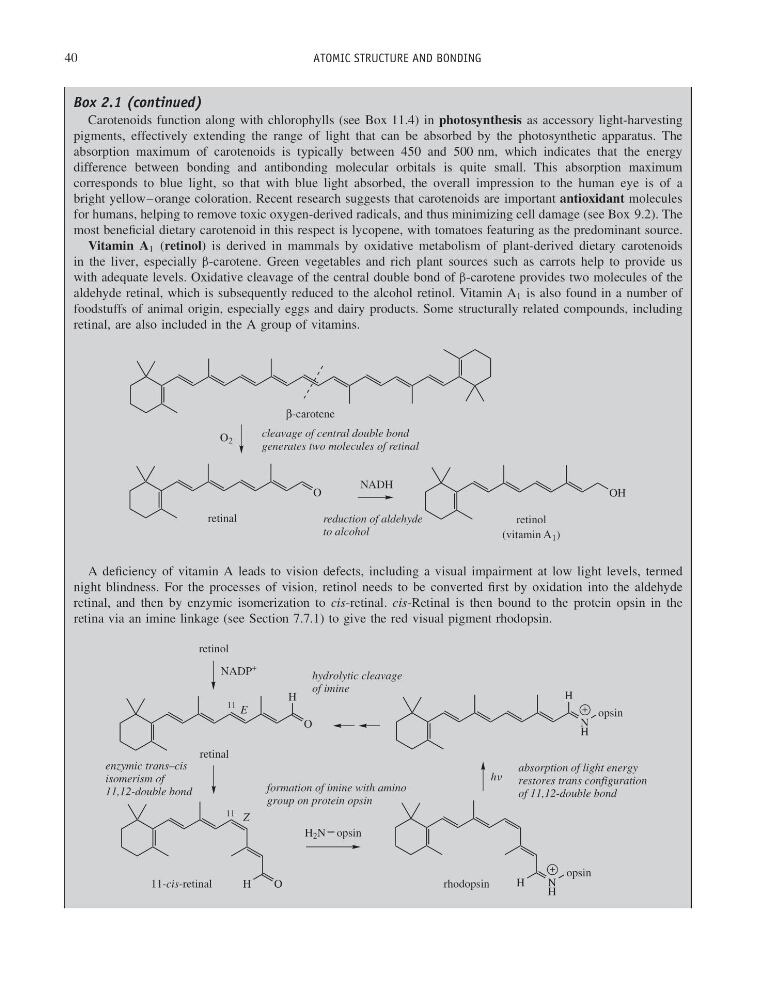
Vitamin A 1 (retinol) is derived in mammals by oxidative metabolism of plant-derived dietary carotenoids
in the liver, especially β-carotene. Green vegetables and rich plant sources such as carrots help to provide us
with adequate levels. Oxidative cleavage of the central double bond of β-carotene provides two molecules of the
aldehyde retinal, which is subsequently reduced to the alcohol retinol. Vitamin A 1 is also found in a number of
foodstuffs of animal origin, especially eggs and dairy products. Some structurally related compounds, including
retinal, are also included in the A group of vitamins.
O
β-carotene
OH
retinal
retinol
(vitamin A 1 )
cleavage of central double bond
generates two molecules of retinal
reduction of aldehyde
to alcohol
O 2
NADH
A deficiency of vitamin A leads to vision defects, including a visual impairment at low light levels, termed
night blindness. For the processes of vision, retinol needs to be converted first by oxidation into the aldehyde
retinal, and then by enzymic isomerization to cis-retinal. cis-Retinal is then bound to the protein opsin in the
retina via an imine linkage (see Section 7.7.1) to give the red visual pigment rhodopsin.
O
H
O
H
N
H
H
opsin
N
H
H
opsin
H 2 N opsin
retinol
retinal
11-cis-retinal
11
11
NADP
+
rhodopsin
hn
enzymic trans–cis
isomerism of
11,12-double bond
absorption of light energy
restores trans configuration
of 11,12-double bond
formation of imine with amino
group on protein opsin
hydrolytic cleavage
of imine
E
Z
ATOMIC STRUCTURE AND BONDING
Box 2.1 (continued)
Carotenoids function along with chlorophylls (see Box 11.4) in photosynthesis as accessory light-harvesting
pigments, effectively extending the range of light that can be absorbed by the photosynthetic apparatus. The
absorption maximum of carotenoids is typically between 450 and 500 nm, which indicates that the energy
difference between bonding and antibonding molecular orbitals is quite small. This absorption maximum
corresponds to blue light, so that with blue light absorbed, the overall impression to the human eye is of a
bright yellow–orange coloration. Recent research suggests that carotenoids are important antioxidant molecules
for humans, helping to remove toxic oxygen-derived radicals, and thus minimizing cell damage (see Box 9.2). The
most beneficial dietary carotenoid in this respect is lycopene, with tomatoes featuring as the predominant source.
Vitamin A 1 (retinol) is derived in mammals by oxidative metabolism of plant-derived dietary carotenoids
in the liver, especially β-carotene. Green vegetables and rich plant sources such as carrots help to provide us
with adequate levels. Oxidative cleavage of the central double bond of β-carotene provides two molecules of the
aldehyde retinal, which is subsequently reduced to the alcohol retinol. Vitamin A 1 is also found in a number of
foodstuffs of animal origin, especially eggs and dairy products. Some structurally related compounds, including
retinal, are also included in the A group of vitamins.
O
β-carotene
OH
retinal
retinol
(vitamin A 1 )
cleavage of central double bond
generates two molecules of retinal
reduction of aldehyde
to alcohol
O 2
NADH
A deficiency of vitamin A leads to vision defects, including a visual impairment at low light levels, termed
night blindness. For the processes of vision, retinol needs to be converted first by oxidation into the aldehyde
retinal, and then by enzymic isomerization to cis-retinal. cis-Retinal is then bound to the protein opsin in the
retina via an imine linkage (see Section 7.7.1) to give the red visual pigment rhodopsin.
O
H
O
H
N
H
H
opsin
N
H
H
opsin
H 2 N opsin
retinol
retinal
11-cis-retinal
11
11
NADP
+
rhodopsin
hn
enzymic trans–cis
isomerism of
11,12-double bond
absorption of light energy
restores trans configuration
of 11,12-double bond
formation of imine with amino
group on protein opsin
hydrolytic cleavage
of imine
E
Z