

AROMATICITY
41
Rhodopsin is sensitive to light by a process that involves isomerization of the cis-retinal portion back to the
trans form, thus translating the light energy into a molecular change that then triggers a nerve impulse to the
brain. The absorption of light energy promotes an electron from a π to a π
∗ orbital, thus temporarily destroying
the double bond character and allowing rotation (see Section 2.6.2). trans-Retinal is then subsequently released
from the protein by hydrolysis, and the process can continue.
2.9 Aromaticity
Aromatic compounds constitute a special group
of conjugated molecules; these are cyclic unsaturated molecules with unusual stability and characteristic properties. The term aromatic originates
from the odour displayed by many of the simple
examples.
2.9.1 Benzene
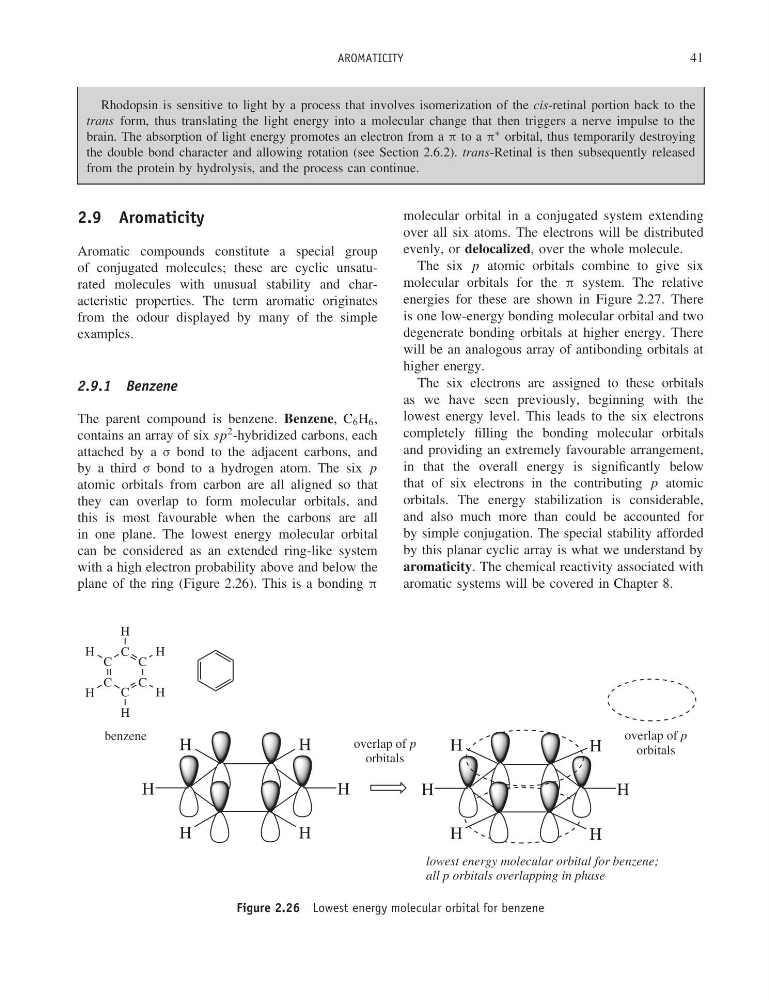
The parent compound is benzene. Benzene, C 6 H 6 ,
contains an array of six sp
2 -hybridized carbons, each
attached by a σ bond to the adjacent carbons, and
by a third σ bond to a hydrogen atom. The six p
atomic orbitals from carbon are all aligned so that
they can overlap to form molecular orbitals, and
this is most favourable when the carbons are all
in one plane. The lowest energy molecular orbital
can be considered as an extended ring-like system
with a high electron probability above and below the
plane of the ring (Figure 2.26). This is a bonding π
molecular orbital in a conjugated system extending
over all six atoms. The electrons will be distributed
evenly, or delocalized, over the whole molecule.
The six p atomic orbitals combine to give six
molecular orbitals for the π system. The relative
energies for these are shown in Figure 2.27. There
is one low-energy bonding molecular orbital and two
degenerate bonding orbitals at higher energy. There
will be an analogous array of antibonding orbitals at
higher energy.
The six electrons are assigned to these orbitals
as we have seen previously, beginning with the
lowest energy level. This leads to the six electrons
completely filling the bonding molecular orbitals
and providing an extremely favourable arrangement,
in that the overall energy is significantly below
that of six electrons in the contributing p atomic
orbitals. The energy stabilization is considerable,
and also much more than could be accounted for
by simple conjugation. The special stability afforded
by this planar cyclic array is what we understand by
aromaticity. The chemical reactivity associated with
aromatic systems will be covered in Chapter 8.
H
H
H
H
H
H
H
H
H
H
H
H
overlap of p
orbitals
C
C
C
C
C
C
benzene
H
H
H
H
H
H
lowest energy molecular orbital for benzene;
all p orbitals overlapping in phase
overlap of p
orbitals
Figure 2.26 Lowest energy molecular orbital for benzene
41
Rhodopsin is sensitive to light by a process that involves isomerization of the cis-retinal portion back to the
trans form, thus translating the light energy into a molecular change that then triggers a nerve impulse to the
brain. The absorption of light energy promotes an electron from a π to a π
∗ orbital, thus temporarily destroying
the double bond character and allowing rotation (see Section 2.6.2). trans-Retinal is then subsequently released
from the protein by hydrolysis, and the process can continue.
2.9 Aromaticity
Aromatic compounds constitute a special group
of conjugated molecules; these are cyclic unsaturated molecules with unusual stability and characteristic properties. The term aromatic originates
from the odour displayed by many of the simple
examples.
2.9.1 Benzene
The parent compound is benzene. Benzene, C 6 H 6 ,
contains an array of six sp
2 -hybridized carbons, each
attached by a σ bond to the adjacent carbons, and
by a third σ bond to a hydrogen atom. The six p
atomic orbitals from carbon are all aligned so that
they can overlap to form molecular orbitals, and
this is most favourable when the carbons are all
in one plane. The lowest energy molecular orbital
can be considered as an extended ring-like system
with a high electron probability above and below the
plane of the ring (Figure 2.26). This is a bonding π
molecular orbital in a conjugated system extending
over all six atoms. The electrons will be distributed
evenly, or delocalized, over the whole molecule.
The six p atomic orbitals combine to give six
molecular orbitals for the π system. The relative
energies for these are shown in Figure 2.27. There
is one low-energy bonding molecular orbital and two
degenerate bonding orbitals at higher energy. There
will be an analogous array of antibonding orbitals at
higher energy.
The six electrons are assigned to these orbitals
as we have seen previously, beginning with the
lowest energy level. This leads to the six electrons
completely filling the bonding molecular orbitals
and providing an extremely favourable arrangement,
in that the overall energy is significantly below
that of six electrons in the contributing p atomic
orbitals. The energy stabilization is considerable,
and also much more than could be accounted for
by simple conjugation. The special stability afforded
by this planar cyclic array is what we understand by
aromaticity. The chemical reactivity associated with
aromatic systems will be covered in Chapter 8.
H
H
H
H
H
H
H
H
H
H
H
H
overlap of p
orbitals
C
C
C
C
C
C
benzene
H
H
H
H
H
H
lowest energy molecular orbital for benzene;
all p orbitals overlapping in phase
overlap of p
orbitals
Figure 2.26 Lowest energy molecular orbital for benzene