

CONJUGATION
39
C
C
C
C
H
H
H
H
conjugated diene
C
C
C
O
H
H
conjugated carbonyl
C
C
C
H
H
conjugated nitrile
N
C
C
C
NR
H
H
conjugated imine
C
C C
H
H
conjugated ene–yne
C
C
C
C
H
H
H
conjugated carbocation
C
C
C
H
H
H
conjugated radical
C
C
C
H
H
H
conjugated carbanion
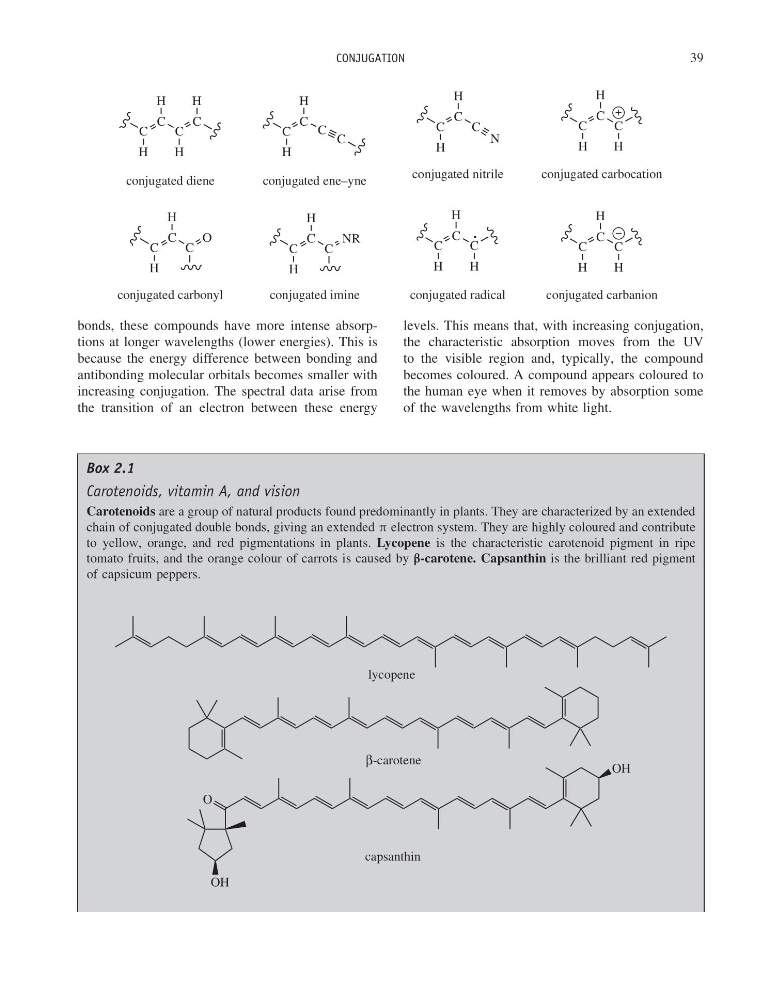
bonds, these compounds have more intense absorptions at longer wavelengths (lower energies). This is
because the energy difference between bonding and
antibonding molecular orbitals becomes smaller with
increasing conjugation. The spectral data arise from
the transition of an electron between these energy
levels. This means that, with increasing conjugation,
the characteristic absorption moves from the UV
to the visible region and, typically, the compound
becomes coloured. A compound appears coloured to
the human eye when it removes by absorption some
of the wavelengths from white light.
Box 2.1
Carotenoids, vitamin A, and vision
Carotenoids are a group of natural products found predominantly in plants. They are characterized by an extended
chain of conjugated double bonds, giving an extended π electron system. They are highly coloured and contribute
to yellow, orange, and red pigmentations in plants. Lycopene is the characteristic carotenoid pigment in ripe
tomato fruits, and the orange colour of carrots is caused by β-carotene. Capsanthin is the brilliant red pigment
of capsicum peppers.
lycopene
β-carotene
O
OH
OH
capsanthin
39
C
C
C
C
H
H
H
H
conjugated diene
C
C
C
O
H
H
conjugated carbonyl
C
C
C
H
H
conjugated nitrile
N
C
C
C
NR
H
H
conjugated imine
C
C C
H
H
conjugated ene–yne
C
C
C
C
H
H
H
conjugated carbocation
C
C
C
H
H
H
conjugated radical
C
C
C
H
H
H
conjugated carbanion
bonds, these compounds have more intense absorptions at longer wavelengths (lower energies). This is
because the energy difference between bonding and
antibonding molecular orbitals becomes smaller with
increasing conjugation. The spectral data arise from
the transition of an electron between these energy
levels. This means that, with increasing conjugation,
the characteristic absorption moves from the UV
to the visible region and, typically, the compound
becomes coloured. A compound appears coloured to
the human eye when it removes by absorption some
of the wavelengths from white light.
Box 2.1
Carotenoids, vitamin A, and vision
Carotenoids are a group of natural products found predominantly in plants. They are characterized by an extended
chain of conjugated double bonds, giving an extended π electron system. They are highly coloured and contribute
to yellow, orange, and red pigmentations in plants. Lycopene is the characteristic carotenoid pigment in ripe
tomato fruits, and the orange colour of carrots is caused by β-carotene. Capsanthin is the brilliant red pigment
of capsicum peppers.
lycopene
β-carotene
O
OH
OH
capsanthin