

38
ATOMIC STRUCTURE AND BONDING
Energy
ethylene
1,3-butadiene
π
π*
y
bonding
interaction
antibonding
interaction
3
y 4
y2
y 1
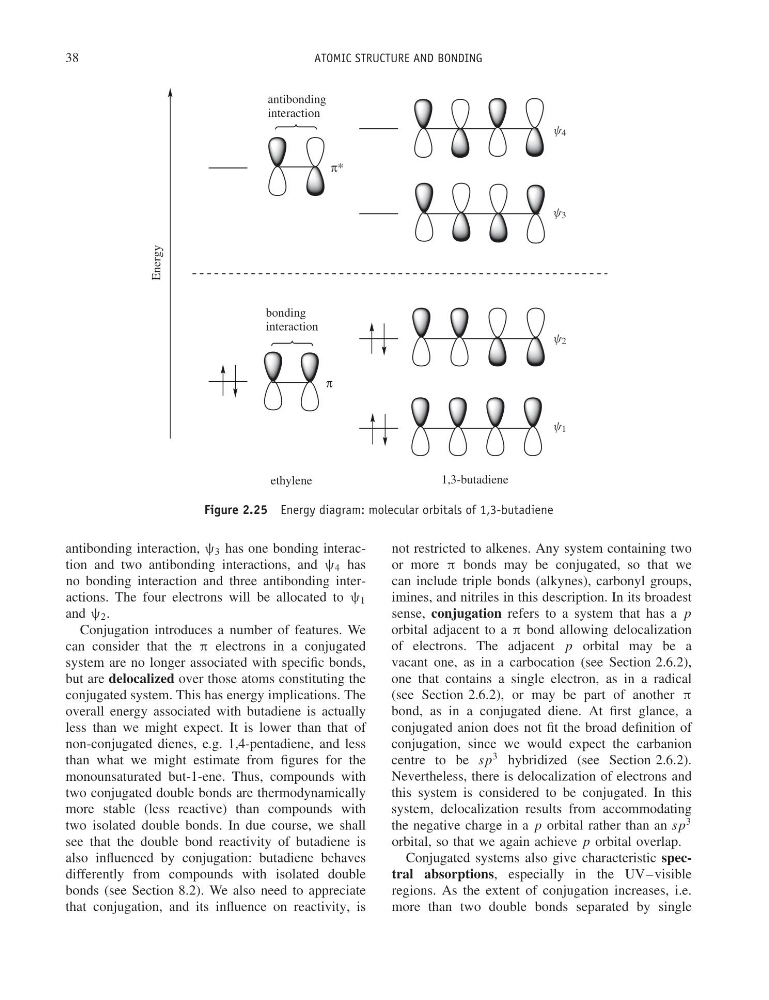
Figure 2.25 Energy diagram: molecular orbitals of 1,3-butadiene
antibonding interaction, ψ 3 has one bonding interaction and two antibonding interactions, and ψ 4 has
no bonding interaction and three antibonding interactions. The four electrons will be allocated to ψ 1
and ψ 2 .
Conjugation introduces a number of features. We
can consider that the π electrons in a conjugated
system are no longer associated with specific bonds,
but are delocalized over those atoms constituting the
conjugated system. This has energy implications. The
overall energy associated with butadiene is actually
less than we might expect. It is lower than that of
non-conjugated dienes, e.g. 1,4-pentadiene, and less
than what we might estimate from figures for the
monounsaturated but-1-ene. Thus, compounds with
two conjugated double bonds are thermodynamically
more stable (less reactive) than compounds with
two isolated double bonds. In due course, we shall
see that the double bond reactivity of butadiene is
also influenced by conjugation: butadiene behaves
differently from compounds with isolated double
bonds (see Section 8.2). We also need to appreciate
that conjugation, and its influence on reactivity, is
not restricted to alkenes. Any system containing two
or more π bonds may be conjugated, so that we
can include triple bonds (alkynes), carbonyl groups,
imines, and nitriles in this description. In its broadest
sense, conjugation refers to a system that has a p
orbital adjacent to a π bond allowing delocalization
of electrons. The adjacent p orbital may be a
vacant one, as in a carbocation (see Section 2.6.2),
one that contains a single electron, as in a radical
(see Section 2.6.2), or may be part of another π
bond, as in a conjugated diene. At first glance, a
conjugated anion does not fit the broad definition of
conjugation, since we would expect the carbanion
centre to be sp
3 hybridized (see Section 2.6.2).
Nevertheless, there is delocalization of electrons and
this system is considered to be conjugated. In this
system, delocalization results from accommodating
the negative charge in a p orbital rather than an sp
3
orbital, so that we again achieve p orbital overlap.
Conjugated systems also give characteristic spectral absorptions, especially in the UV–visible
regions. As the extent of conjugation increases, i.e.
more than two double bonds separated by single
ATOMIC STRUCTURE AND BONDING
Energy
ethylene
1,3-butadiene
π
π*
y
bonding
interaction
antibonding
interaction
3
y 4
y2
y 1
Figure 2.25 Energy diagram: molecular orbitals of 1,3-butadiene
antibonding interaction, ψ 3 has one bonding interaction and two antibonding interactions, and ψ 4 has
no bonding interaction and three antibonding interactions. The four electrons will be allocated to ψ 1
and ψ 2 .
Conjugation introduces a number of features. We
can consider that the π electrons in a conjugated
system are no longer associated with specific bonds,
but are delocalized over those atoms constituting the
conjugated system. This has energy implications. The
overall energy associated with butadiene is actually
less than we might expect. It is lower than that of
non-conjugated dienes, e.g. 1,4-pentadiene, and less
than what we might estimate from figures for the
monounsaturated but-1-ene. Thus, compounds with
two conjugated double bonds are thermodynamically
more stable (less reactive) than compounds with
two isolated double bonds. In due course, we shall
see that the double bond reactivity of butadiene is
also influenced by conjugation: butadiene behaves
differently from compounds with isolated double
bonds (see Section 8.2). We also need to appreciate
that conjugation, and its influence on reactivity, is
not restricted to alkenes. Any system containing two
or more π bonds may be conjugated, so that we
can include triple bonds (alkynes), carbonyl groups,
imines, and nitriles in this description. In its broadest
sense, conjugation refers to a system that has a p
orbital adjacent to a π bond allowing delocalization
of electrons. The adjacent p orbital may be a
vacant one, as in a carbocation (see Section 2.6.2),
one that contains a single electron, as in a radical
(see Section 2.6.2), or may be part of another π
bond, as in a conjugated diene. At first glance, a
conjugated anion does not fit the broad definition of
conjugation, since we would expect the carbanion
centre to be sp
3 hybridized (see Section 2.6.2).
Nevertheless, there is delocalization of electrons and
this system is considered to be conjugated. In this
system, delocalization results from accommodating
the negative charge in a p orbital rather than an sp
3
orbital, so that we again achieve p orbital overlap.
Conjugated systems also give characteristic spectral absorptions, especially in the UV–visible
regions. As the extent of conjugation increases, i.e.
more than two double bonds separated by single