

CONJUGATION
37
Cl
C
CH 3
H
H
d+
d−
dd+
X
C
C
CH 3
d+
d−
dd+ ddd+
inductive effect
inductive effect decreases
as polar group is located
further away
Cl
C
H
Cl
CH 3
Cl
C
Cl
Cl
CH 3
inductive effects increase as
number of polar groups increases
This transmission of polarity through the σ bonds
is termed an inductive effect. It is relatively short
range, decreasing rapidly as the original dipole
is located further away. It becomes unimportant
after about the third carbon atom. However, the
effects will increase with the number of polar
groups, so we see increasing polarization effects
with 1,1-dichloroethane and 1,1,1-trichloroethane.
We shall often need to consider inductive effects
when attempting to predict chemical reactivity.
2.8 Conjugation
Double bonds, whether they be C=C, C=O, or
C=N, are sites of special reactivity in a molecule.
This reactivity may take on different characteristics
if we have two or more double bonds in the
same molecule, depending upon whether the double
bonds are isolated or conjugated. We use the term
conjugated to describe an arrangement in which
double bonds are separated by a single bond. Thus,
in 1,3-pentadiene the double bonds are conjugated,
whereas in 1,4-pentadiene they are isolated or nonconjugated. The nomenclature ‘diene’ indicates two
C=C double bonds, the numbers the position in
the molecule (see Section 1.4). Conjugated dienes
usually display rather different chemical reactivity
and spectral properties from non-conjugated dienes
(see Section 8.2).
C
C
C
C
C
H
H
H
H
H
H
C
C
C
C
C
H
H
H
H
H
H
H H
1,4-pentadiene
1,3-pentadiene
H
H
conjugated double bonds
isolated double bonds
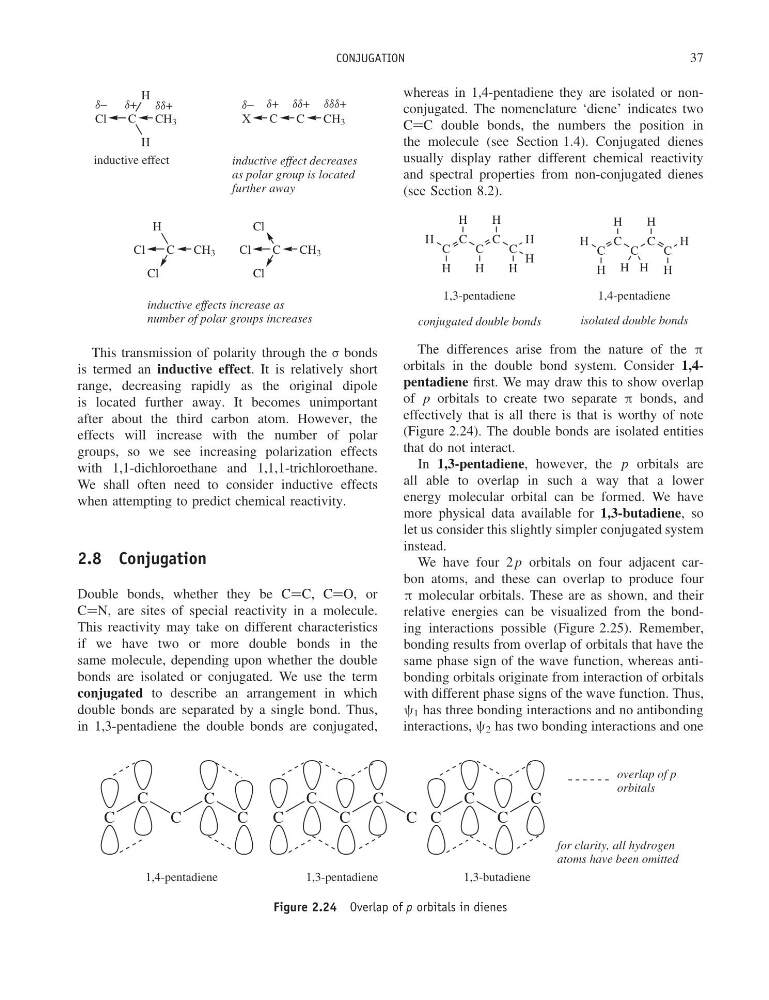
The differences arise from the nature of the π
orbitals in the double bond system. Consider 1,4pentadiene first. We may draw this to show overlap
of p orbitals to create two separate π bonds, and
effectively that is all there is that is worthy of note
(Figure 2.24). The double bonds are isolated entities
that do not interact.
In 1,3-pentadiene, however, the p orbitals are
all able to overlap in such a way that a lower
energy molecular orbital can be formed. We have
more physical data available for 1,3-butadiene, so
let us consider this slightly simpler conjugated system
instead.
We have four 2p orbitals on four adjacent carbon atoms, and these can overlap to produce four
π molecular orbitals. These are as shown, and their
relative energies can be visualized from the bonding interactions possible (Figure 2.25). Remember,
bonding results from overlap of orbitals that have the
same phase sign of the wave function, whereas antibonding orbitals originate from interaction of orbitals
with different phase signs of the wave function. Thus,
ψ 1 has three bonding interactions and no antibonding
interactions, ψ 2 has two bonding interactions and one
C
C
C
C
C
C
C
C
C
C
1,3-pentadiene
1,4-pentadiene
C
C
C
C
1,3-butadiene
for clarity, all hydrogen
atoms have been omitted
overlap of p
orbitals
Figure 2.24 Overlap of p orbitals in dienes
37
Cl
C
CH 3
H
H
d+
d−
dd+
X
C
C
CH 3
d+
d−
dd+ ddd+
inductive effect
inductive effect decreases
as polar group is located
further away
Cl
C
H
Cl
CH 3
Cl
C
Cl
Cl
CH 3
inductive effects increase as
number of polar groups increases
This transmission of polarity through the σ bonds
is termed an inductive effect. It is relatively short
range, decreasing rapidly as the original dipole
is located further away. It becomes unimportant
after about the third carbon atom. However, the
effects will increase with the number of polar
groups, so we see increasing polarization effects
with 1,1-dichloroethane and 1,1,1-trichloroethane.
We shall often need to consider inductive effects
when attempting to predict chemical reactivity.
2.8 Conjugation
Double bonds, whether they be C=C, C=O, or
C=N, are sites of special reactivity in a molecule.
This reactivity may take on different characteristics
if we have two or more double bonds in the
same molecule, depending upon whether the double
bonds are isolated or conjugated. We use the term
conjugated to describe an arrangement in which
double bonds are separated by a single bond. Thus,
in 1,3-pentadiene the double bonds are conjugated,
whereas in 1,4-pentadiene they are isolated or nonconjugated. The nomenclature ‘diene’ indicates two
C=C double bonds, the numbers the position in
the molecule (see Section 1.4). Conjugated dienes
usually display rather different chemical reactivity
and spectral properties from non-conjugated dienes
(see Section 8.2).
C
C
C
C
C
H
H
H
H
H
H
C
C
C
C
C
H
H
H
H
H
H
H H
1,4-pentadiene
1,3-pentadiene
H
H
conjugated double bonds
isolated double bonds
The differences arise from the nature of the π
orbitals in the double bond system. Consider 1,4pentadiene first. We may draw this to show overlap
of p orbitals to create two separate π bonds, and
effectively that is all there is that is worthy of note
(Figure 2.24). The double bonds are isolated entities
that do not interact.
In 1,3-pentadiene, however, the p orbitals are
all able to overlap in such a way that a lower
energy molecular orbital can be formed. We have
more physical data available for 1,3-butadiene, so
let us consider this slightly simpler conjugated system
instead.
We have four 2p orbitals on four adjacent carbon atoms, and these can overlap to produce four
π molecular orbitals. These are as shown, and their
relative energies can be visualized from the bonding interactions possible (Figure 2.25). Remember,
bonding results from overlap of orbitals that have the
same phase sign of the wave function, whereas antibonding orbitals originate from interaction of orbitals
with different phase signs of the wave function. Thus,
ψ 1 has three bonding interactions and no antibonding
interactions, ψ 2 has two bonding interactions and one
C
C
C
C
C
C
C
C
C
C
1,3-pentadiene
1,4-pentadiene
C
C
C
C
1,3-butadiene
for clarity, all hydrogen
atoms have been omitted
overlap of p
orbitals
Figure 2.24 Overlap of p orbitals in dienes