

534
AMINO ACIDS, PEPTIDES AND PROTEINS
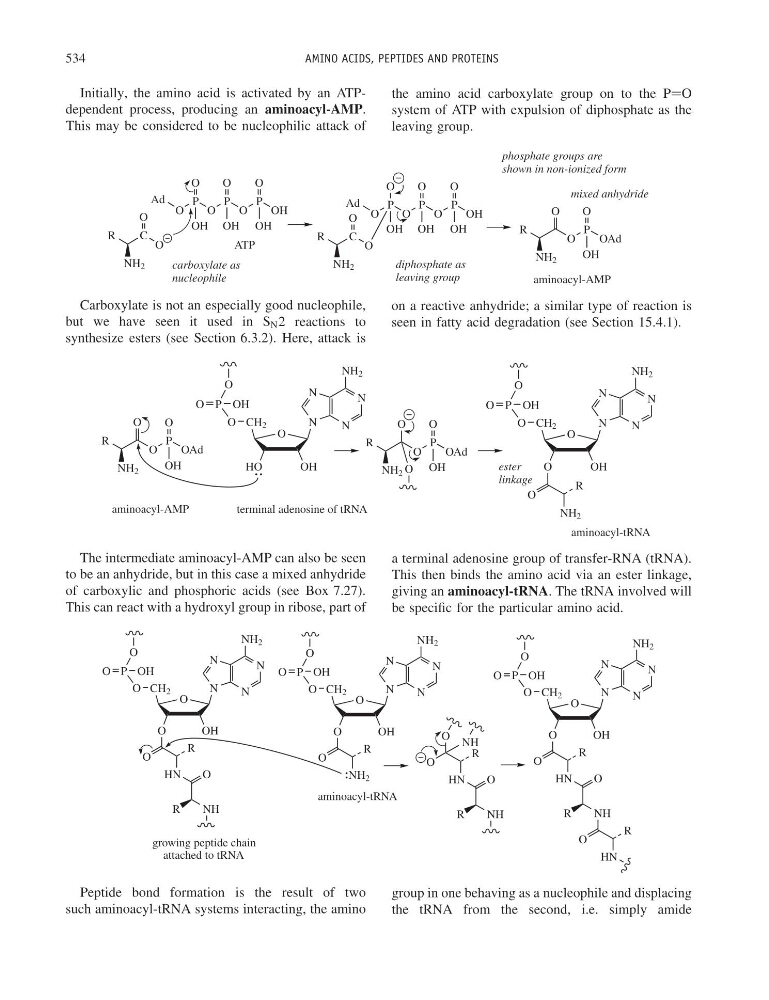
Initially, the amino acid is activated by an ATPdependent process, producing an aminoacyl-AMP.
This may be considered to be nucleophilic attack of
the amino acid carboxylate group on to the P=O
system of ATP with expulsion of diphosphate as the
leaving group.
C
O
O
carboxylate as
nucleophile
R
NH 2
R
NH 2
O
aminoacyl-AMP
diphosphate as
leaving group
mixed anhydride
phosphate groups are
shown in non-ionized form
ATP
O
P
OH
O
P
O
O
OH
OH
P
O
O
OH
Ad
O
P
OH
O
P
O
O
OH
OH
P
O
O
OH
Ad
C
O
O
R
NH 2
O
P
O
OAd
OH
Carboxylate is not an especially good nucleophile,
but we have seen it used in S N 2 reactions to
synthesize esters (see Section 6.3.2). Here, attack is
on a reactive anhydride; a similar type of reaction is
seen in fatty acid degradation (see Section 15.4.1).
N
N
N
NH 2
O
HO
OH
N
CH 2
R
NH 2
O
terminal adenosine of tRNA
aminoacyl-AMP
N
N
N
NH 2
O
O
OH
N
CH 2
O
NH 2
R
ester
linkage
aminoacyl-tRNA
R
NH 2
O
O
O
P
O
OAd
OH
O
P
O
OAd
OH
O
P
O
O
OH
O
P
O
O
OH
The intermediate aminoacyl-AMP can also be seen
to be an anhydride, but in this case a mixed anhydride
of carboxylic and phosphoric acids (see Box 7.27).
This can react with a hydroxyl group in ribose, part of
a terminal adenosine group of transfer-RNA (tRNA).
This then binds the amino acid via an ester linkage,
giving an aminoacyl-tRNA. The tRNA involved will
be specific for the particular amino acid.
N
N
N
NH 2
O
O
OH
N
CH 2
O
HN
R
N
N
N
NH 2
O
O
OH
N
CH 2
O
NH 2
R
O
R
NH
N
N
N
NH 2
O
O
OH
N
CH 2
O
HN
R
O
R
NH
HN
O
R
O
O
HN
R
O
R
NH
NH
aminoacyl-tRNA
growing peptide chain
attached to tRNA
O
P
O
O
OH
O
P
O
O
OH
O
P
O
O
OH
Peptide bond formation is the result of two
such aminoacyl-tRNA systems interacting, the amino
group in one behaving as a nucleophile and displacing
the tRNA from the second, i.e. simply amide
AMINO ACIDS, PEPTIDES AND PROTEINS
Initially, the amino acid is activated by an ATPdependent process, producing an aminoacyl-AMP.
This may be considered to be nucleophilic attack of
the amino acid carboxylate group on to the P=O
system of ATP with expulsion of diphosphate as the
leaving group.
C
O
O
carboxylate as
nucleophile
R
NH 2
R
NH 2
O
aminoacyl-AMP
diphosphate as
leaving group
mixed anhydride
phosphate groups are
shown in non-ionized form
ATP
O
P
OH
O
P
O
O
OH
OH
P
O
O
OH
Ad
O
P
OH
O
P
O
O
OH
OH
P
O
O
OH
Ad
C
O
O
R
NH 2
O
P
O
OAd
OH
Carboxylate is not an especially good nucleophile,
but we have seen it used in S N 2 reactions to
synthesize esters (see Section 6.3.2). Here, attack is
on a reactive anhydride; a similar type of reaction is
seen in fatty acid degradation (see Section 15.4.1).
N
N
N
NH 2
O
HO
OH
N
CH 2
R
NH 2
O
terminal adenosine of tRNA
aminoacyl-AMP
N
N
N
NH 2
O
O
OH
N
CH 2
O
NH 2
R
ester
linkage
aminoacyl-tRNA
R
NH 2
O
O
O
P
O
OAd
OH
O
P
O
OAd
OH
O
P
O
O
OH
O
P
O
O
OH
The intermediate aminoacyl-AMP can also be seen
to be an anhydride, but in this case a mixed anhydride
of carboxylic and phosphoric acids (see Box 7.27).
This can react with a hydroxyl group in ribose, part of
a terminal adenosine group of transfer-RNA (tRNA).
This then binds the amino acid via an ester linkage,
giving an aminoacyl-tRNA. The tRNA involved will
be specific for the particular amino acid.
N
N
N
NH 2
O
O
OH
N
CH 2
O
HN
R
N
N
N
NH 2
O
O
OH
N
CH 2
O
NH 2
R
O
R
NH
N
N
N
NH 2
O
O
OH
N
CH 2
O
HN
R
O
R
NH
HN
O
R
O
O
HN
R
O
R
NH
NH
aminoacyl-tRNA
growing peptide chain
attached to tRNA
O
P
O
O
OH
O
P
O
O
OH
O
P
O
O
OH
Peptide bond formation is the result of two
such aminoacyl-tRNA systems interacting, the amino
group in one behaving as a nucleophile and displacing
the tRNA from the second, i.e. simply amide