

PEPTIDE BIOSYNTHESIS
533
13.5 Peptide biosynthesis
Synthesis and biosynthesis of peptides and proteins
requires the combination of amino acids via amide
bonds. We have seen earlier that the chemical reaction
of amines and acids to produce a simple amide is
severely hindered by initial salt formation, and that
a more efficient way of making amides is to employ
a carboxylic derivative that is non-acidic and has a
better leaving group (see Section 7.10). Thus, acyl
halides, anhydrides, or even esters provide better
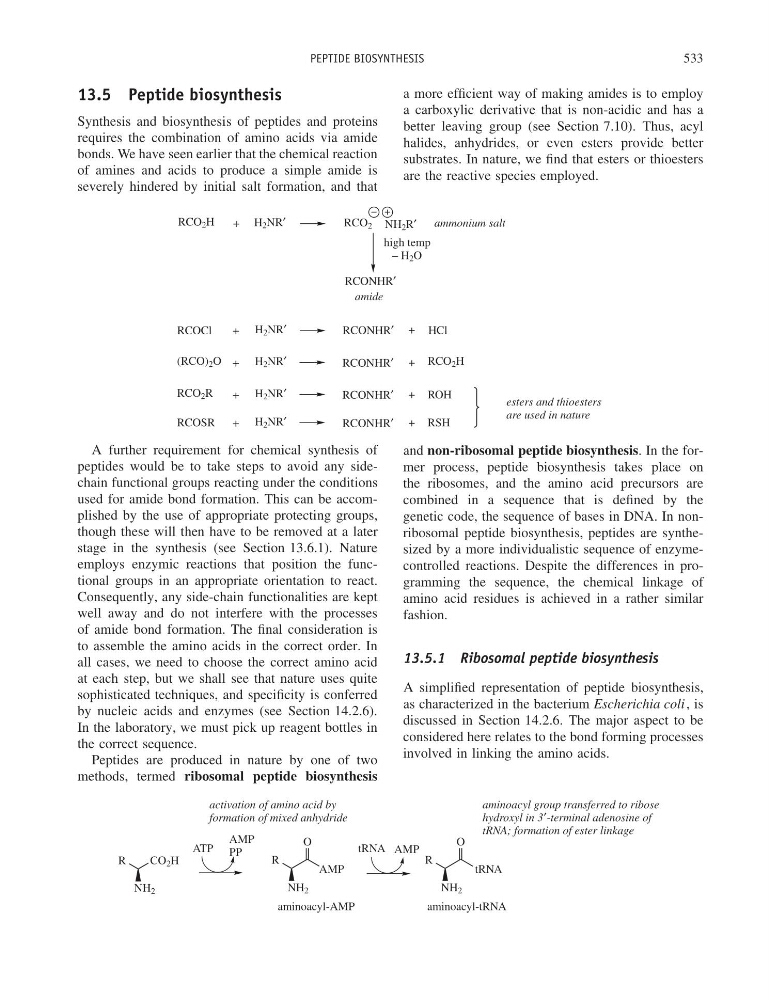
substrates. In nature, we find that esters or thioesters
are the reactive species employed.
ammonium salt
+ H 2 NR′
NH 2 R′
RCONHR′
high temp
– H 2 O
+ H 2 NR′
+
RCONHR′
+ H 2 NR′
RCONHR′ +
+ H 2 NR′
RCONHR′ +
(RCO) 2 O
RCO 2 H
amide
+ H 2 NR′
RCONHR′ +
RCOSR
RSH
RCO 2 R
ROH
esters and thioesters
are used in nature
RCO 2
RCO 2 H
RCOCl
HCl
A further requirement for chemical synthesis of
peptides would be to take steps to avoid any sidechain functional groups reacting under the conditions
used for amide bond formation. This can be accomplished by the use of appropriate protecting groups,
though these will then have to be removed at a later
stage in the synthesis (see Section 13.6.1). Nature
employs enzymic reactions that position the functional groups in an appropriate orientation to react.
Consequently, any side-chain functionalities are kept
well away and do not interfere with the processes
of amide bond formation. The final consideration is
to assemble the amino acids in the correct order. In
all cases, we need to choose the correct amino acid
at each step, but we shall see that nature uses quite
sophisticated techniques, and specificity is conferred
by nucleic acids and enzymes (see Section 14.2.6).
In the laboratory, we must pick up reagent bottles in
the correct sequence.
Peptides are produced in nature by one of two
methods, termed ribosomal peptide biosynthesis
and non-ribosomal peptide biosynthesis. In the former process, peptide biosynthesis takes place on
the ribosomes, and the amino acid precursors are
combined in a sequence that is defined by the
genetic code, the sequence of bases in DNA. In nonribosomal peptide biosynthesis, peptides are synthesized by a more individualistic sequence of enzymecontrolled reactions. Despite the differences in programming the sequence, the chemical linkage of
amino acid residues is achieved in a rather similar
fashion.
13.5.1 Ribosomal peptide biosynthesis
A simplified representation of peptide biosynthesis,
as characterized in the bacterium Escherichia coli , is
discussed in Section 14.2.6. The major aspect to be
considered here relates to the bond forming processes
involved in linking the amino acids.
R
CO 2 H
NH 2
R
NH 2
O
AMP
R
NH 2
O
tRNA
aminoacyl-tRNA
aminoacyl-AMP
ATP
AMP
PP
tRNA
activation of amino acid by
formation of mixed anhydride
aminoacyl group transferred to ribose
hydroxyl in 3′-terminal adenosine of
tRNA; formation of ester linkage
AMP
533
13.5 Peptide biosynthesis
Synthesis and biosynthesis of peptides and proteins
requires the combination of amino acids via amide
bonds. We have seen earlier that the chemical reaction
of amines and acids to produce a simple amide is
severely hindered by initial salt formation, and that
a more efficient way of making amides is to employ
a carboxylic derivative that is non-acidic and has a
better leaving group (see Section 7.10). Thus, acyl
halides, anhydrides, or even esters provide better
substrates. In nature, we find that esters or thioesters
are the reactive species employed.
ammonium salt
+ H 2 NR′
NH 2 R′
RCONHR′
high temp
– H 2 O
+ H 2 NR′
+
RCONHR′
+ H 2 NR′
RCONHR′ +
+ H 2 NR′
RCONHR′ +
(RCO) 2 O
RCO 2 H
amide
+ H 2 NR′
RCONHR′ +
RCOSR
RSH
RCO 2 R
ROH
esters and thioesters
are used in nature
RCO 2
RCO 2 H
RCOCl
HCl
A further requirement for chemical synthesis of
peptides would be to take steps to avoid any sidechain functional groups reacting under the conditions
used for amide bond formation. This can be accomplished by the use of appropriate protecting groups,
though these will then have to be removed at a later
stage in the synthesis (see Section 13.6.1). Nature
employs enzymic reactions that position the functional groups in an appropriate orientation to react.
Consequently, any side-chain functionalities are kept
well away and do not interfere with the processes
of amide bond formation. The final consideration is
to assemble the amino acids in the correct order. In
all cases, we need to choose the correct amino acid
at each step, but we shall see that nature uses quite
sophisticated techniques, and specificity is conferred
by nucleic acids and enzymes (see Section 14.2.6).
In the laboratory, we must pick up reagent bottles in
the correct sequence.
Peptides are produced in nature by one of two
methods, termed ribosomal peptide biosynthesis
and non-ribosomal peptide biosynthesis. In the former process, peptide biosynthesis takes place on
the ribosomes, and the amino acid precursors are
combined in a sequence that is defined by the
genetic code, the sequence of bases in DNA. In nonribosomal peptide biosynthesis, peptides are synthesized by a more individualistic sequence of enzymecontrolled reactions. Despite the differences in programming the sequence, the chemical linkage of
amino acid residues is achieved in a rather similar
fashion.
13.5.1 Ribosomal peptide biosynthesis
A simplified representation of peptide biosynthesis,
as characterized in the bacterium Escherichia coli , is
discussed in Section 14.2.6. The major aspect to be
considered here relates to the bond forming processes
involved in linking the amino acids.
R
CO 2 H
NH 2
R
NH 2
O
AMP
R
NH 2
O
tRNA
aminoacyl-tRNA
aminoacyl-AMP
ATP
AMP
PP
tRNA
activation of amino acid by
formation of mixed anhydride
aminoacyl group transferred to ribose
hydroxyl in 3′-terminal adenosine of
tRNA; formation of ester linkage
AMP