

532
AMINO ACIDS, PEPTIDES AND PROTEINS
than lowering the proportion of molecules with a
bound substrate. In contrast to competitive inhibition,
increasing the concentration of substrate has no effect
on the level of inhibition. The chemical structures
of non-competitive inhibitors frequently bear no
similarity to the natural substrate structures. For
example, heavy metal ions, such as Pb
2+ and Hg
2+ ,
inhibit the activity of some enzymes by binding to
thiol groups, and cyanide reacts with and inhibits
iron–porphyrin enzymes (see Box 11.4).
The third type of inhibition is called allosteric
inhibition, and is particularly important in the
control of intermediary metabolism. This refers to
the ability of enzymes to change their shape (tertiary
and quaternary structure, see Section 13.3) when
exposed to certain molecules. This sometimes leads
to inhibition, whereas in other cases it may actually
activate the enzyme. The process allows subtle
control of enzyme activity according to an organism’s
demands. Further consideration of this complex
phenomenon is outside our immediate needs.
Box 13.9
Angiotensin-converting enzyme (ACE) inhibitors: captopril
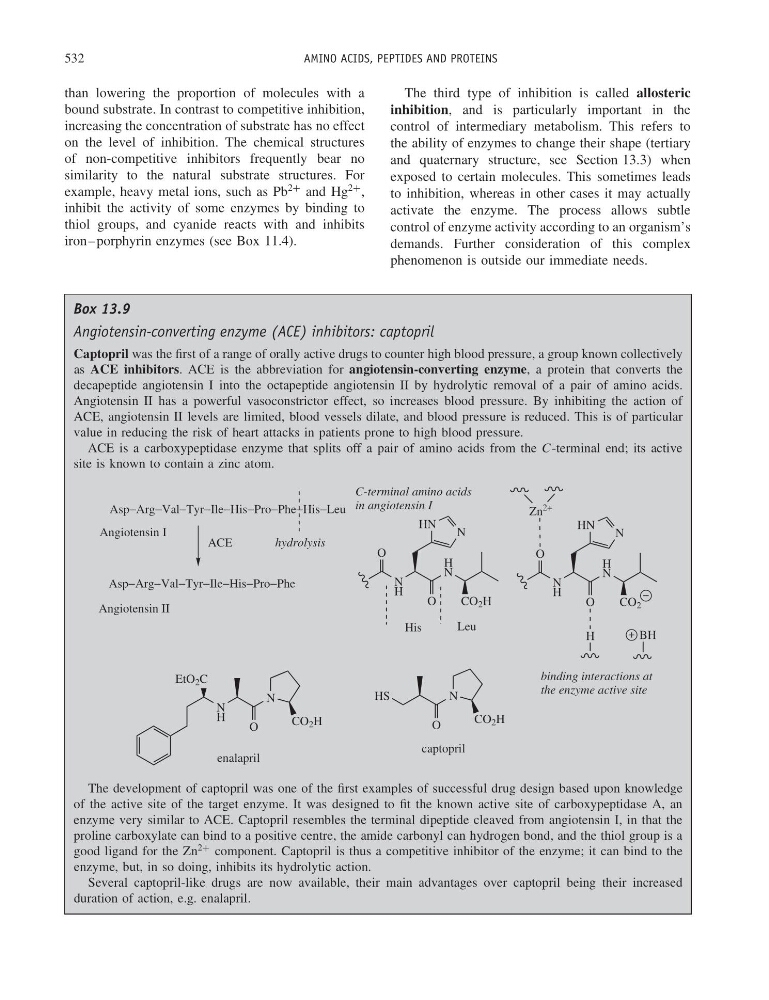
Captopril was the first of a range of orally active drugs to counter high blood pressure, a group known collectively
as ACE inhibitors. ACE is the abbreviation for angiotensin-converting enzyme, a protein that converts the
decapeptide angiotensin I into the octapeptide angiotensin II by hydrolytic removal of a pair of amino acids.
Angiotensin II has a powerful vasoconstrictor effect, so increases blood pressure. By inhibiting the action of
ACE, angiotensin II levels are limited, blood vessels dilate, and blood pressure is reduced. This is of particular
value in reducing the risk of heart attacks in patients prone to high blood pressure.
ACE is a carboxypeptidase enzyme that splits off a pair of amino acids from the C-terminal end; its active
site is known to contain a zinc atom.
Asp−Arg−Val−Tyr−Ile−His−Pro−Phe−His−Leu
Asp−Arg−Val−Tyr−Ile−His−Pro−Phe
ACE
Angiotensin I
Angiotensin II
HS
N
CO 2 H
O
N
H
H
N
O
N
HN
O
CO 2 H
captopril
Leu
His
N
H
H
N
O
N
HN
O
CO 2
Zn 2+
BH
H
binding interactions at
the enzyme active site
C-terminal amino acids
in angiotensin I
N
H
N
CO 2 H
O
EtO 2 C
enalapril
hydrolysis
The development of captopril was one of the first examples of successful drug design based upon knowledge
of the active site of the target enzyme. It was designed to fit the known active site of carboxypeptidase A, an
enzyme very similar to ACE. Captopril resembles the terminal dipeptide cleaved from angiotensin I, in that the
proline carboxylate can bind to a positive centre, the amide carbonyl can hydrogen bond, and the thiol group is a
good ligand for the Zn
2+ component. Captopril is thus a competitive inhibitor of the enzyme; it can bind to the
enzyme, but, in so doing, inhibits its hydrolytic action.
Several captopril-like drugs are now available, their main advantages over captopril being their increased
duration of action, e.g. enalapril.
AMINO ACIDS, PEPTIDES AND PROTEINS
than lowering the proportion of molecules with a
bound substrate. In contrast to competitive inhibition,
increasing the concentration of substrate has no effect
on the level of inhibition. The chemical structures
of non-competitive inhibitors frequently bear no
similarity to the natural substrate structures. For
example, heavy metal ions, such as Pb
2+ and Hg
2+ ,
inhibit the activity of some enzymes by binding to
thiol groups, and cyanide reacts with and inhibits
iron–porphyrin enzymes (see Box 11.4).
The third type of inhibition is called allosteric
inhibition, and is particularly important in the
control of intermediary metabolism. This refers to
the ability of enzymes to change their shape (tertiary
and quaternary structure, see Section 13.3) when
exposed to certain molecules. This sometimes leads
to inhibition, whereas in other cases it may actually
activate the enzyme. The process allows subtle
control of enzyme activity according to an organism’s
demands. Further consideration of this complex
phenomenon is outside our immediate needs.
Box 13.9
Angiotensin-converting enzyme (ACE) inhibitors: captopril
Captopril was the first of a range of orally active drugs to counter high blood pressure, a group known collectively
as ACE inhibitors. ACE is the abbreviation for angiotensin-converting enzyme, a protein that converts the
decapeptide angiotensin I into the octapeptide angiotensin II by hydrolytic removal of a pair of amino acids.
Angiotensin II has a powerful vasoconstrictor effect, so increases blood pressure. By inhibiting the action of
ACE, angiotensin II levels are limited, blood vessels dilate, and blood pressure is reduced. This is of particular
value in reducing the risk of heart attacks in patients prone to high blood pressure.
ACE is a carboxypeptidase enzyme that splits off a pair of amino acids from the C-terminal end; its active
site is known to contain a zinc atom.
Asp−Arg−Val−Tyr−Ile−His−Pro−Phe−His−Leu
Asp−Arg−Val−Tyr−Ile−His−Pro−Phe
ACE
Angiotensin I
Angiotensin II
HS
N
CO 2 H
O
N
H
H
N
O
N
HN
O
CO 2 H
captopril
Leu
His
N
H
H
N
O
N
HN
O
CO 2
Zn 2+
BH
H
binding interactions at
the enzyme active site
C-terminal amino acids
in angiotensin I
N
H
N
CO 2 H
O
EtO 2 C
enalapril
hydrolysis
The development of captopril was one of the first examples of successful drug design based upon knowledge
of the active site of the target enzyme. It was designed to fit the known active site of carboxypeptidase A, an
enzyme very similar to ACE. Captopril resembles the terminal dipeptide cleaved from angiotensin I, in that the
proline carboxylate can bind to a positive centre, the amide carbonyl can hydrogen bond, and the thiol group is a
good ligand for the Zn
2+ component. Captopril is thus a competitive inhibitor of the enzyme; it can bind to the
enzyme, but, in so doing, inhibits its hydrolytic action.
Several captopril-like drugs are now available, their main advantages over captopril being their increased
duration of action, e.g. enalapril.