

PEPTIDE BIOSYNTHESIS
535
formation utilizing an ester substrate. The process
is repeated as required. The sequence of amino
acids is controlled by messenger RNA (mRNA),
the message being stored as a series of threebase sequences (codons) in its nucleotides (see
Section 14.2.4). Elongation of the peptide continues
until a termination codon is reached, and the peptide
or protein is then hydrolysed and released from the
tRNA carrier.
13.5.2 Non-ribosomal peptide biosynthesis
In marked contrast to the ribosomal biosynthesis of
peptides and proteins where a biological production
line interprets the genetic code of mRNA, many
natural peptides are known to be synthesized by a
more individualistic sequence of enzyme-controlled
processes, in which each amino acid is added as a
result of the specificity of each enzyme involved.
The many stages of the whole process appear to
be carried out by a multi-functional enzyme nonribosomal peptide synthase (NRPS) comprised of
a linear sequence of modules. Each module is
responsible for inserting a particular amino acid to
generate the sequence in the peptide product. The
amino acids are first activated to aminoacyl-AMP
derivatives as for ribosomal peptide biosynthesis.
These are then converted into thioesters, by reaction
with thiol functions in the enzyme. The process is
exactly analogous to forming aminoacyl-tRNA units,
but utilizes SH rather than OH as nucleophile.
R
CO 2 H
NH 2
R
NH 2
O
AMP
R
NH 2
O
SEnz
AMP
PP
activation of amino acid by
formation of mixed anhydride
Enz–SH
ATP
aminoacyl–AMP
AMP
formation of thioester
linkage to enzyme
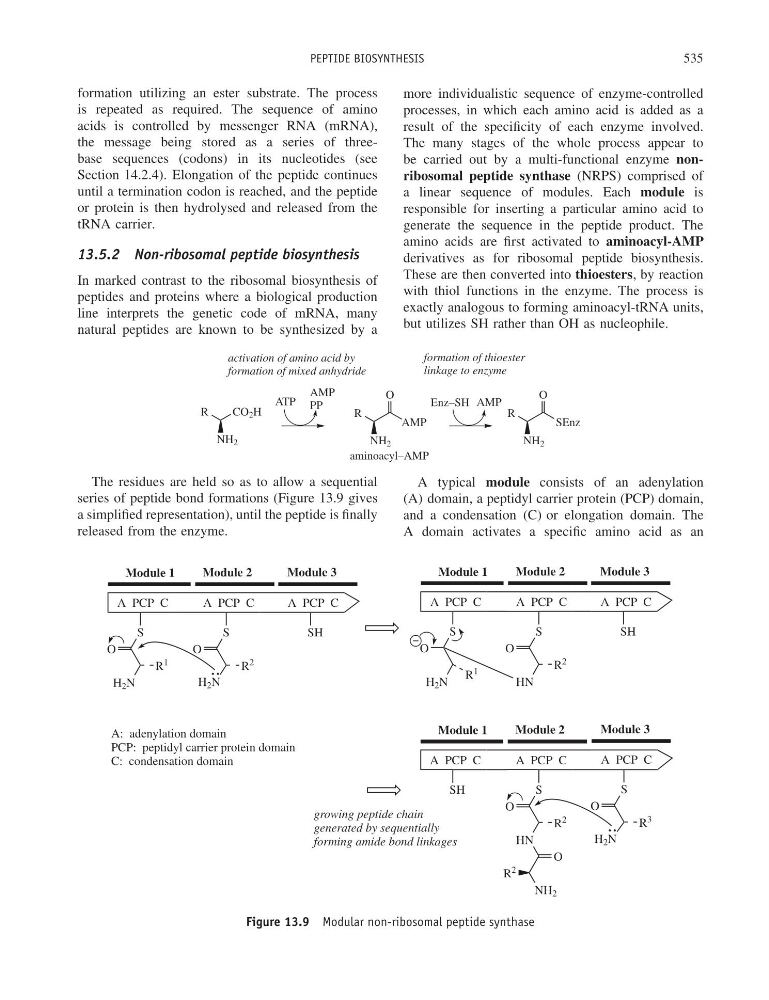
The residues are held so as to allow a sequential
series of peptide bond formations (Figure 13.9 gives
a simplified representation), until the peptide is finally
released from the enzyme.
A typical module consists of an adenylation
(A) domain, a peptidyl carrier protein (PCP) domain,
and a condensation (C) or elongation domain. The
A domain activates a specific amino acid as an
S
O
H 2 N
R 1
S
O
H 2 N
R 2
growing peptide chain
generated by sequentially
forming amide bond linkages
SH
A PCP C
S
O
HN
R 2
A PCP C
Module 1
O
NH 2
R 2
Module 2
A: adenylation domain
PCP: peptidyl carrier protein domain
C: condensation domain
SH
A PCP C
A PCP C
Module 1
Module 2
A PCP C
Module 3
A PCP C
Module 3
S
O
H 2 N
R 3
S
O
H 2 N
S
O
HN
R 2
A PCP C
A PCP C
Module 1
Module 2
SH
A PCP C
Module 3
R 1
Figure 13.9 Modular non-ribosomal peptide synthase
535
formation utilizing an ester substrate. The process
is repeated as required. The sequence of amino
acids is controlled by messenger RNA (mRNA),
the message being stored as a series of threebase sequences (codons) in its nucleotides (see
Section 14.2.4). Elongation of the peptide continues
until a termination codon is reached, and the peptide
or protein is then hydrolysed and released from the
tRNA carrier.
13.5.2 Non-ribosomal peptide biosynthesis
In marked contrast to the ribosomal biosynthesis of
peptides and proteins where a biological production
line interprets the genetic code of mRNA, many
natural peptides are known to be synthesized by a
more individualistic sequence of enzyme-controlled
processes, in which each amino acid is added as a
result of the specificity of each enzyme involved.
The many stages of the whole process appear to
be carried out by a multi-functional enzyme nonribosomal peptide synthase (NRPS) comprised of
a linear sequence of modules. Each module is
responsible for inserting a particular amino acid to
generate the sequence in the peptide product. The
amino acids are first activated to aminoacyl-AMP
derivatives as for ribosomal peptide biosynthesis.
These are then converted into thioesters, by reaction
with thiol functions in the enzyme. The process is
exactly analogous to forming aminoacyl-tRNA units,
but utilizes SH rather than OH as nucleophile.
R
CO 2 H
NH 2
R
NH 2
O
AMP
R
NH 2
O
SEnz
AMP
PP
activation of amino acid by
formation of mixed anhydride
Enz–SH
ATP
aminoacyl–AMP
AMP
formation of thioester
linkage to enzyme
The residues are held so as to allow a sequential
series of peptide bond formations (Figure 13.9 gives
a simplified representation), until the peptide is finally
released from the enzyme.
A typical module consists of an adenylation
(A) domain, a peptidyl carrier protein (PCP) domain,
and a condensation (C) or elongation domain. The
A domain activates a specific amino acid as an
S
O
H 2 N
R 1
S
O
H 2 N
R 2
growing peptide chain
generated by sequentially
forming amide bond linkages
SH
A PCP C
S
O
HN
R 2
A PCP C
Module 1
O
NH 2
R 2
Module 2
A: adenylation domain
PCP: peptidyl carrier protein domain
C: condensation domain
SH
A PCP C
A PCP C
Module 1
Module 2
A PCP C
Module 3
A PCP C
Module 3
S
O
H 2 N
R 3
S
O
H 2 N
S
O
HN
R 2
A PCP C
A PCP C
Module 1
Module 2
SH
A PCP C
Module 3
R 1
Figure 13.9 Modular non-ribosomal peptide synthase