

THE CHEMISTRY OF ENZYME ACTION
527
OH
O
H
OH
H
H
P
O
O
O
O
O
P
O
O
O
O
O
Asp
OH
O
H
OH
H
H
P
O
O
O
O
O
P
O
O
O
O
O
Asp
H
H
BH
HB
Lys
H 2 N
Lys
H 2 N
BH
HB
O
HO
H
OH
H
H
P
O
O
O
OH
O
P
O
O
O
glyceraldehyde
3-P
dihydroxyacetone P
fructose 1,6-diP
fructose 1,6-diP
(hemiketal form)
OH
O
H
HO
H
P
O
O
O
NH
O
P
O
O
O
O
O
Asp
H
BH
HB
Lys
enamine
H
imine
formation
enamine
formation
aldol
reaction
enamine
hydrolysis
hemiketal
formation
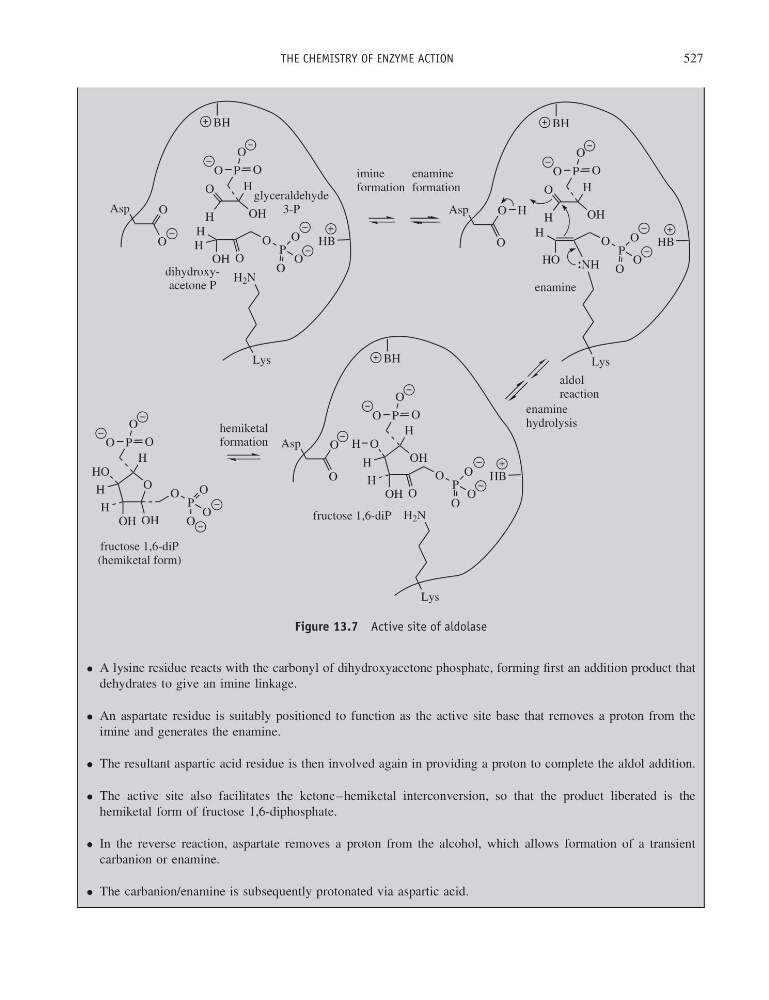
Figure 13.7 Active site of aldolase
• A lysine residue reacts with the carbonyl of dihydroxyacetone phosphate, forming first an addition product that
dehydrates to give an imine linkage.
• An aspartate residue is suitably positioned to function as the active site base that removes a proton from the
imine and generates the enamine.
• The resultant aspartic acid residue is then involved again in providing a proton to complete the aldol addition.
• The active site also facilitates the ketone–hemiketal interconversion, so that the product liberated is the
hemiketal form of fructose 1,6-diphosphate.
• In the reverse reaction, aspartate removes a proton from the alcohol, which allows formation of a transient
carbanion or enamine.
• The carbanion/enamine is subsequently protonated via aspartic acid.
527
OH
O
H
OH
H
H
P
O
O
O
O
O
P
O
O
O
O
O
Asp
OH
O
H
OH
H
H
P
O
O
O
O
O
P
O
O
O
O
O
Asp
H
H
BH
HB
Lys
H 2 N
Lys
H 2 N
BH
HB
O
HO
H
OH
H
H
P
O
O
O
OH
O
P
O
O
O
glyceraldehyde
3-P
dihydroxyacetone P
fructose 1,6-diP
fructose 1,6-diP
(hemiketal form)
OH
O
H
HO
H
P
O
O
O
NH
O
P
O
O
O
O
O
Asp
H
BH
HB
Lys
enamine
H
imine
formation
enamine
formation
aldol
reaction
enamine
hydrolysis
hemiketal
formation
Figure 13.7 Active site of aldolase
• A lysine residue reacts with the carbonyl of dihydroxyacetone phosphate, forming first an addition product that
dehydrates to give an imine linkage.
• An aspartate residue is suitably positioned to function as the active site base that removes a proton from the
imine and generates the enamine.
• The resultant aspartic acid residue is then involved again in providing a proton to complete the aldol addition.
• The active site also facilitates the ketone–hemiketal interconversion, so that the product liberated is the
hemiketal form of fructose 1,6-diphosphate.
• In the reverse reaction, aspartate removes a proton from the alcohol, which allows formation of a transient
carbanion or enamine.
• The carbanion/enamine is subsequently protonated via aspartic acid.