

528
AMINO ACIDS, PEPTIDES AND PROTEINS
Box 13.8
Citrate synthase catalyses an aldol reaction rather than a Claisen reaction
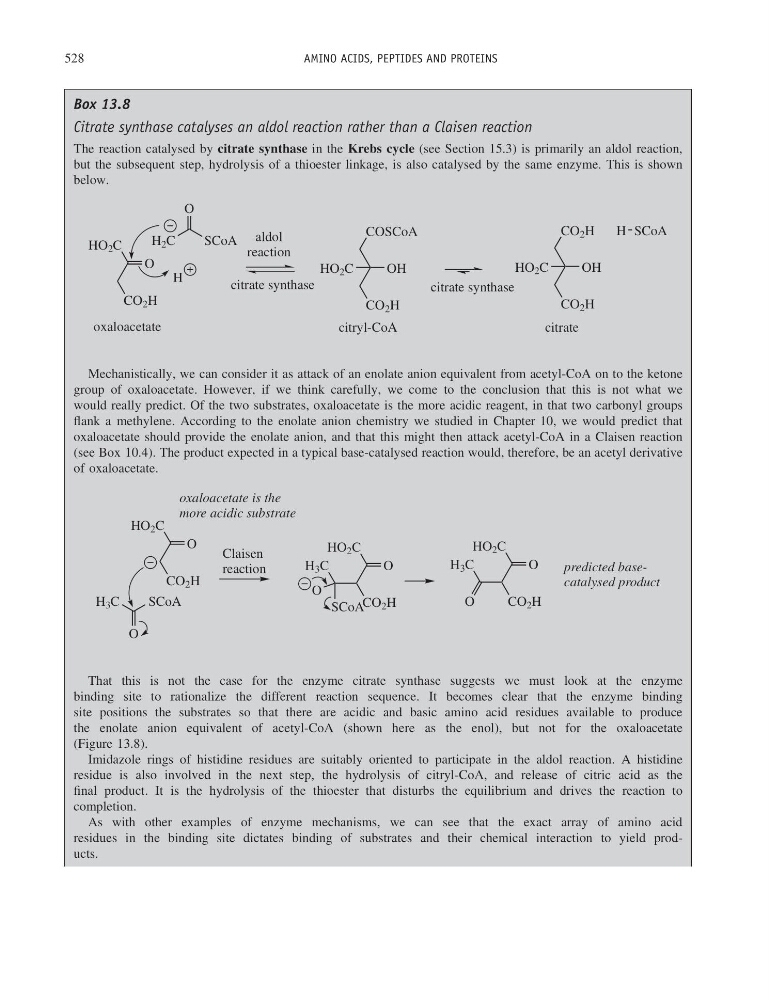
The reaction catalysed by citrate synthase in the Krebs cycle (see Section 15.3) is primarily an aldol reaction,
but the subsequent step, hydrolysis of a thioester linkage, is also catalysed by the same enzyme. This is shown
below.
oxaloacetate
citryl-CoA
citrate
HO 2 C
CO 2 H
O
O
H 2 C
SCoA
citrate synthase
citrate synthase
CO 2 H
CO 2 H
OH
HO 2 C
COSCoA
CO 2 H
OH
HO 2 C
H SCoA
aldol
reaction
H
Mechanistically, we can consider it as attack of an enolate anion equivalent from acetyl-CoA on to the ketone
group of oxaloacetate. However, if we think carefully, we come to the conclusion that this is not what we
would really predict. Of the two substrates, oxaloacetate is the more acidic reagent, in that two carbonyl groups
flank a methylene. According to the enolate anion chemistry we studied in Chapter 10, we would predict that
oxaloacetate should provide the enolate anion, and that this might then attack acetyl-CoA in a Claisen reaction
(see Box 10.4). The product expected in a typical base-catalysed reaction would, therefore, be an acetyl derivative
of oxaloacetate.
predicted basecatalysed product
HO 2 C
CO 2 H
O
O
H 3 C
SCoA
HO 2 C
CO 2 H
O
SCoA
H 3 C
O
HO 2 C
CO 2 H
O
H 3 C
O
oxaloacetate is the
more acidic substrate
Claisen
reaction
That this is not the case for the enzyme citrate synthase suggests we must look at the enzyme
binding site to rationalize the different reaction sequence. It becomes clear that the enzyme binding
site positions the substrates so that there are acidic and basic amino acid residues available to produce
the enolate anion equivalent of acetyl-CoA (shown here as the enol), but not for the oxaloacetate
(Figure 13.8).
Imidazole rings of histidine residues are suitably oriented to participate in the aldol reaction. A histidine
residue is also involved in the next step, the hydrolysis of citryl-CoA, and release of citric acid as the
final product. It is the hydrolysis of the thioester that disturbs the equilibrium and drives the reaction to
completion.
As with other examples of enzyme mechanisms, we can see that the exact array of amino acid
residues in the binding site dictates binding of substrates and their chemical interaction to yield products.
AMINO ACIDS, PEPTIDES AND PROTEINS
Box 13.8
Citrate synthase catalyses an aldol reaction rather than a Claisen reaction
The reaction catalysed by citrate synthase in the Krebs cycle (see Section 15.3) is primarily an aldol reaction,
but the subsequent step, hydrolysis of a thioester linkage, is also catalysed by the same enzyme. This is shown
below.
oxaloacetate
citryl-CoA
citrate
HO 2 C
CO 2 H
O
O
H 2 C
SCoA
citrate synthase
citrate synthase
CO 2 H
CO 2 H
OH
HO 2 C
COSCoA
CO 2 H
OH
HO 2 C
H SCoA
aldol
reaction
H
Mechanistically, we can consider it as attack of an enolate anion equivalent from acetyl-CoA on to the ketone
group of oxaloacetate. However, if we think carefully, we come to the conclusion that this is not what we
would really predict. Of the two substrates, oxaloacetate is the more acidic reagent, in that two carbonyl groups
flank a methylene. According to the enolate anion chemistry we studied in Chapter 10, we would predict that
oxaloacetate should provide the enolate anion, and that this might then attack acetyl-CoA in a Claisen reaction
(see Box 10.4). The product expected in a typical base-catalysed reaction would, therefore, be an acetyl derivative
of oxaloacetate.
predicted basecatalysed product
HO 2 C
CO 2 H
O
O
H 3 C
SCoA
HO 2 C
CO 2 H
O
SCoA
H 3 C
O
HO 2 C
CO 2 H
O
H 3 C
O
oxaloacetate is the
more acidic substrate
Claisen
reaction
That this is not the case for the enzyme citrate synthase suggests we must look at the enzyme
binding site to rationalize the different reaction sequence. It becomes clear that the enzyme binding
site positions the substrates so that there are acidic and basic amino acid residues available to produce
the enolate anion equivalent of acetyl-CoA (shown here as the enol), but not for the oxaloacetate
(Figure 13.8).
Imidazole rings of histidine residues are suitably oriented to participate in the aldol reaction. A histidine
residue is also involved in the next step, the hydrolysis of citryl-CoA, and release of citric acid as the
final product. It is the hydrolysis of the thioester that disturbs the equilibrium and drives the reaction to
completion.
As with other examples of enzyme mechanisms, we can see that the exact array of amino acid
residues in the binding site dictates binding of substrates and their chemical interaction to yield products.