

526
AMINO ACIDS, PEPTIDES AND PROTEINS
O
H
O
O
chemical aldol reaction
requires strong base
O
POH 2 C
H
HO
H 2 N Enz
N
POH 2 C
H
HO
Enz
amine side-chain
on enzyme
imine
NH
POH 2 C
H
HO
Enz
iminium ion
enamine
NH
POH 2 C
HO
Enz
substrate bound
to enzyme
O
H
NH
POH 2 C
HO
Enz
O
POH 2 C
HO
H 2 N Enz
hydrolysis
release from
enzyme
O
OH
carbonyl properties of
substrate are retained via
enamine no need
for strong base
enzymic aldol reaction
HO
−
aldol reaction
with enamine
as nucleophile
H
H
H
H
CH 2 OP
H
OH
H
CH 2 OP
H
OH
CH 2 OP
H
HO
HO
HO
H
H
H
D-glyceraldehyde
3-phosphate
dihydroxyacetone
phosphate
D-fructose 1,6diphosphate
–
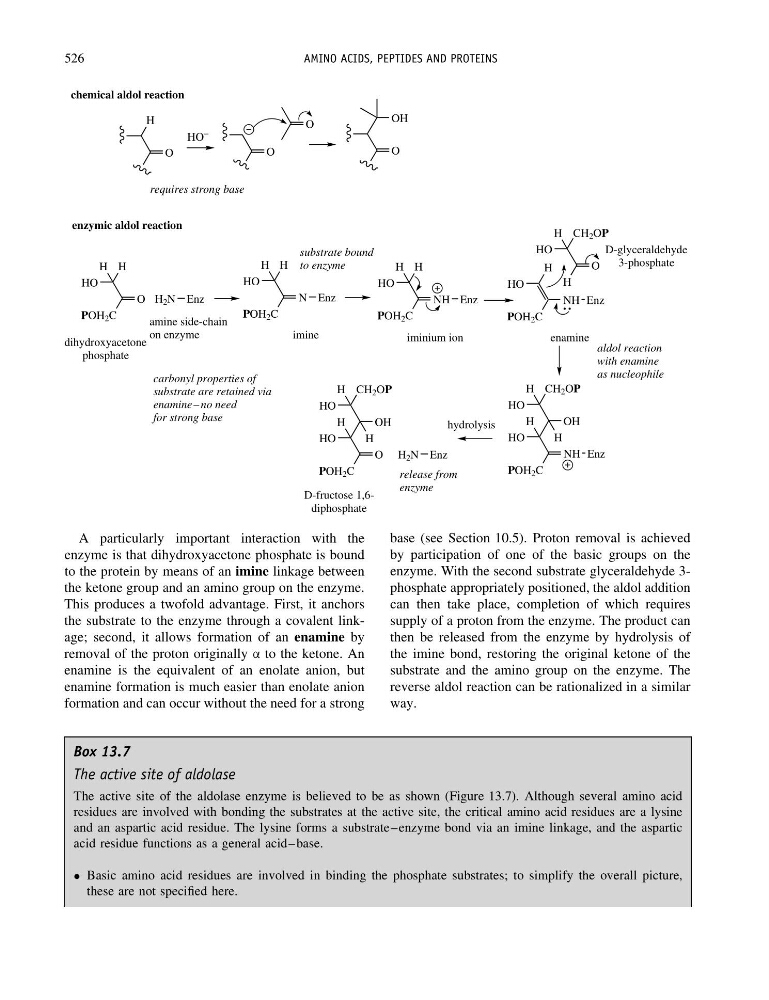
A particularly important interaction with the
enzyme is that dihydroxyacetone phosphate is bound
to the protein by means of an imine linkage between
the ketone group and an amino group on the enzyme.
This produces a twofold advantage. First, it anchors
the substrate to the enzyme through a covalent linkage; second, it allows formation of an enamine by
removal of the proton originally α to the ketone. An
enamine is the equivalent of an enolate anion, but
enamine formation is much easier than enolate anion
formation and can occur without the need for a strong
base (see Section 10.5). Proton removal is achieved
by participation of one of the basic groups on the
enzyme. With the second substrate glyceraldehyde 3phosphate appropriately positioned, the aldol addition
can then take place, completion of which requires
supply of a proton from the enzyme. The product can
then be released from the enzyme by hydrolysis of
the imine bond, restoring the original ketone of the
substrate and the amino group on the enzyme. The
reverse aldol reaction can be rationalized in a similar
way.
Box 13.7
The active site of aldolase
The active site of the aldolase enzyme is believed to be as shown (Figure 13.7). Although several amino acid
residues are involved with bonding the substrates at the active site, the critical amino acid residues are a lysine
and an aspartic acid residue. The lysine forms a substrate–enzyme bond via an imine linkage, and the aspartic
acid residue functions as a general acid–base.
• Basic amino acid residues are involved in binding the phosphate substrates; to simplify the overall picture,
these are not specified here.
AMINO ACIDS, PEPTIDES AND PROTEINS
O
H
O
O
chemical aldol reaction
requires strong base
O
POH 2 C
H
HO
H 2 N Enz
N
POH 2 C
H
HO
Enz
amine side-chain
on enzyme
imine
NH
POH 2 C
H
HO
Enz
iminium ion
enamine
NH
POH 2 C
HO
Enz
substrate bound
to enzyme
O
H
NH
POH 2 C
HO
Enz
O
POH 2 C
HO
H 2 N Enz
hydrolysis
release from
enzyme
O
OH
carbonyl properties of
substrate are retained via
enamine no need
for strong base
enzymic aldol reaction
HO
−
aldol reaction
with enamine
as nucleophile
H
H
H
H
CH 2 OP
H
OH
H
CH 2 OP
H
OH
CH 2 OP
H
HO
HO
HO
H
H
H
D-glyceraldehyde
3-phosphate
dihydroxyacetone
phosphate
D-fructose 1,6diphosphate
–
A particularly important interaction with the
enzyme is that dihydroxyacetone phosphate is bound
to the protein by means of an imine linkage between
the ketone group and an amino group on the enzyme.
This produces a twofold advantage. First, it anchors
the substrate to the enzyme through a covalent linkage; second, it allows formation of an enamine by
removal of the proton originally α to the ketone. An
enamine is the equivalent of an enolate anion, but
enamine formation is much easier than enolate anion
formation and can occur without the need for a strong
base (see Section 10.5). Proton removal is achieved
by participation of one of the basic groups on the
enzyme. With the second substrate glyceraldehyde 3phosphate appropriately positioned, the aldol addition
can then take place, completion of which requires
supply of a proton from the enzyme. The product can
then be released from the enzyme by hydrolysis of
the imine bond, restoring the original ketone of the
substrate and the amino group on the enzyme. The
reverse aldol reaction can be rationalized in a similar
way.
Box 13.7
The active site of aldolase
The active site of the aldolase enzyme is believed to be as shown (Figure 13.7). Although several amino acid
residues are involved with bonding the substrates at the active site, the critical amino acid residues are a lysine
and an aspartic acid residue. The lysine forms a substrate–enzyme bond via an imine linkage, and the aspartic
acid residue functions as a general acid–base.
• Basic amino acid residues are involved in binding the phosphate substrates; to simplify the overall picture,
these are not specified here.