

THE CHEMISTRY OF ENZYME ACTION
525
glutamic acid. These two enolization processes thus account for the observed isomerization. Note that the glutamic
acid and histidine side-chains are suitably positioned so that they can remove/supply protons at either of two
different atoms. The only additional feature to mention is the known involvement of a lysine residue, which acts
to provide ionic bonding at the active site through an ammonium–phosphate interaction.
We have seen many examples of chemical reactions involving enolate anions, and should now realize just how versatile they are in chemical synthesis
(see Chapter 10). We have also seen several examples
of how equivalent reactions are utilized in nature.
For the triose phosphate isomerase mechanism above,
we did not actually invoke a distinct enolate anion
intermediate in the enolization process, but proposed
that there was a smooth flow of electrons. For other
reactions, we shall also need to consider whether enolate anions are actually involved, or whether a more
favourable alternative exists. The aldol-type reaction
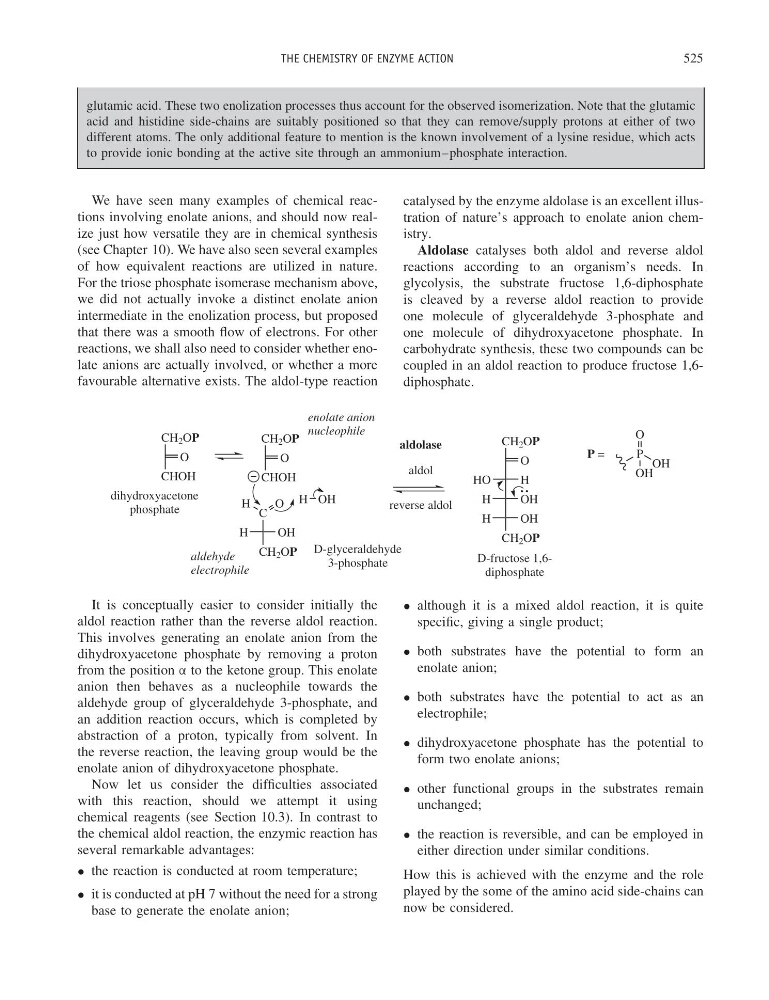
catalysed by the enzyme aldolase is an excellent illustration of nature’s approach to enolate anion chemistry.
Aldolase catalyses both aldol and reverse aldol
reactions according to an organism’s needs. In
glycolysis, the substrate fructose 1,6-diphosphate
is cleaved by a reverse aldol reaction to provide
one molecule of glyceraldehyde 3-phosphate and
one molecule of dihydroxyacetone phosphate. In
carbohydrate synthesis, these two compounds can be
coupled in an aldol reaction to produce fructose 1,6diphosphate.
C
H
OH
CH 2 OP
CHOH
O
CH 2 OP
H
O
CH 2 OP
O
HO
H
H
OH
H
OH
CH 2 OP
D-glyceraldehyde
3-phosphate
aldol
reverse aldol
dihydroxyacetone
phosphate
D-fructose 1,6diphosphate
H OH
P =
CHOH
O
CH 2 OP
enolate anion
nucleophile
aldehyde
electrophile
aldolase
O
P
OH
OH
It is conceptually easier to consider initially the
aldol reaction rather than the reverse aldol reaction.
This involves generating an enolate anion from the
dihydroxyacetone phosphate by removing a proton
from the position α to the ketone group. This enolate
anion then behaves as a nucleophile towards the
aldehyde group of glyceraldehyde 3-phosphate, and
an addition reaction occurs, which is completed by
abstraction of a proton, typically from solvent. In
the reverse reaction, the leaving group would be the
enolate anion of dihydroxyacetone phosphate.
Now let us consider the difficulties associated
with this reaction, should we attempt it using
chemical reagents (see Section 10.3). In contrast to
the chemical aldol reaction, the enzymic reaction has
several remarkable advantages:
• the reaction is conducted at room temperature;
• it is conducted at pH 7 without the need for a strong
base to generate the enolate anion;
• although it is a mixed aldol reaction, it is quite
specific, giving a single product;
• both substrates have the potential to form an
enolate anion;
• both substrates have the potential to act as an
electrophile;
• dihydroxyacetone phosphate has the potential to
form two enolate anions;
• other functional groups in the substrates remain
unchanged;
• the reaction is reversible, and can be employed in
either direction under similar conditions.
How this is achieved with the enzyme and the role
played by the some of the amino acid side-chains can
now be considered.
525
glutamic acid. These two enolization processes thus account for the observed isomerization. Note that the glutamic
acid and histidine side-chains are suitably positioned so that they can remove/supply protons at either of two
different atoms. The only additional feature to mention is the known involvement of a lysine residue, which acts
to provide ionic bonding at the active site through an ammonium–phosphate interaction.
We have seen many examples of chemical reactions involving enolate anions, and should now realize just how versatile they are in chemical synthesis
(see Chapter 10). We have also seen several examples
of how equivalent reactions are utilized in nature.
For the triose phosphate isomerase mechanism above,
we did not actually invoke a distinct enolate anion
intermediate in the enolization process, but proposed
that there was a smooth flow of electrons. For other
reactions, we shall also need to consider whether enolate anions are actually involved, or whether a more
favourable alternative exists. The aldol-type reaction
catalysed by the enzyme aldolase is an excellent illustration of nature’s approach to enolate anion chemistry.
Aldolase catalyses both aldol and reverse aldol
reactions according to an organism’s needs. In
glycolysis, the substrate fructose 1,6-diphosphate
is cleaved by a reverse aldol reaction to provide
one molecule of glyceraldehyde 3-phosphate and
one molecule of dihydroxyacetone phosphate. In
carbohydrate synthesis, these two compounds can be
coupled in an aldol reaction to produce fructose 1,6diphosphate.
C
H
OH
CH 2 OP
CHOH
O
CH 2 OP
H
O
CH 2 OP
O
HO
H
H
OH
H
OH
CH 2 OP
D-glyceraldehyde
3-phosphate
aldol
reverse aldol
dihydroxyacetone
phosphate
D-fructose 1,6diphosphate
H OH
P =
CHOH
O
CH 2 OP
enolate anion
nucleophile
aldehyde
electrophile
aldolase
O
P
OH
OH
It is conceptually easier to consider initially the
aldol reaction rather than the reverse aldol reaction.
This involves generating an enolate anion from the
dihydroxyacetone phosphate by removing a proton
from the position α to the ketone group. This enolate
anion then behaves as a nucleophile towards the
aldehyde group of glyceraldehyde 3-phosphate, and
an addition reaction occurs, which is completed by
abstraction of a proton, typically from solvent. In
the reverse reaction, the leaving group would be the
enolate anion of dihydroxyacetone phosphate.
Now let us consider the difficulties associated
with this reaction, should we attempt it using
chemical reagents (see Section 10.3). In contrast to
the chemical aldol reaction, the enzymic reaction has
several remarkable advantages:
• the reaction is conducted at room temperature;
• it is conducted at pH 7 without the need for a strong
base to generate the enolate anion;
• although it is a mixed aldol reaction, it is quite
specific, giving a single product;
• both substrates have the potential to form an
enolate anion;
• both substrates have the potential to act as an
electrophile;
• dihydroxyacetone phosphate has the potential to
form two enolate anions;
• other functional groups in the substrates remain
unchanged;
• the reaction is reversible, and can be employed in
either direction under similar conditions.
How this is achieved with the enzyme and the role
played by the some of the amino acid side-chains can
now be considered.