

524
AMINO ACIDS, PEPTIDES AND PROTEINS
Box 13.6
Triose phosphate isomerase: enolization via acid–base catalysis
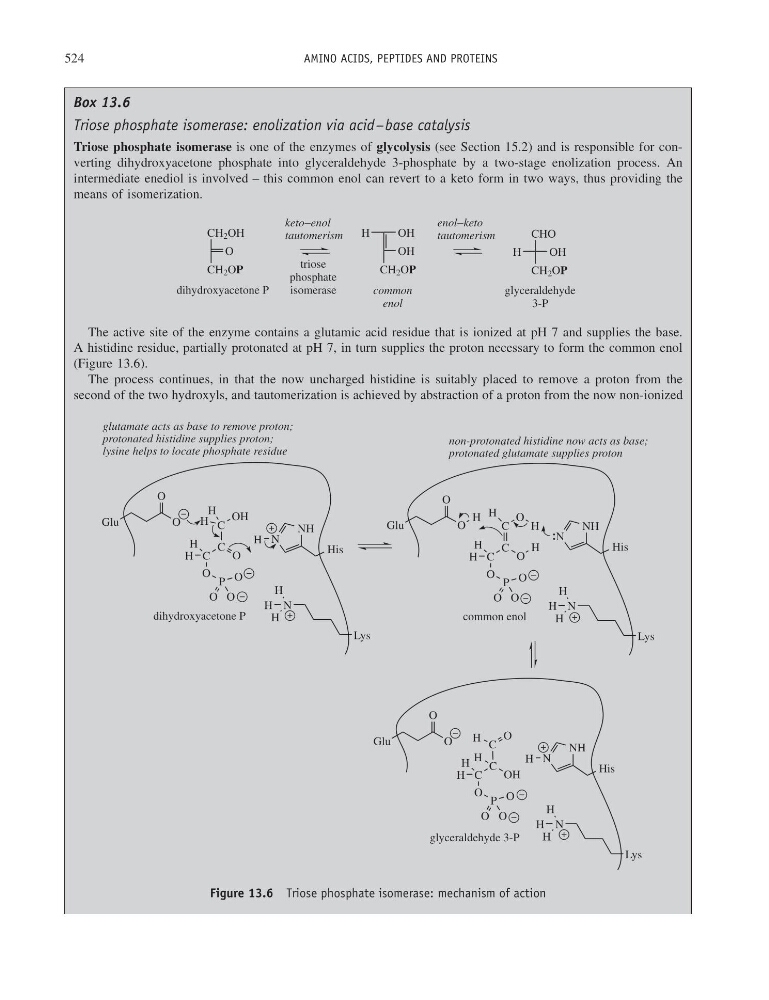
Triose phosphate isomerase is one of the enzymes of glycolysis (see Section 15.2) and is responsible for converting dihydroxyacetone phosphate into glyceraldehyde 3-phosphate by a two-stage enolization process. An
intermediate enediol is involved – this common enol can revert to a keto form in two ways, thus providing the
means of isomerization.
CHO
H
OH
CH 2 OP
CH 2 OH
O
CH 2 OP
OH
CH 2 OP
OH
H
dihydroxyacetone P
glyceraldehyde
3-P
keto−enol
tautomerism
enol−keto
tautomerism
triose
phosphate
isomerase
common
enol
The active site of the enzyme contains a glutamic acid residue that is ionized at pH 7 and supplies the base.
A histidine residue, partially protonated at pH 7, in turn supplies the proton necessary to form the common enol
(Figure 13.6).
The process continues, in that the now uncharged histidine is suitably placed to remove a proton from the
second of the two hydroxyls, and tautomerization is achieved by abstraction of a proton from the now non-ionized
glyceraldehyde 3-P
C
O
C
C
OH
H
H
H
H
O
P
O
O
O
O
O
Glu
N
NH
His
H
N
H
H
H
Lys
C
O
C
C
O
H
H
O
P
O
O
O
O
O
Glu
N
NH
His
N
H
H
H
Lys
H H
H
H
C
OH
C
C
O
H
H
H
O
P
O
O
O
O
O
Glu
N
NH
His
H
N
H
H
H
Lys
H
dihydroxyacetone P
glutamate acts as base to remove proton;
protonated histidine supplies proton;
lysine helps to locate phosphate residue
common enol
non-protonated histidine now acts as base;
protonated glutamate supplies proton
Figure 13.6 Triose phosphate isomerase: mechanism of action
AMINO ACIDS, PEPTIDES AND PROTEINS
Box 13.6
Triose phosphate isomerase: enolization via acid–base catalysis
Triose phosphate isomerase is one of the enzymes of glycolysis (see Section 15.2) and is responsible for converting dihydroxyacetone phosphate into glyceraldehyde 3-phosphate by a two-stage enolization process. An
intermediate enediol is involved – this common enol can revert to a keto form in two ways, thus providing the
means of isomerization.
CHO
H
OH
CH 2 OP
CH 2 OH
O
CH 2 OP
OH
CH 2 OP
OH
H
dihydroxyacetone P
glyceraldehyde
3-P
keto−enol
tautomerism
enol−keto
tautomerism
triose
phosphate
isomerase
common
enol
The active site of the enzyme contains a glutamic acid residue that is ionized at pH 7 and supplies the base.
A histidine residue, partially protonated at pH 7, in turn supplies the proton necessary to form the common enol
(Figure 13.6).
The process continues, in that the now uncharged histidine is suitably placed to remove a proton from the
second of the two hydroxyls, and tautomerization is achieved by abstraction of a proton from the now non-ionized
glyceraldehyde 3-P
C
O
C
C
OH
H
H
H
H
O
P
O
O
O
O
O
Glu
N
NH
His
H
N
H
H
H
Lys
C
O
C
C
O
H
H
O
P
O
O
O
O
O
Glu
N
NH
His
N
H
H
H
Lys
H H
H
H
C
OH
C
C
O
H
H
H
O
P
O
O
O
O
O
Glu
N
NH
His
H
N
H
H
H
Lys
H
dihydroxyacetone P
glutamate acts as base to remove proton;
protonated histidine supplies proton;
lysine helps to locate phosphate residue
common enol
non-protonated histidine now acts as base;
protonated glutamate supplies proton
Figure 13.6 Triose phosphate isomerase: mechanism of action