

THE CHEMISTRY OF ENZYME ACTION
523
the participation of the histidine group, with the basicity of the histidine nitrogen also being increased because of
the proximity of a neighbouring aspartate residue – a charge-relay network, as seen with acetylcholinesterase
(see Box 13.4). This allows nucleophilic attack on to the peptide carbonyl, giving an initial tetrahedral transition
state. We also know that specific amino acid residues are positioned so that they help to stabilize this anionic transition state. Reformation of the carbonyl group is followed by cleavage of the peptide bond. The proton required
to form the amino group is acquired from the imidazole. The product is now an acyl–enzyme intermediate, actually an ester involving the serine hydroxyl. This ester is hydrolysed by a water nucleophile, and deprotonation is
achieved via the aspartate–histidine system once again. This generates another tetrahedral transition state, which
collapses and allows release of the carboxylic acid and regeneration of the serine hydroxyl by protonation from
the imidazole system.
Note that penicillins and structurally related antibiotics are frequently deactivated by the action of bacterial
β-lactamase enzymes. These enzymes also contain a serine residue in the active site, and this is the nucleophile
that attacks and cleaves the β-lactam ring (see Box 7.20). The β-lactam (amide) linkage is hydrolysed, and then the
inactivated penicillin derivative is released from the enzyme by further hydrolysis of the ester linkage, restoring
the functional enzyme. The mode of action of these enzymes thus closely resembles that of the serine proteases;
there is further discussion in Box 7.20.
Whilst chymotrypsin and trypsin are especially useful in peptide sequence analysis, they also have medicinal
applications. Their ability to hydrolyse proteins makes them valuable for wound and ulcer cleansing (trypsin) or
during cataract removal (chymotrypsin).
13.4.2 Enolization and enolate anion
biochemistry
Let us now look at an example of how nature
exploits the equivalent of enol and enolate anion
chemistry. Enolization provides another application
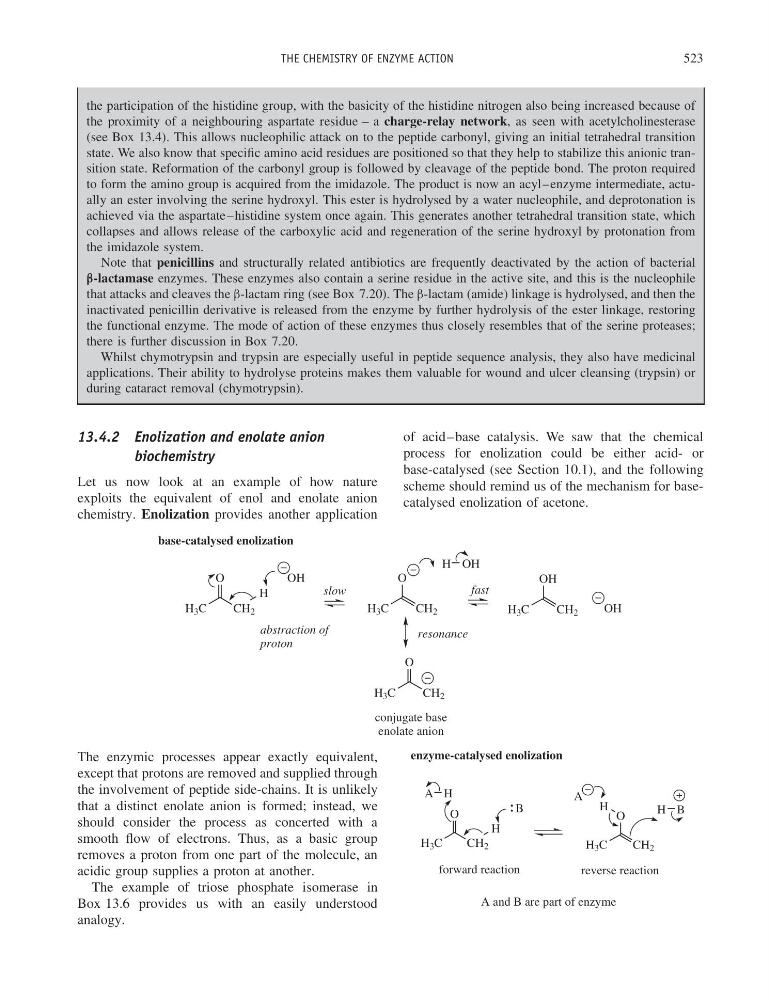
of acid–base catalysis. We saw that the chemical
process for enolization could be either acid- or
base-catalysed (see Section 10.1), and the following
scheme should remind us of the mechanism for basecatalysed enolization of acetone.
base-catalysed enolization
fast
slow
conjugate base
enolate anion
abstraction of
proton
O
H 3 C
CH 2
H
OH
O
H 3 C
CH 2
resonance
O
H 3 C
CH 2
OH
H 3 C
CH 2
OH
H OH
The enzymic processes appear exactly equivalent,
except that protons are removed and supplied through
the involvement of peptide side-chains. It is unlikely
that a distinct enolate anion is formed; instead, we
should consider the process as concerted with a
smooth flow of electrons. Thus, as a basic group
removes a proton from one part of the molecule, an
acidic group supplies a proton at another.
The example of triose phosphate isomerase in
Box 13.6 provides us with an easily understood
analogy.
O
H 3 C
CH 2
H
B
O
H 3 C
CH 2
A H
H B
A
H
forward reaction
reverse reaction
enzyme-catalysed enolization
A and B are part of enzyme
523
the participation of the histidine group, with the basicity of the histidine nitrogen also being increased because of
the proximity of a neighbouring aspartate residue – a charge-relay network, as seen with acetylcholinesterase
(see Box 13.4). This allows nucleophilic attack on to the peptide carbonyl, giving an initial tetrahedral transition
state. We also know that specific amino acid residues are positioned so that they help to stabilize this anionic transition state. Reformation of the carbonyl group is followed by cleavage of the peptide bond. The proton required
to form the amino group is acquired from the imidazole. The product is now an acyl–enzyme intermediate, actually an ester involving the serine hydroxyl. This ester is hydrolysed by a water nucleophile, and deprotonation is
achieved via the aspartate–histidine system once again. This generates another tetrahedral transition state, which
collapses and allows release of the carboxylic acid and regeneration of the serine hydroxyl by protonation from
the imidazole system.
Note that penicillins and structurally related antibiotics are frequently deactivated by the action of bacterial
β-lactamase enzymes. These enzymes also contain a serine residue in the active site, and this is the nucleophile
that attacks and cleaves the β-lactam ring (see Box 7.20). The β-lactam (amide) linkage is hydrolysed, and then the
inactivated penicillin derivative is released from the enzyme by further hydrolysis of the ester linkage, restoring
the functional enzyme. The mode of action of these enzymes thus closely resembles that of the serine proteases;
there is further discussion in Box 7.20.
Whilst chymotrypsin and trypsin are especially useful in peptide sequence analysis, they also have medicinal
applications. Their ability to hydrolyse proteins makes them valuable for wound and ulcer cleansing (trypsin) or
during cataract removal (chymotrypsin).
13.4.2 Enolization and enolate anion
biochemistry
Let us now look at an example of how nature
exploits the equivalent of enol and enolate anion
chemistry. Enolization provides another application
of acid–base catalysis. We saw that the chemical
process for enolization could be either acid- or
base-catalysed (see Section 10.1), and the following
scheme should remind us of the mechanism for basecatalysed enolization of acetone.
base-catalysed enolization
fast
slow
conjugate base
enolate anion
abstraction of
proton
O
H 3 C
CH 2
H
OH
O
H 3 C
CH 2
resonance
O
H 3 C
CH 2
OH
H 3 C
CH 2
OH
H OH
The enzymic processes appear exactly equivalent,
except that protons are removed and supplied through
the involvement of peptide side-chains. It is unlikely
that a distinct enolate anion is formed; instead, we
should consider the process as concerted with a
smooth flow of electrons. Thus, as a basic group
removes a proton from one part of the molecule, an
acidic group supplies a proton at another.
The example of triose phosphate isomerase in
Box 13.6 provides us with an easily understood
analogy.
O
H 3 C
CH 2
H
B
O
H 3 C
CH 2
A H
H B
A
H
forward reaction
reverse reaction
enzyme-catalysed enolization
A and B are part of enzyme