

THE CHEMISTRY OF ENZYME ACTION
519
In the general acid-catalysed mechanism, the imidazolium ion acts as a proton donor to protonate
the carbonyl oxygen, thus producing a better electrophile. The protonated ester is then attacked by a
water nucleophile, after which the imidazole nitrogen
removes the now unwanted proton from the nucleophile; the imidazole nitrogen consequently becomes
reprotonated. The carboxylic acid is then formed via
loss of the leaving group, and this is facilitated by
protonation, so that the leaving group is an alcohol rather than alkoxide. The imidazolium proton is
again a participant in this process. Finally, abstracting
the proton from the protonated carbonyl regenerates
the imidazolium ion. As in the chemical reactions,
the general base-catalysed process is mechanistically
rather simpler. The imidazole nitrogen acts as a base
to remove a proton from water, generating hydroxide
that attacks the carbonyl. Subsequently, the alkoxide
leaving group is reprotonated by the imidazolium ion.
However, not included in the above mechanisms
are other amino acid side-chains at the active
site, whose special role will be to help bind
the reagents in the required conformation for the
reaction to occur. Examples of such interactions are
found with acetylcholinesterase and chymotrypsin,
representatives of a group of hydrolytic enzymes
termed serine hydrolases, in that a specific serine
amino acid residue is crucial for the mechanism of
action.
The proposed enzyme mechanisms just described,
and those that follow, are depicted to show how certain amino acid residues become involved. Remember that the enzyme active site is three-dimensional,
whereas our representation is only two-dimensional.
This means that bond angles and bond lengths sometimes look a little odd and distorted. However, such
imperfect representations are actually easier to follow
than if we had provided pictures that tried to emulate
three-dimensional views.
Box 13.4
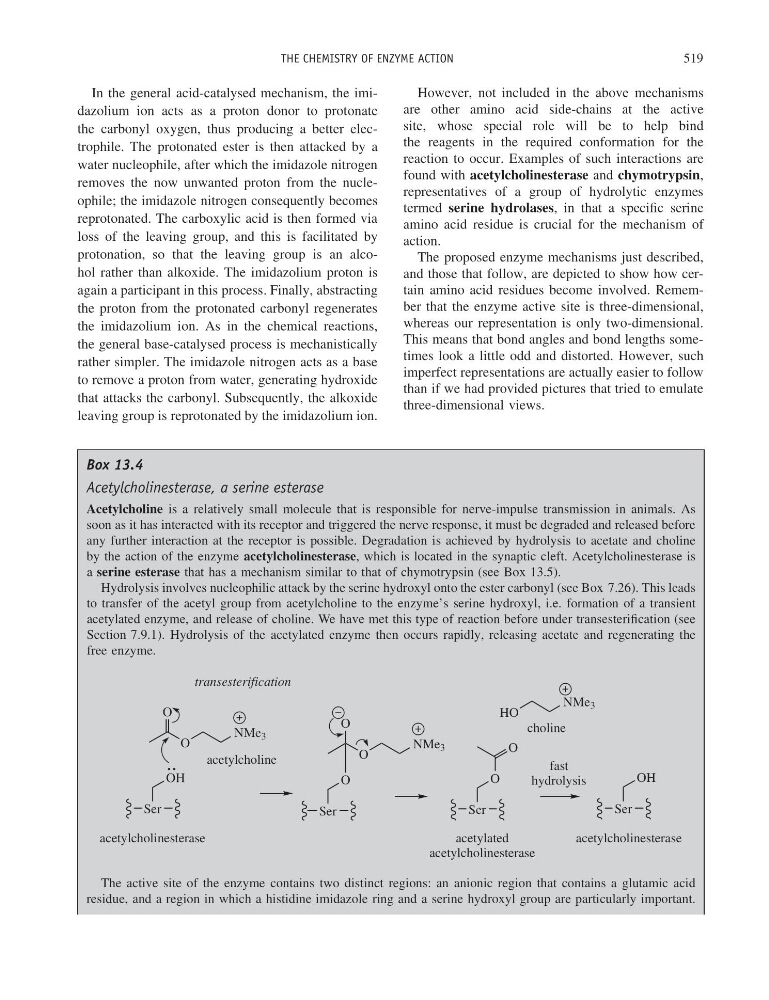
Acetylcholinesterase, a serine esterase
Acetylcholine is a relatively small molecule that is responsible for nerve-impulse transmission in animals. As
soon as it has interacted with its receptor and triggered the nerve response, it must be degraded and released before
any further interaction at the receptor is possible. Degradation is achieved by hydrolysis to acetate and choline
by the action of the enzyme acetylcholinesterase, which is located in the synaptic cleft. Acetylcholinesterase is
a serine esterase that has a mechanism similar to that of chymotrypsin (see Box 13.5).
Hydrolysis involves nucleophilic attack by the serine hydroxyl onto the ester carbonyl (see Box 7.26). This leads
to transfer of the acetyl group from acetylcholine to the enzyme’s serine hydroxyl, i.e. formation of a transient
acetylated enzyme, and release of choline. We have met this type of reaction before under transesterification (see
Section 7.9.1). Hydrolysis of the acetylated enzyme then occurs rapidly, releasing acetate and regenerating the
free enzyme.
O
NMe 3
O
Ser
OH
Ser
O
O
Ser
OH
O
NMe 3
O
Ser
O
HO
NMe 3
acetylcholinesterase
acetylcholine
fast
hydrolysis
acetylcholinesterase
acetylated
acetylcholinesterase
choline
transesterification
The active site of the enzyme contains two distinct regions: an anionic region that contains a glutamic acid
residue, and a region in which a histidine imidazole ring and a serine hydroxyl group are particularly important.
519
In the general acid-catalysed mechanism, the imidazolium ion acts as a proton donor to protonate
the carbonyl oxygen, thus producing a better electrophile. The protonated ester is then attacked by a
water nucleophile, after which the imidazole nitrogen
removes the now unwanted proton from the nucleophile; the imidazole nitrogen consequently becomes
reprotonated. The carboxylic acid is then formed via
loss of the leaving group, and this is facilitated by
protonation, so that the leaving group is an alcohol rather than alkoxide. The imidazolium proton is
again a participant in this process. Finally, abstracting
the proton from the protonated carbonyl regenerates
the imidazolium ion. As in the chemical reactions,
the general base-catalysed process is mechanistically
rather simpler. The imidazole nitrogen acts as a base
to remove a proton from water, generating hydroxide
that attacks the carbonyl. Subsequently, the alkoxide
leaving group is reprotonated by the imidazolium ion.
However, not included in the above mechanisms
are other amino acid side-chains at the active
site, whose special role will be to help bind
the reagents in the required conformation for the
reaction to occur. Examples of such interactions are
found with acetylcholinesterase and chymotrypsin,
representatives of a group of hydrolytic enzymes
termed serine hydrolases, in that a specific serine
amino acid residue is crucial for the mechanism of
action.
The proposed enzyme mechanisms just described,
and those that follow, are depicted to show how certain amino acid residues become involved. Remember that the enzyme active site is three-dimensional,
whereas our representation is only two-dimensional.
This means that bond angles and bond lengths sometimes look a little odd and distorted. However, such
imperfect representations are actually easier to follow
than if we had provided pictures that tried to emulate
three-dimensional views.
Box 13.4
Acetylcholinesterase, a serine esterase
Acetylcholine is a relatively small molecule that is responsible for nerve-impulse transmission in animals. As
soon as it has interacted with its receptor and triggered the nerve response, it must be degraded and released before
any further interaction at the receptor is possible. Degradation is achieved by hydrolysis to acetate and choline
by the action of the enzyme acetylcholinesterase, which is located in the synaptic cleft. Acetylcholinesterase is
a serine esterase that has a mechanism similar to that of chymotrypsin (see Box 13.5).
Hydrolysis involves nucleophilic attack by the serine hydroxyl onto the ester carbonyl (see Box 7.26). This leads
to transfer of the acetyl group from acetylcholine to the enzyme’s serine hydroxyl, i.e. formation of a transient
acetylated enzyme, and release of choline. We have met this type of reaction before under transesterification (see
Section 7.9.1). Hydrolysis of the acetylated enzyme then occurs rapidly, releasing acetate and regenerating the
free enzyme.
O
NMe 3
O
Ser
OH
Ser
O
O
Ser
OH
O
NMe 3
O
Ser
O
HO
NMe 3
acetylcholinesterase
acetylcholine
fast
hydrolysis
acetylcholinesterase
acetylated
acetylcholinesterase
choline
transesterification
The active site of the enzyme contains two distinct regions: an anionic region that contains a glutamic acid
residue, and a region in which a histidine imidazole ring and a serine hydroxyl group are particularly important.