

518
AMINO ACIDS, PEPTIDES AND PROTEINS
either of the tautomeric forms shown. Do not think
there is a discrepancy in structures. On the other hand,
we can write resonance structures for the protonated
ring, the imidazolium cation.
HN
N
N
NH
His
HN
NH
HN
NH
tautomerism
resonance
pK a 6.0
< pH 6.0
> pH 6.0
+ H +
− H +
at pH 7.0, ratio non-ionized:ionized = approx 10:1
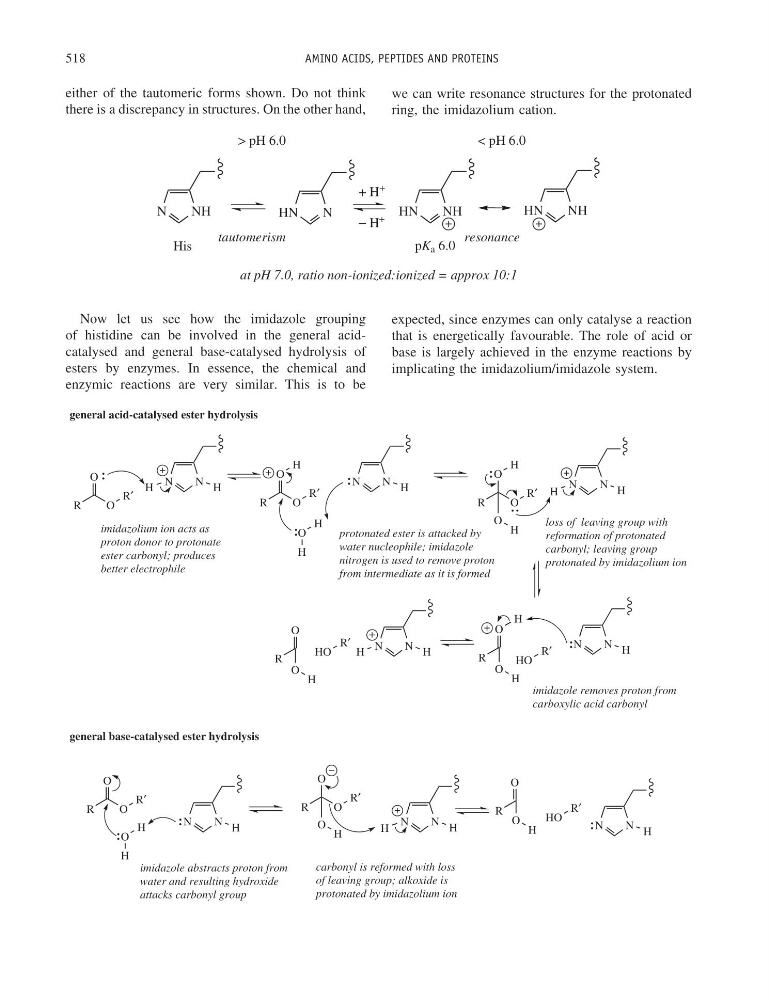
Now let us see how the imidazole grouping
of histidine can be involved in the general acidcatalysed and general base-catalysed hydrolysis of
esters by enzymes. In essence, the chemical and
enzymic reactions are very similar. This is to be
expected, since enzymes can only catalyse a reaction
that is energetically favourable. The role of acid or
base is largely achieved in the enzyme reactions by
implicating the imidazolium/imidazole system.
N
N
O
R
O
R′
H
H
N
N
O
R
O
R′
H
H
general acid-catalysed ester hydrolysis
O
H
H
N
N
O
R
HO
R′
H
H
O
H
N
N
O
R
HO
R′
H
H
O
H
general base-catalysed ester hydrolysis
imidazolium ion acts as
proton donor to protonate
ester carbonyl; produces
better electrophile
protonated ester is attacked by
water nucleophile; imidazole
nitrogen is used to remove proton
from intermediate as it is formed
loss of leaving group with
reformation of protonated
carbonyl; leaving group
protonated by imidazolium ion
imidazole removes proton from
carboxylic acid carbonyl
O
R
O
R′
O
H
H
N
N H
O
R
O
R′
H
O
H
N
N H
O
R
HO
R′
O
H
imidazole abstracts proton from
water and resulting hydroxide
attacks carbonyl group
carbonyl is reformed with loss
of leaving group; alkoxide is
protonated by imidazolium ion
N
N H
N
N
O
R
O
R′
H
H
H
O
H
AMINO ACIDS, PEPTIDES AND PROTEINS
either of the tautomeric forms shown. Do not think
there is a discrepancy in structures. On the other hand,
we can write resonance structures for the protonated
ring, the imidazolium cation.
HN
N
N
NH
His
HN
NH
HN
NH
tautomerism
resonance
pK a 6.0
< pH 6.0
> pH 6.0
+ H +
− H +
at pH 7.0, ratio non-ionized:ionized = approx 10:1
Now let us see how the imidazole grouping
of histidine can be involved in the general acidcatalysed and general base-catalysed hydrolysis of
esters by enzymes. In essence, the chemical and
enzymic reactions are very similar. This is to be
expected, since enzymes can only catalyse a reaction
that is energetically favourable. The role of acid or
base is largely achieved in the enzyme reactions by
implicating the imidazolium/imidazole system.
N
N
O
R
O
R′
H
H
N
N
O
R
O
R′
H
H
general acid-catalysed ester hydrolysis
O
H
H
N
N
O
R
HO
R′
H
H
O
H
N
N
O
R
HO
R′
H
H
O
H
general base-catalysed ester hydrolysis
imidazolium ion acts as
proton donor to protonate
ester carbonyl; produces
better electrophile
protonated ester is attacked by
water nucleophile; imidazole
nitrogen is used to remove proton
from intermediate as it is formed
loss of leaving group with
reformation of protonated
carbonyl; leaving group
protonated by imidazolium ion
imidazole removes proton from
carboxylic acid carbonyl
O
R
O
R′
O
H
H
N
N H
O
R
O
R′
H
O
H
N
N H
O
R
HO
R′
O
H
imidazole abstracts proton from
water and resulting hydroxide
attacks carbonyl group
carbonyl is reformed with loss
of leaving group; alkoxide is
protonated by imidazolium ion
N
N H
N
N
O
R
O
R′
H
H
H
O
H