

THE CHEMISTRY OF ENZYME ACTION
517
O
H 3 C
OCH 3
O
H 3 C
O
O
H 3 C
O
H
base hydrolysis of esters
base is reactant and consumed;
reaction becomes essentially irreversible
because of formation of the carboxylate anion
nucleophilic attack of
good nucleophile
hydroxide onto carbonyl
loss of leaving group with
reformation of carbonyl
leaving group (strong base)
abstracts proton from acid
carboxylate anion
O
H 3 C
OCH 3
OH
ionization of carboxylic
acid makes reaction
essentially irreversible
OH
OCH 3
HOCH 3
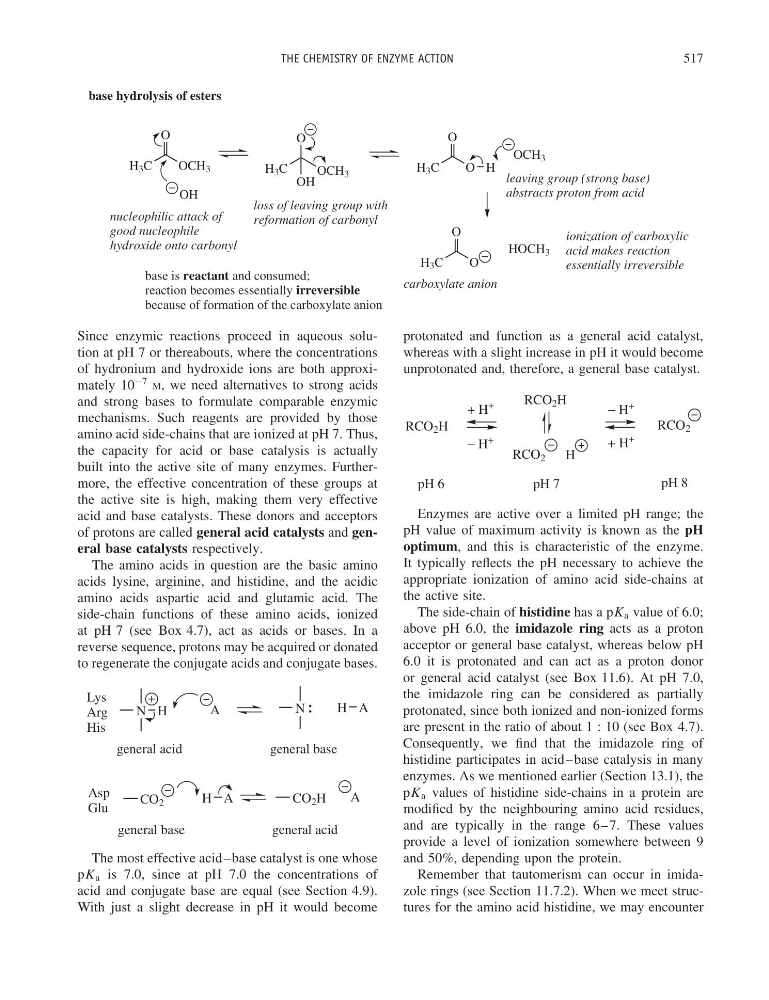
Since enzymic reactions proceed in aqueous solution at pH 7 or thereabouts, where the concentrations
of hydronium and hydroxide ions are both approximately 10
−7 M, we need alternatives to strong acids
and strong bases to formulate comparable enzymic
mechanisms. Such reagents are provided by those
amino acid side-chains that are ionized at pH 7. Thus,
the capacity for acid or base catalysis is actually
built into the active site of many enzymes. Furthermore, the effective concentration of these groups at
the active site is high, making them very effective
acid and base catalysts. These donors and acceptors
of protons are called general acid catalysts and general base catalysts respectively.
The amino acids in question are the basic amino
acids lysine, arginine, and histidine, and the acidic
amino acids aspartic acid and glutamic acid. The
side-chain functions of these amino acids, ionized
at pH 7 (see Box 4.7), act as acids or bases. In a
reverse sequence, protons may be acquired or donated
to regenerate the conjugate acids and conjugate bases.
N
A
H
N
H A
H A
CO 2
CO 2 H
A
Lys
Arg
His
Asp
Glu
general acid
general base
general base
general acid
The most effective acid–base catalyst is one whose
pK a is 7.0, since at pH 7.0 the concentrations of
acid and conjugate base are equal (see Section 4.9).
With just a slight decrease in pH it would become
protonated and function as a general acid catalyst,
whereas with a slight increase in pH it would become
unprotonated and, therefore, a general base catalyst.
RCO 2 H
RCO 2
− H
+
+ H
+
− H +
+ H +
RCO 2 H
RCO 2
pH 7
pH 8
pH 6
H
Enzymes are active over a limited pH range; the
pH value of maximum activity is known as the pH
optimum, and this is characteristic of the enzyme.
It typically reflects the pH necessary to achieve the
appropriate ionization of amino acid side-chains at
the active site.
The side-chain of histidine has a pK a value of 6.0;
above pH 6.0, the imidazole ring acts as a proton
acceptor or general base catalyst, whereas below pH
6.0 it is protonated and can act as a proton donor
or general acid catalyst (see Box 11.6). At pH 7.0,
the imidazole ring can be considered as partially
protonated, since both ionized and non-ionized forms
are present in the ratio of about 1 : 10 (see Box 4.7).
Consequently, we find that the imidazole ring of
histidine participates in acid–base catalysis in many
enzymes. As we mentioned earlier (Section 13.1), the
pK a values of histidine side-chains in a protein are
modified by the neighbouring amino acid residues,
and are typically in the range 6–7. These values
provide a level of ionization somewhere between 9
and 50%, depending upon the protein.
Remember that tautomerism can occur in imidazole rings (see Section 11.7.2). When we meet structures for the amino acid histidine, we may encounter
517
O
H 3 C
OCH 3
O
H 3 C
O
O
H 3 C
O
H
base hydrolysis of esters
base is reactant and consumed;
reaction becomes essentially irreversible
because of formation of the carboxylate anion
nucleophilic attack of
good nucleophile
hydroxide onto carbonyl
loss of leaving group with
reformation of carbonyl
leaving group (strong base)
abstracts proton from acid
carboxylate anion
O
H 3 C
OCH 3
OH
ionization of carboxylic
acid makes reaction
essentially irreversible
OH
OCH 3
HOCH 3
Since enzymic reactions proceed in aqueous solution at pH 7 or thereabouts, where the concentrations
of hydronium and hydroxide ions are both approximately 10
−7 M, we need alternatives to strong acids
and strong bases to formulate comparable enzymic
mechanisms. Such reagents are provided by those
amino acid side-chains that are ionized at pH 7. Thus,
the capacity for acid or base catalysis is actually
built into the active site of many enzymes. Furthermore, the effective concentration of these groups at
the active site is high, making them very effective
acid and base catalysts. These donors and acceptors
of protons are called general acid catalysts and general base catalysts respectively.
The amino acids in question are the basic amino
acids lysine, arginine, and histidine, and the acidic
amino acids aspartic acid and glutamic acid. The
side-chain functions of these amino acids, ionized
at pH 7 (see Box 4.7), act as acids or bases. In a
reverse sequence, protons may be acquired or donated
to regenerate the conjugate acids and conjugate bases.
N
A
H
N
H A
H A
CO 2
CO 2 H
A
Lys
Arg
His
Asp
Glu
general acid
general base
general base
general acid
The most effective acid–base catalyst is one whose
pK a is 7.0, since at pH 7.0 the concentrations of
acid and conjugate base are equal (see Section 4.9).
With just a slight decrease in pH it would become
protonated and function as a general acid catalyst,
whereas with a slight increase in pH it would become
unprotonated and, therefore, a general base catalyst.
RCO 2 H
RCO 2
− H
+
+ H
+
− H +
+ H +
RCO 2 H
RCO 2
pH 7
pH 8
pH 6
H
Enzymes are active over a limited pH range; the
pH value of maximum activity is known as the pH
optimum, and this is characteristic of the enzyme.
It typically reflects the pH necessary to achieve the
appropriate ionization of amino acid side-chains at
the active site.
The side-chain of histidine has a pK a value of 6.0;
above pH 6.0, the imidazole ring acts as a proton
acceptor or general base catalyst, whereas below pH
6.0 it is protonated and can act as a proton donor
or general acid catalyst (see Box 11.6). At pH 7.0,
the imidazole ring can be considered as partially
protonated, since both ionized and non-ionized forms
are present in the ratio of about 1 : 10 (see Box 4.7).
Consequently, we find that the imidazole ring of
histidine participates in acid–base catalysis in many
enzymes. As we mentioned earlier (Section 13.1), the
pK a values of histidine side-chains in a protein are
modified by the neighbouring amino acid residues,
and are typically in the range 6–7. These values
provide a level of ionization somewhere between 9
and 50%, depending upon the protein.
Remember that tautomerism can occur in imidazole rings (see Section 11.7.2). When we meet structures for the amino acid histidine, we may encounter