

516
AMINO ACIDS, PEPTIDES AND PROTEINS
the reaction to occur. After the reaction is completed,
the products are then released from the enzyme, so
that the reaction can be repeated on further molecules
of the substrates. These amino acid side-chains confer
immense catalytic power to the enzyme, giving it an
ability to carry out reactions that organic chemists
can only dream of.
Several types of bonding might be utilized to bind
substrates to enzymes. These are analogous to the
bondings that contribute to the secondary and tertiary
structures of a protein and include the following noncovalent interactions:
• electrostatic bonding, via acids, bases, phosphates;
• hydrophobic interactions, via alkyl groups, aromatic rings;
• hydrogen bonding, via NH, OH, SH, C=O.
In addition, we can meet examples of covalent
bonding that are responsible for binding a substrate,
where a functional group in the substrate reacts
chemically with a protein side-chain functional group.
Two important reactions are:
• imine formation, via NH 2 and C=O;
• thioester formation, via SH and C=O.
A large proportion of the substrates used in intermediary metabolism are in the form of phosphates.
Phosphates are favoured in nature since they usually confer water solubility on the compound, and
they provide a functional group that is able to bind
to enzymes through simple electrostatic bonding. In
many cases, the phosphate group may also feature as
a chemically reactive functional group – phosphates
are good leaving groups (see Section 7.13.2).
We have considered the structures of the various
amino acids in terms of polarity, basicity, acidity,
etc. Here is a useful reminder of the important
functionalities that are pertinent to enzyme action:
• amino acids with hydroxyl groups: Ser, Thr, Tyr;
• amino acids containing thiol (sulfhydryl) groups:
Cys;
• amino acids with acidic groups: Asp, Glu;
• amino acids with basic groups: Lys, Arg, His.
It is not sensible to try to cover a wide range
of enzymic reactions to demonstrate how amino
acid side-chains are responsible for the chemical
changes the enzyme brings about. Instead, one or two
suitable examples will suffice to illustrate the general
principles.
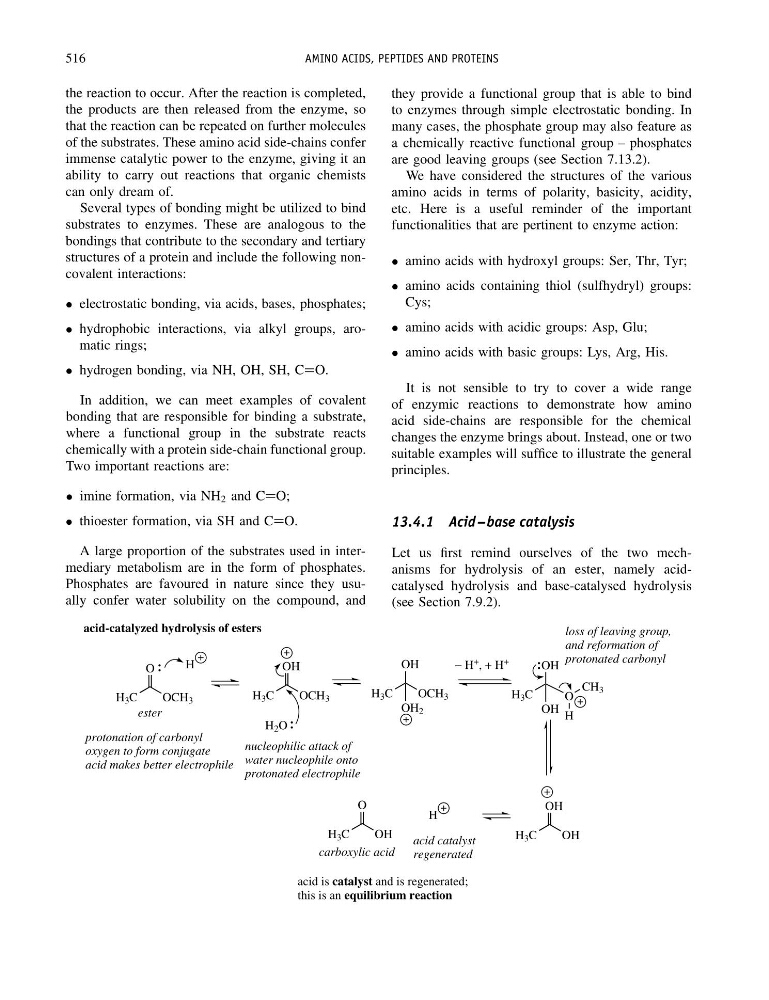
13.4.1 Acid–base catalysis
Let us first remind ourselves of the two mechanisms for hydrolysis of an ester, namely acidcatalysed hydrolysis and base-catalysed hydrolysis
(see Section 7.9.2).
OH
H 3 C
OCH 3
OH
H 3 C
OH
O
H 3 C
OH
O
H 3 C
OCH 3
carboxylic acid
acid-catalyzed hydrolysis of esters
acid catalyst
regenerated
acid is catalyst and is regenerated;
this is an equilibrium reaction
nucleophilic attack of
water nucleophile onto
protonated electrophile
ester
protonation of carbonyl
oxygen to form conjugate
acid makes better electrophile
OH
H 3 C
OCH 3
OH 2
OH
H 3 C
O
OH
CH 3
H
loss of leaving group,
and reformation of
protonated carbonyl
− H + , + H +
H 2 O
H
H
AMINO ACIDS, PEPTIDES AND PROTEINS
the reaction to occur. After the reaction is completed,
the products are then released from the enzyme, so
that the reaction can be repeated on further molecules
of the substrates. These amino acid side-chains confer
immense catalytic power to the enzyme, giving it an
ability to carry out reactions that organic chemists
can only dream of.
Several types of bonding might be utilized to bind
substrates to enzymes. These are analogous to the
bondings that contribute to the secondary and tertiary
structures of a protein and include the following noncovalent interactions:
• electrostatic bonding, via acids, bases, phosphates;
• hydrophobic interactions, via alkyl groups, aromatic rings;
• hydrogen bonding, via NH, OH, SH, C=O.
In addition, we can meet examples of covalent
bonding that are responsible for binding a substrate,
where a functional group in the substrate reacts
chemically with a protein side-chain functional group.
Two important reactions are:
• imine formation, via NH 2 and C=O;
• thioester formation, via SH and C=O.
A large proportion of the substrates used in intermediary metabolism are in the form of phosphates.
Phosphates are favoured in nature since they usually confer water solubility on the compound, and
they provide a functional group that is able to bind
to enzymes through simple electrostatic bonding. In
many cases, the phosphate group may also feature as
a chemically reactive functional group – phosphates
are good leaving groups (see Section 7.13.2).
We have considered the structures of the various
amino acids in terms of polarity, basicity, acidity,
etc. Here is a useful reminder of the important
functionalities that are pertinent to enzyme action:
• amino acids with hydroxyl groups: Ser, Thr, Tyr;
• amino acids containing thiol (sulfhydryl) groups:
Cys;
• amino acids with acidic groups: Asp, Glu;
• amino acids with basic groups: Lys, Arg, His.
It is not sensible to try to cover a wide range
of enzymic reactions to demonstrate how amino
acid side-chains are responsible for the chemical
changes the enzyme brings about. Instead, one or two
suitable examples will suffice to illustrate the general
principles.
13.4.1 Acid–base catalysis
Let us first remind ourselves of the two mechanisms for hydrolysis of an ester, namely acidcatalysed hydrolysis and base-catalysed hydrolysis
(see Section 7.9.2).
OH
H 3 C
OCH 3
OH
H 3 C
OH
O
H 3 C
OH
O
H 3 C
OCH 3
carboxylic acid
acid-catalyzed hydrolysis of esters
acid catalyst
regenerated
acid is catalyst and is regenerated;
this is an equilibrium reaction
nucleophilic attack of
water nucleophile onto
protonated electrophile
ester
protonation of carbonyl
oxygen to form conjugate
acid makes better electrophile
OH
H 3 C
OCH 3
OH 2
OH
H 3 C
O
OH
CH 3
H
loss of leaving group,
and reformation of
protonated carbonyl
− H + , + H +
H 2 O
H
H