

THE CHEMISTRY OF ENZYME ACTION
515
Box 13.3 (continued)
Tyr–Gly–Gly–Phe–Met–Thr–Ser–Glu–Lys–Ser–
Gln–Thr–Pro–Leu–Val–Thr–Leu–Phe–Lys–Asn–
Ala–Ile–Val–Lys–Asn–Ala–His–Lys–Lys–Gly–
Gln
β-endorphin
Tyr–Gly–Gly–Phe–Leu
Leu-enkephalin
Tyr–Gly–Gly–Phe–Met
Met-enkephalin
Tyr–Gly–Gly–Phe–Leu–Arg–Arg–Ile–Arg–Pro–
Lys–Leu–Lys–Trp–Asp–Asn–Gln
dynorphin A
amino acid sequences listed in blocks of 10 residues
Although β-endorphin at its N-terminus contains the sequence for Met-enkephalin, the latter peptide and
Leu-enkephalin are derived from a larger peptide, namely proenkephalin A, and β-endorphin itself is formed
by cleavage of the peptide pro-opiomelanocortin. The proenkephalin A structure contains four Met-enkephalin
sequences and one of Leu-enkephalin. The dynorphins, e.g. dynorphin A, are also produced by cleavage of a
larger precursor, namely proenkephalin B (prodynorphin), and all contain the Leu-enkephalin sequence. Some 20
opioid ligands have now been characterized. When released, these endogenous opioids act upon specific receptors,
inducing analgesia and depressing respiratory function and several other processes. The individual peptides have
relatively high specificity towards different receptors. It is known that morphine, β-endorphin, and Met-enkephalin
are agonists for the same site. The opioid peptides are implicated in analgesia brought about by acupuncture, since
opiate antagonists can reverse the effects. The hope of exploiting similar peptides as ideal, non-addictive analgesics
has yet to be attained; repeated doses of endorphin or enkephalin produce addiction and withdrawal symptoms.
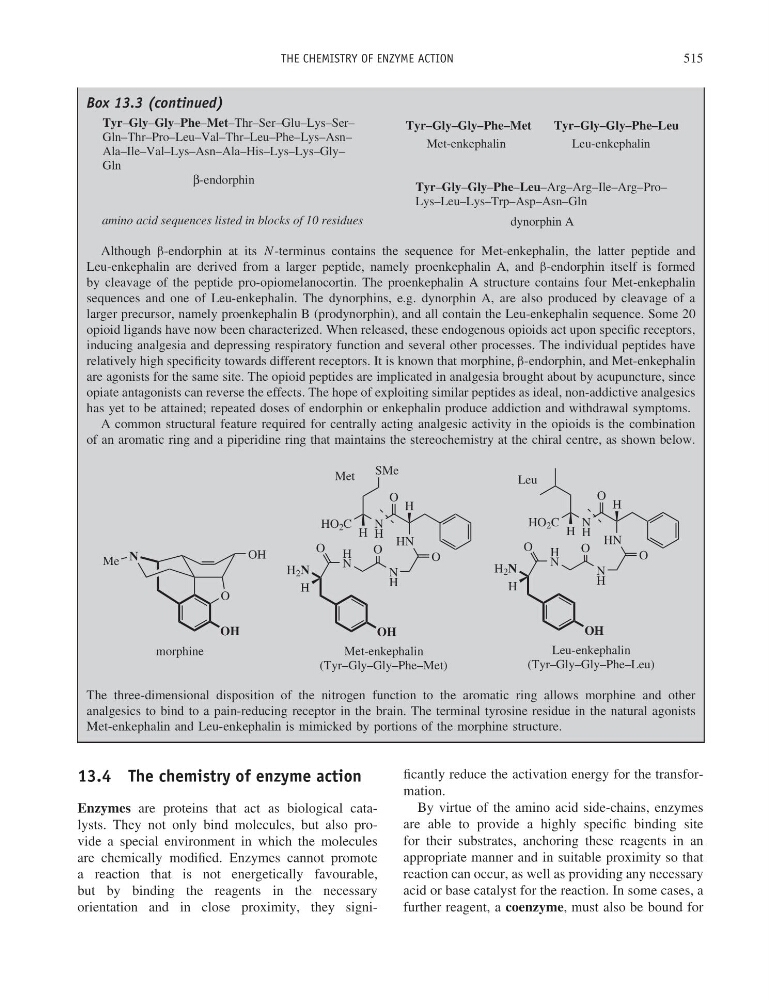
A common structural feature required for centrally acting analgesic activity in the opioids is the combination
of an aromatic ring and a piperidine ring that maintains the stereochemistry at the chiral centre, as shown below.
N
OH
O
OH
Me
HO 2 C
N
H
SMe
O
HN
O
O
N
H
H
H
H 2 N
H
N
OH
H
O
Met-enkephalin
(Tyr–Gly–Gly–Phe–Met)
Leu-enkephalin
(Tyr–Gly–Gly–Phe–Leu)
morphine
O
HN
O
O
N
H
H
H 2 N
H
N
OH
H
O
HO 2 C
N
H
H
Met
Leu
The three-dimensional disposition of the nitrogen function to the aromatic ring allows morphine and other
analgesics to bind to a pain-reducing receptor in the brain. The terminal tyrosine residue in the natural agonists
Met-enkephalin and Leu-enkephalin is mimicked by portions of the morphine structure.
13.4 The chemistry of enzyme action
Enzymes are proteins that act as biological catalysts. They not only bind molecules, but also provide a special environment in which the molecules
are chemically modified. Enzymes cannot promote
a reaction that is not energetically favourable,
but by binding the reagents in the necessary
orientation and in close proximity, they significantly reduce the activation energy for the transformation.
By virtue of the amino acid side-chains, enzymes
are able to provide a highly specific binding site
for their substrates, anchoring these reagents in an
appropriate manner and in suitable proximity so that
reaction can occur, as well as providing any necessary
acid or base catalyst for the reaction. In some cases, a
further reagent, a coenzyme, must also be bound for
515
Box 13.3 (continued)
Tyr–Gly–Gly–Phe–Met–Thr–Ser–Glu–Lys–Ser–
Gln–Thr–Pro–Leu–Val–Thr–Leu–Phe–Lys–Asn–
Ala–Ile–Val–Lys–Asn–Ala–His–Lys–Lys–Gly–
Gln
β-endorphin
Tyr–Gly–Gly–Phe–Leu
Leu-enkephalin
Tyr–Gly–Gly–Phe–Met
Met-enkephalin
Tyr–Gly–Gly–Phe–Leu–Arg–Arg–Ile–Arg–Pro–
Lys–Leu–Lys–Trp–Asp–Asn–Gln
dynorphin A
amino acid sequences listed in blocks of 10 residues
Although β-endorphin at its N-terminus contains the sequence for Met-enkephalin, the latter peptide and
Leu-enkephalin are derived from a larger peptide, namely proenkephalin A, and β-endorphin itself is formed
by cleavage of the peptide pro-opiomelanocortin. The proenkephalin A structure contains four Met-enkephalin
sequences and one of Leu-enkephalin. The dynorphins, e.g. dynorphin A, are also produced by cleavage of a
larger precursor, namely proenkephalin B (prodynorphin), and all contain the Leu-enkephalin sequence. Some 20
opioid ligands have now been characterized. When released, these endogenous opioids act upon specific receptors,
inducing analgesia and depressing respiratory function and several other processes. The individual peptides have
relatively high specificity towards different receptors. It is known that morphine, β-endorphin, and Met-enkephalin
are agonists for the same site. The opioid peptides are implicated in analgesia brought about by acupuncture, since
opiate antagonists can reverse the effects. The hope of exploiting similar peptides as ideal, non-addictive analgesics
has yet to be attained; repeated doses of endorphin or enkephalin produce addiction and withdrawal symptoms.
A common structural feature required for centrally acting analgesic activity in the opioids is the combination
of an aromatic ring and a piperidine ring that maintains the stereochemistry at the chiral centre, as shown below.
N
OH
O
OH
Me
HO 2 C
N
H
SMe
O
HN
O
O
N
H
H
H
H 2 N
H
N
OH
H
O
Met-enkephalin
(Tyr–Gly–Gly–Phe–Met)
Leu-enkephalin
(Tyr–Gly–Gly–Phe–Leu)
morphine
O
HN
O
O
N
H
H
H 2 N
H
N
OH
H
O
HO 2 C
N
H
H
Met
Leu
The three-dimensional disposition of the nitrogen function to the aromatic ring allows morphine and other
analgesics to bind to a pain-reducing receptor in the brain. The terminal tyrosine residue in the natural agonists
Met-enkephalin and Leu-enkephalin is mimicked by portions of the morphine structure.
13.4 The chemistry of enzyme action
Enzymes are proteins that act as biological catalysts. They not only bind molecules, but also provide a special environment in which the molecules
are chemically modified. Enzymes cannot promote
a reaction that is not energetically favourable,
but by binding the reagents in the necessary
orientation and in close proximity, they significantly reduce the activation energy for the transformation.
By virtue of the amino acid side-chains, enzymes
are able to provide a highly specific binding site
for their substrates, anchoring these reagents in an
appropriate manner and in suitable proximity so that
reaction can occur, as well as providing any necessary
acid or base catalyst for the reaction. In some cases, a
further reagent, a coenzyme, must also be bound for