

MOLECULAR SHAPE OF PROTEINS: PRIMARY, SECONDARY AND TERTIARY STRUCTURES
513
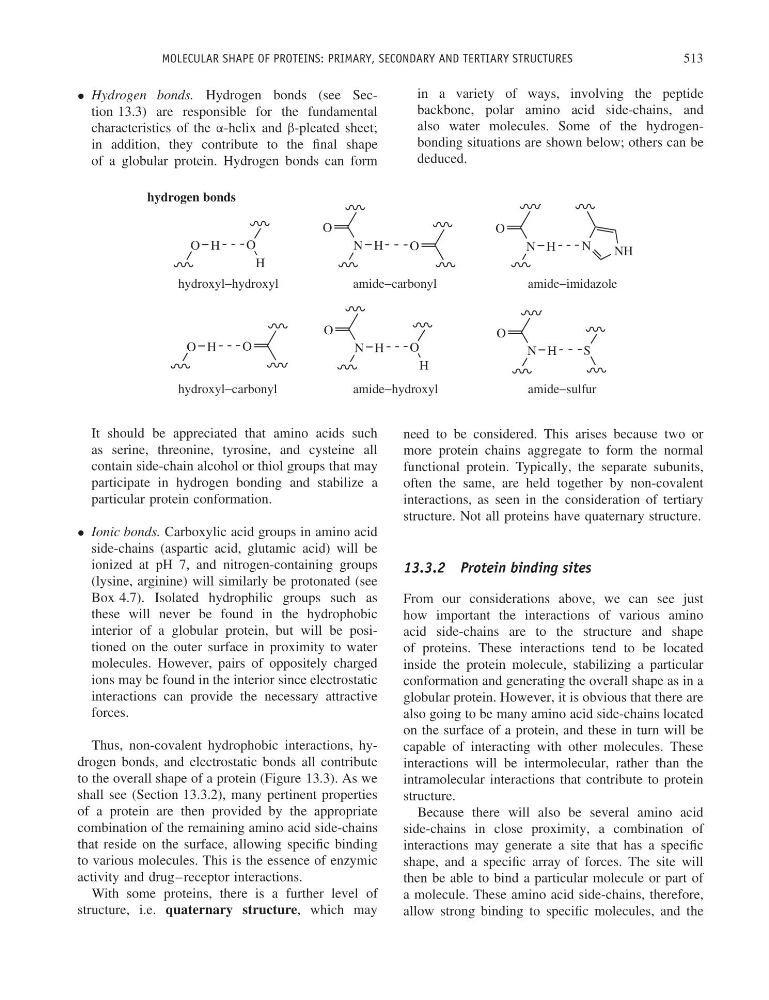
• Hydrogen bonds. Hydrogen bonds (see Section 13.3) are responsible for the fundamental
characteristics of the α-helix and β-pleated sheet;
in addition, they contribute to the final shape
of a globular protein. Hydrogen bonds can form
in a variety of ways, involving the peptide
backbone, polar amino acid side-chains, and
also water molecules. Some of the hydrogenbonding situations are shown below; others can be
deduced.
hydrogen bonds
O H
O
H
hydroxyl−hydroxyl
O H
O
hydroxyl−carbonyl
amide−carbonyl
N H
O
amide−hydroxyl
N H
O
H
amide−imidazole
N H
N
NH
amide−sulfur
N H
S
O
O
O
O
It should be appreciated that amino acids such
as serine, threonine, tyrosine, and cysteine all
contain side-chain alcohol or thiol groups that may
participate in hydrogen bonding and stabilize a
particular protein conformation.
• Ionic bonds. Carboxylic acid groups in amino acid
side-chains (aspartic acid, glutamic acid) will be
ionized at pH 7, and nitrogen-containing groups
(lysine, arginine) will similarly be protonated (see
Box 4.7). Isolated hydrophilic groups such as
these will never be found in the hydrophobic
interior of a globular protein, but will be positioned on the outer surface in proximity to water
molecules. However, pairs of oppositely charged
ions may be found in the interior since electrostatic
interactions can provide the necessary attractive
forces.
Thus, non-covalent hydrophobic interactions, hydrogen bonds, and electrostatic bonds all contribute
to the overall shape of a protein (Figure 13.3). As we
shall see (Section 13.3.2), many pertinent properties
of a protein are then provided by the appropriate
combination of the remaining amino acid side-chains
that reside on the surface, allowing specific binding
to various molecules. This is the essence of enzymic
activity and drug–receptor interactions.
With some proteins, there is a further level of
structure, i.e. quaternary structure, which may
need to be considered. This arises because two or
more protein chains aggregate to form the normal
functional protein. Typically, the separate subunits,
often the same, are held together by non-covalent
interactions, as seen in the consideration of tertiary
structure. Not all proteins have quaternary structure.
13.3.2 Protein binding sites
From our considerations above, we can see just
how important the interactions of various amino
acid side-chains are to the structure and shape
of proteins. These interactions tend to be located
inside the protein molecule, stabilizing a particular
conformation and generating the overall shape as in a
globular protein. However, it is obvious that there are
also going to be many amino acid side-chains located
on the surface of a protein, and these in turn will be
capable of interacting with other molecules. These
interactions will be intermolecular, rather than the
intramolecular interactions that contribute to protein
structure.
Because there will also be several amino acid
side-chains in close proximity, a combination of
interactions may generate a site that has a specific
shape, and a specific array of forces. The site will
then be able to bind a particular molecule or part of
a molecule. These amino acid side-chains, therefore,
allow strong binding to specific molecules, and the
513
• Hydrogen bonds. Hydrogen bonds (see Section 13.3) are responsible for the fundamental
characteristics of the α-helix and β-pleated sheet;
in addition, they contribute to the final shape
of a globular protein. Hydrogen bonds can form
in a variety of ways, involving the peptide
backbone, polar amino acid side-chains, and
also water molecules. Some of the hydrogenbonding situations are shown below; others can be
deduced.
hydrogen bonds
O H
O
H
hydroxyl−hydroxyl
O H
O
hydroxyl−carbonyl
amide−carbonyl
N H
O
amide−hydroxyl
N H
O
H
amide−imidazole
N H
N
NH
amide−sulfur
N H
S
O
O
O
O
It should be appreciated that amino acids such
as serine, threonine, tyrosine, and cysteine all
contain side-chain alcohol or thiol groups that may
participate in hydrogen bonding and stabilize a
particular protein conformation.
• Ionic bonds. Carboxylic acid groups in amino acid
side-chains (aspartic acid, glutamic acid) will be
ionized at pH 7, and nitrogen-containing groups
(lysine, arginine) will similarly be protonated (see
Box 4.7). Isolated hydrophilic groups such as
these will never be found in the hydrophobic
interior of a globular protein, but will be positioned on the outer surface in proximity to water
molecules. However, pairs of oppositely charged
ions may be found in the interior since electrostatic
interactions can provide the necessary attractive
forces.
Thus, non-covalent hydrophobic interactions, hydrogen bonds, and electrostatic bonds all contribute
to the overall shape of a protein (Figure 13.3). As we
shall see (Section 13.3.2), many pertinent properties
of a protein are then provided by the appropriate
combination of the remaining amino acid side-chains
that reside on the surface, allowing specific binding
to various molecules. This is the essence of enzymic
activity and drug–receptor interactions.
With some proteins, there is a further level of
structure, i.e. quaternary structure, which may
need to be considered. This arises because two or
more protein chains aggregate to form the normal
functional protein. Typically, the separate subunits,
often the same, are held together by non-covalent
interactions, as seen in the consideration of tertiary
structure. Not all proteins have quaternary structure.
13.3.2 Protein binding sites
From our considerations above, we can see just
how important the interactions of various amino
acid side-chains are to the structure and shape
of proteins. These interactions tend to be located
inside the protein molecule, stabilizing a particular
conformation and generating the overall shape as in a
globular protein. However, it is obvious that there are
also going to be many amino acid side-chains located
on the surface of a protein, and these in turn will be
capable of interacting with other molecules. These
interactions will be intermolecular, rather than the
intramolecular interactions that contribute to protein
structure.
Because there will also be several amino acid
side-chains in close proximity, a combination of
interactions may generate a site that has a specific
shape, and a specific array of forces. The site will
then be able to bind a particular molecule or part of
a molecule. These amino acid side-chains, therefore,
allow strong binding to specific molecules, and the