

512
AMINO ACIDS, PEPTIDES AND PROTEINS
that arise from some of the amino acid sidechain substituents. These are non-covalent interactions, although we must also remember that a
disulfide bond formed between pairs of cysteine
residues also contributes to the three-dimensional
shape of the protein by providing cross-chain
links. Non-covalent interactions are relatively weak
when compared with covalent bonds, but there
are usually many such interactions in a protein
and, overall, a substantial degree of stabilization is
attained.
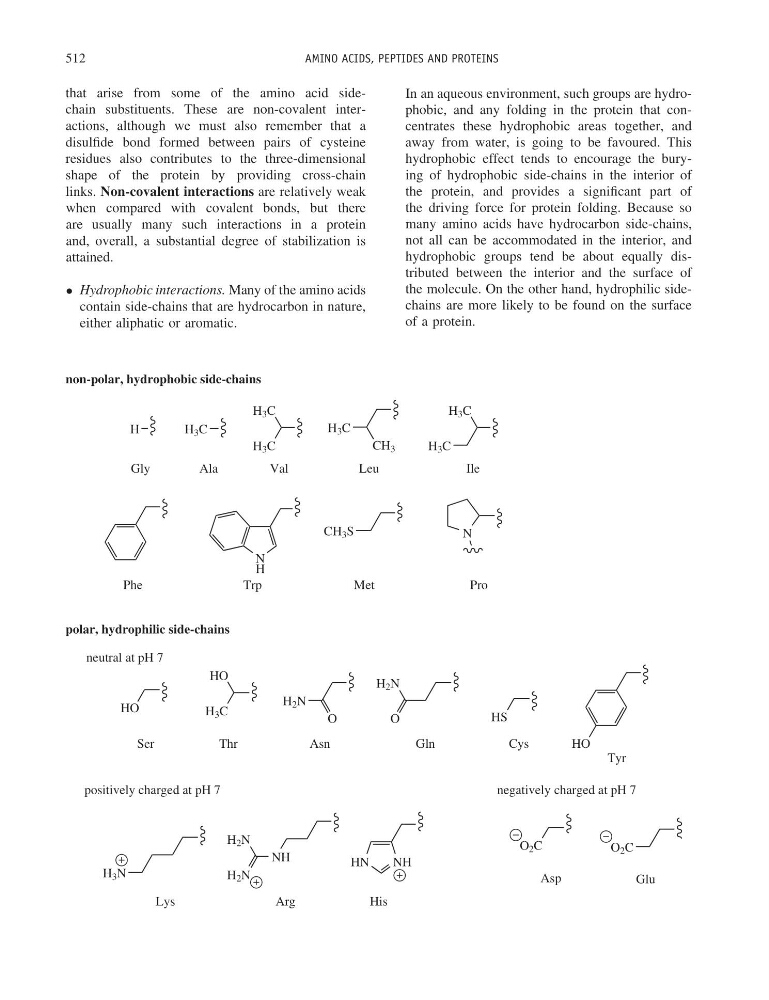
• Hydrophobic interactions. Many of the amino acids
contain side-chains that are hydrocarbon in nature,
either aliphatic or aromatic.
In an aqueous environment, such groups are hydrophobic, and any folding in the protein that concentrates these hydrophobic areas together, and
away from water, is going to be favoured. This
hydrophobic effect tends to encourage the burying of hydrophobic side-chains in the interior of
the protein, and provides a significant part of
the driving force for protein folding. Because so
many amino acids have hydrocarbon side-chains,
not all can be accommodated in the interior, and
hydrophobic groups tend be about equally distributed between the interior and the surface of
the molecule. On the other hand, hydrophilic sidechains are more likely to be found on the surface
of a protein.
non-polar, hydrophobic side-chains
H
H 3 C
H 3 C
H 3 C
H 3 C
CH 3
H 3 C
H 3 C
Gly
Ala
Val
Leu
Ile
N
H
CH 3 S
N
Phe
Trp
Met
Pro
polar, hydrophilic side-chains
neutral at pH 7
positively charged at pH 7
negatively charged at pH 7
HO
Ser
H 3 C
HO
Thr
H 2 N
O
Asn
O
H 2 N
Gln
HN
NH
His
Tyr
HO
H 3 N
Lys
NH
Arg
H 2 N
H 2 N
O 2 C
Asp
O 2 C
Glu
HS
Cys
AMINO ACIDS, PEPTIDES AND PROTEINS
that arise from some of the amino acid sidechain substituents. These are non-covalent interactions, although we must also remember that a
disulfide bond formed between pairs of cysteine
residues also contributes to the three-dimensional
shape of the protein by providing cross-chain
links. Non-covalent interactions are relatively weak
when compared with covalent bonds, but there
are usually many such interactions in a protein
and, overall, a substantial degree of stabilization is
attained.
• Hydrophobic interactions. Many of the amino acids
contain side-chains that are hydrocarbon in nature,
either aliphatic or aromatic.
In an aqueous environment, such groups are hydrophobic, and any folding in the protein that concentrates these hydrophobic areas together, and
away from water, is going to be favoured. This
hydrophobic effect tends to encourage the burying of hydrophobic side-chains in the interior of
the protein, and provides a significant part of
the driving force for protein folding. Because so
many amino acids have hydrocarbon side-chains,
not all can be accommodated in the interior, and
hydrophobic groups tend be about equally distributed between the interior and the surface of
the molecule. On the other hand, hydrophilic sidechains are more likely to be found on the surface
of a protein.
non-polar, hydrophobic side-chains
H
H 3 C
H 3 C
H 3 C
H 3 C
CH 3
H 3 C
H 3 C
Gly
Ala
Val
Leu
Ile
N
H
CH 3 S
N
Phe
Trp
Met
Pro
polar, hydrophilic side-chains
neutral at pH 7
positively charged at pH 7
negatively charged at pH 7
HO
Ser
H 3 C
HO
Thr
H 2 N
O
Asn
O
H 2 N
Gln
HN
NH
His
Tyr
HO
H 3 N
Lys
NH
Arg
H 2 N
H 2 N
O 2 C
Asp
O 2 C
Glu
HS
Cys