

MOLECULAR SHAPE OF PROTEINS: PRIMARY, SECONDARY AND TERTIARY STRUCTURES
505
HO 2 C
N
H
H
N
CO 2 H
NH 2
O
SH
O
glutathione: γ-Glu−Cys−Gly
HO 2 C
H 2 N
H 2 N
CO 2 H
NH 2
O
SH
O
OH
OH
L-Glu
L-Cys
Gly
α
β γ
Peptides and proteins may be hydrolysed to their
constituent amino acids by either acid or base
hydrolysis (see Box 7.17). However, because of its
nature, the amide bond is quite resistant to hydrolytic
conditions (see Section 7.9.2), a very important
feature for natural proteins. Hydrolysis of peptides
and proteins, therefore, requires heating with quite
concentrated strong acid or strong base. Neither acid
nor base hydrolysis provides the ideal hydrolytic
conditions, however, since some of the constituent
amino acids are found to be sensitive to the reagents.
Acid hydrolysis is preferred, but the indole system of
tryptophan is largely degraded in strong acid, and the
sulfur-containing amino acid cysteine is also unstable.
Serine, threonine, and tyrosine may also suffer
partial degradation. Those amino acids containing
amide side-chains, e.g. asparagine and glutamine,
will be hydrolysed further, giving the corresponding
structures with acidic side-chains, namely aspartic
acid and glutamic acid.
13.3 Molecular shape of proteins:
primary, secondary and tertiary
structures
Peptides and proteins are composed of amino acids
linked together via amide (peptide) bonds, the amino
group of one condensing with the carboxylic acid of
another. The sequence of amino acids in a peptide
or protein is closely controlled by genetic factors.
Some peptides are synthesized via a multi-functional
enzyme complex (non-ribosomal peptide synthesis),
whereas others, including the larger proteins, are
produced on the ribosome, and the sequence can be
related directly to the nucleotide sequence of DNA.
This amino acid sequence provides what we term the
primary structure of the protein, although this term
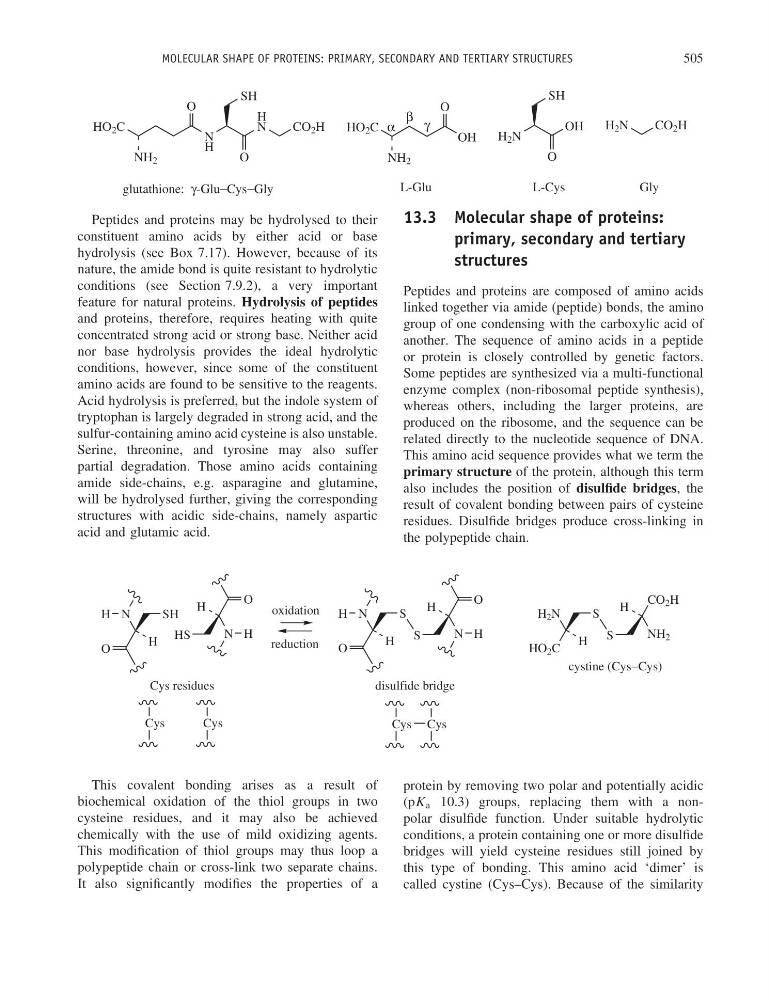
also includes the position of disulfide bridges, the
result of covalent bonding between pairs of cysteine
residues. Disulfide bridges produce cross-linking in
the polypeptide chain.
N
N
H
O
O
H
H
H
SH
HS
N
N
H
O
O
H
H
H
S
S
Cys Cys
disulfide bridge
Cys
Cys
Cys residues
oxidation
H 2 N
HO 2 C
CO 2 H
NH 2
H
H
S
S
cystine (Cys−Cys)
reduction
This covalent bonding arises as a result of
biochemical oxidation of the thiol groups in two
cysteine residues, and it may also be achieved
chemically with the use of mild oxidizing agents.
This modification of thiol groups may thus loop a
polypeptide chain or cross-link two separate chains.
It also significantly modifies the properties of a
protein by removing two polar and potentially acidic
(pK a 10.3) groups, replacing them with a nonpolar disulfide function. Under suitable hydrolytic
conditions, a protein containing one or more disulfide
bridges will yield cysteine residues still joined by
this type of bonding. This amino acid ‘dimer’ is
called cystine (Cys–Cys). Because of the similarity
505
HO 2 C
N
H
H
N
CO 2 H
NH 2
O
SH
O
glutathione: γ-Glu−Cys−Gly
HO 2 C
H 2 N
H 2 N
CO 2 H
NH 2
O
SH
O
OH
OH
L-Glu
L-Cys
Gly
α
β γ
Peptides and proteins may be hydrolysed to their
constituent amino acids by either acid or base
hydrolysis (see Box 7.17). However, because of its
nature, the amide bond is quite resistant to hydrolytic
conditions (see Section 7.9.2), a very important
feature for natural proteins. Hydrolysis of peptides
and proteins, therefore, requires heating with quite
concentrated strong acid or strong base. Neither acid
nor base hydrolysis provides the ideal hydrolytic
conditions, however, since some of the constituent
amino acids are found to be sensitive to the reagents.
Acid hydrolysis is preferred, but the indole system of
tryptophan is largely degraded in strong acid, and the
sulfur-containing amino acid cysteine is also unstable.
Serine, threonine, and tyrosine may also suffer
partial degradation. Those amino acids containing
amide side-chains, e.g. asparagine and glutamine,
will be hydrolysed further, giving the corresponding
structures with acidic side-chains, namely aspartic
acid and glutamic acid.
13.3 Molecular shape of proteins:
primary, secondary and tertiary
structures
Peptides and proteins are composed of amino acids
linked together via amide (peptide) bonds, the amino
group of one condensing with the carboxylic acid of
another. The sequence of amino acids in a peptide
or protein is closely controlled by genetic factors.
Some peptides are synthesized via a multi-functional
enzyme complex (non-ribosomal peptide synthesis),
whereas others, including the larger proteins, are
produced on the ribosome, and the sequence can be
related directly to the nucleotide sequence of DNA.
This amino acid sequence provides what we term the
primary structure of the protein, although this term
also includes the position of disulfide bridges, the
result of covalent bonding between pairs of cysteine
residues. Disulfide bridges produce cross-linking in
the polypeptide chain.
N
N
H
O
O
H
H
H
SH
HS
N
N
H
O
O
H
H
H
S
S
Cys Cys
disulfide bridge
Cys
Cys
Cys residues
oxidation
H 2 N
HO 2 C
CO 2 H
NH 2
H
H
S
S
cystine (Cys−Cys)
reduction
This covalent bonding arises as a result of
biochemical oxidation of the thiol groups in two
cysteine residues, and it may also be achieved
chemically with the use of mild oxidizing agents.
This modification of thiol groups may thus loop a
polypeptide chain or cross-link two separate chains.
It also significantly modifies the properties of a
protein by removing two polar and potentially acidic
(pK a 10.3) groups, replacing them with a nonpolar disulfide function. Under suitable hydrolytic
conditions, a protein containing one or more disulfide
bridges will yield cysteine residues still joined by
this type of bonding. This amino acid ‘dimer’ is
called cystine (Cys–Cys). Because of the similarity