

504
AMINO ACIDS, PEPTIDES AND PROTEINS
13.2 Peptides and proteins
Although superficially similar, peptides and proteins display a wide variety of biological functions,
and many have marked physiological properties. For
example, they may function as structural molecules
in tissues, as enzymes, as antibodies, or as neurotransmitters. Acting as hormones, they can control many physiological processes, ranging from gastric acid secretion and carbohydrate metabolism to
growth itself. The toxic components of snake and
spider venoms are usually peptide in nature, as are
some plant toxins. These different activities arise as
a consequence of the sequence of amino acids in
the peptide or protein (the primary structure), the
three-dimensional structure that the molecule then
adopts as a result of this sequence (the secondary and
tertiary structures), and the specific nature of individual side-chains in the molecule. Many structures have
additional modifications to the basic polyamide system shown, and these features may also contribute
significantly to their biological activity.
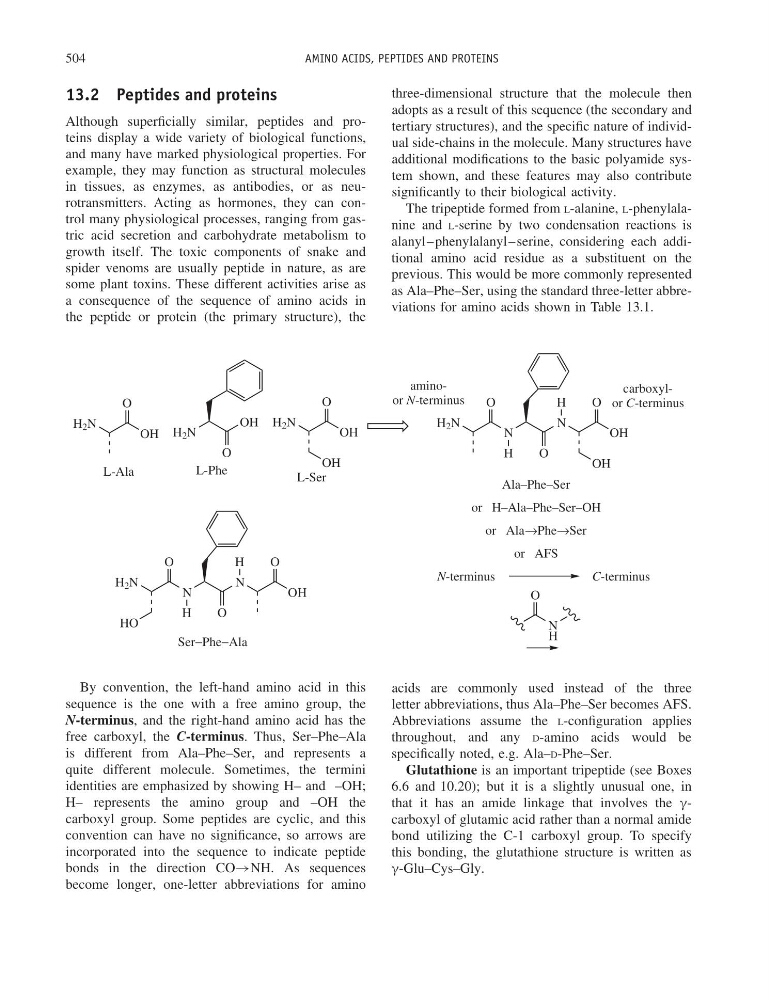
The tripeptide formed from L-alanine, L-phenylalanine and L-serine by two condensation reactions is
alanyl–phenylalanyl–serine, considering each additional amino acid residue as a substituent on the
previous. This would be more commonly represented
as Ala–Phe–Ser, using the standard three-letter abbreviations for amino acids shown in Table 13.1.
H 2 N
OH
O
H 2 N
OH
O
H 2 N
OH
O
H 2 N
N
N
OH
O
H
O
O
N
H
O
OH
OH
H
L-Ala
L-Ser
L-Phe
aminoor N-terminus
carboxylor C-terminus
Ala–Phe–Ser
or H–Ala–Phe–Ser–OH
or Ala→Phe→Ser
or AFS
N-terminus
C-terminus
Ser−Phe−Ala
H 2 N
N
N
OH
O
H
O
O
H
HO
By convention, the left-hand amino acid in this
sequence is the one with a free amino group, the
N-terminus, and the right-hand amino acid has the
free carboxyl, the C-terminus. Thus, Ser–Phe–Ala
is different from Ala–Phe–Ser, and represents a
quite different molecule. Sometimes, the termini
identities are emphasized by showing H– and –OH;
H– represents the amino group and –OH the
carboxyl group. Some peptides are cyclic, and this
convention can have no significance, so arrows are
incorporated into the sequence to indicate peptide
bonds in the direction CO→NH. As sequences
become longer, one-letter abbreviations for amino
acids are commonly used instead of the three
letter abbreviations, thus Ala–Phe–Ser becomes AFS.
Abbreviations assume the L-configuration applies
throughout, and any D-amino acids would be
specifically noted, e.g. Ala–D-Phe–Ser.
Glutathione is an important tripeptide (see Boxes
6.6 and 10.20); but it is a slightly unusual one, in
that it has an amide linkage that involves the γcarboxyl of glutamic acid rather than a normal amide
bond utilizing the C-1 carboxyl group. To specify
this bonding, the glutathione structure is written as
γ-Glu–Cys–Gly.
AMINO ACIDS, PEPTIDES AND PROTEINS
13.2 Peptides and proteins
Although superficially similar, peptides and proteins display a wide variety of biological functions,
and many have marked physiological properties. For
example, they may function as structural molecules
in tissues, as enzymes, as antibodies, or as neurotransmitters. Acting as hormones, they can control many physiological processes, ranging from gastric acid secretion and carbohydrate metabolism to
growth itself. The toxic components of snake and
spider venoms are usually peptide in nature, as are
some plant toxins. These different activities arise as
a consequence of the sequence of amino acids in
the peptide or protein (the primary structure), the
three-dimensional structure that the molecule then
adopts as a result of this sequence (the secondary and
tertiary structures), and the specific nature of individual side-chains in the molecule. Many structures have
additional modifications to the basic polyamide system shown, and these features may also contribute
significantly to their biological activity.
The tripeptide formed from L-alanine, L-phenylalanine and L-serine by two condensation reactions is
alanyl–phenylalanyl–serine, considering each additional amino acid residue as a substituent on the
previous. This would be more commonly represented
as Ala–Phe–Ser, using the standard three-letter abbreviations for amino acids shown in Table 13.1.
H 2 N
OH
O
H 2 N
OH
O
H 2 N
OH
O
H 2 N
N
N
OH
O
H
O
O
N
H
O
OH
OH
H
L-Ala
L-Ser
L-Phe
aminoor N-terminus
carboxylor C-terminus
Ala–Phe–Ser
or H–Ala–Phe–Ser–OH
or Ala→Phe→Ser
or AFS
N-terminus
C-terminus
Ser−Phe−Ala
H 2 N
N
N
OH
O
H
O
O
H
HO
By convention, the left-hand amino acid in this
sequence is the one with a free amino group, the
N-terminus, and the right-hand amino acid has the
free carboxyl, the C-terminus. Thus, Ser–Phe–Ala
is different from Ala–Phe–Ser, and represents a
quite different molecule. Sometimes, the termini
identities are emphasized by showing H– and –OH;
H– represents the amino group and –OH the
carboxyl group. Some peptides are cyclic, and this
convention can have no significance, so arrows are
incorporated into the sequence to indicate peptide
bonds in the direction CO→NH. As sequences
become longer, one-letter abbreviations for amino
acids are commonly used instead of the three
letter abbreviations, thus Ala–Phe–Ser becomes AFS.
Abbreviations assume the L-configuration applies
throughout, and any D-amino acids would be
specifically noted, e.g. Ala–D-Phe–Ser.
Glutathione is an important tripeptide (see Boxes
6.6 and 10.20); but it is a slightly unusual one, in
that it has an amide linkage that involves the γcarboxyl of glutamic acid rather than a normal amide
bond utilizing the C-1 carboxyl group. To specify
this bonding, the glutathione structure is written as
γ-Glu–Cys–Gly.