

AMINO ACIDS
503
HS
CO 2 H
NH 2
Cysteine
CO 2 H
NH 2
Tyrosine
HO
pK a 1.96
pK a 8.18
pK a 2.2
pK a 10.06
pK a 10.29
pK a 9.11
ionic form at pH 7
HS
CO 2
NH 3
CO 2
NH 3
HO
Amino acids with ionizable side-chains
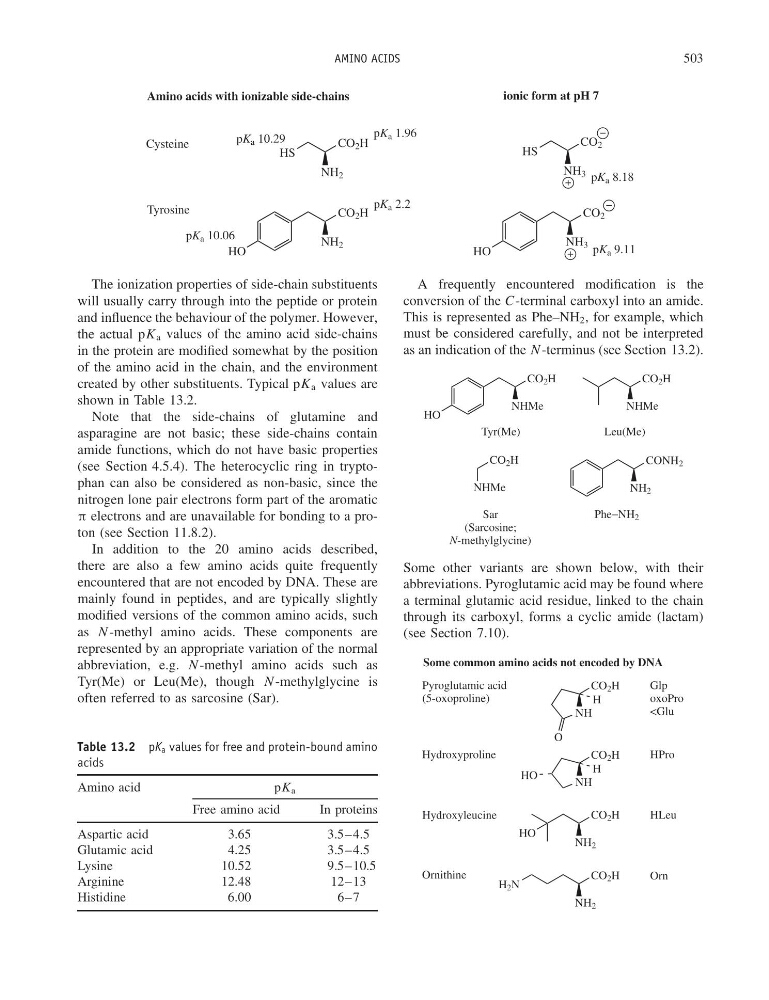
The ionization properties of side-chain substituents
will usually carry through into the peptide or protein
and influence the behaviour of the polymer. However,
the actual pK a values of the amino acid side-chains
in the protein are modified somewhat by the position
of the amino acid in the chain, and the environment
created by other substituents. Typical pK a values are
shown in Table 13.2.
Note that the side-chains of glutamine and
asparagine are not basic; these side-chains contain
amide functions, which do not have basic properties
(see Section 4.5.4). The heterocyclic ring in tryptophan can also be considered as non-basic, since the
nitrogen lone pair electrons form part of the aromatic
π electrons and are unavailable for bonding to a proton (see Section 11.8.2).
In addition to the 20 amino acids described,
there are also a few amino acids quite frequently
encountered that are not encoded by DNA. These are
mainly found in peptides, and are typically slightly
modified versions of the common amino acids, such
as N -methyl amino acids. These components are
represented by an appropriate variation of the normal
abbreviation, e.g. N -methyl amino acids such as
Tyr(Me) or Leu(Me), though N -methylglycine is
often referred to as sarcosine (Sar).
Table 13.2 pK a values for free and protein-bound amino
acids
Amino acid
pK a
Free amino acid
In proteins
Aspartic acid
3.65
3.5–4.5
Glutamic acid
4.25
3.5–4.5
Lysine
10.52
9.5–10.5
Arginine
12.48
12–13
Histidine
6.00
6–7
A frequently encountered modification is the
conversion of the C-terminal carboxyl into an amide.
This is represented as Phe–NH 2 , for example, which
must be considered carefully, and not be interpreted
as an indication of the N -terminus (see Section 13.2).
Tyr(Me)
Leu(Me)
Phe−NH 2
CO 2 H
NHMe
HO
CO 2 H
NHMe
CONH 2
NH 2
CO 2 H
NHMe
Sar
(Sarcosine;
N-methylglycine)
Some other variants are shown below, with their
abbreviations. Pyroglutamic acid may be found where
a terminal glutamic acid residue, linked to the chain
through its carboxyl, forms a cyclic amide (lactam)
(see Section 7.10).
CO 2 H
NH
H
O
CO 2 H
NH
H
HO
CO 2 H
NH 2
Pyroglutamic acid
(5-oxoproline)
H 2 N
Glp
oxoPro
HPro
Ornithine
Orn
Some common amino acids not encoded by DNA
CO 2 H
NH 2
Hydroxyleucine
HO
HLeu
503
HS
CO 2 H
NH 2
Cysteine
CO 2 H
NH 2
Tyrosine
HO
pK a 1.96
pK a 8.18
pK a 2.2
pK a 10.06
pK a 10.29
pK a 9.11
ionic form at pH 7
HS
CO 2
NH 3
CO 2
NH 3
HO
Amino acids with ionizable side-chains
The ionization properties of side-chain substituents
will usually carry through into the peptide or protein
and influence the behaviour of the polymer. However,
the actual pK a values of the amino acid side-chains
in the protein are modified somewhat by the position
of the amino acid in the chain, and the environment
created by other substituents. Typical pK a values are
shown in Table 13.2.
Note that the side-chains of glutamine and
asparagine are not basic; these side-chains contain
amide functions, which do not have basic properties
(see Section 4.5.4). The heterocyclic ring in tryptophan can also be considered as non-basic, since the
nitrogen lone pair electrons form part of the aromatic
π electrons and are unavailable for bonding to a proton (see Section 11.8.2).
In addition to the 20 amino acids described,
there are also a few amino acids quite frequently
encountered that are not encoded by DNA. These are
mainly found in peptides, and are typically slightly
modified versions of the common amino acids, such
as N -methyl amino acids. These components are
represented by an appropriate variation of the normal
abbreviation, e.g. N -methyl amino acids such as
Tyr(Me) or Leu(Me), though N -methylglycine is
often referred to as sarcosine (Sar).
Table 13.2 pK a values for free and protein-bound amino
acids
Amino acid
pK a
Free amino acid
In proteins
Aspartic acid
3.65
3.5–4.5
Glutamic acid
4.25
3.5–4.5
Lysine
10.52
9.5–10.5
Arginine
12.48
12–13
Histidine
6.00
6–7
A frequently encountered modification is the
conversion of the C-terminal carboxyl into an amide.
This is represented as Phe–NH 2 , for example, which
must be considered carefully, and not be interpreted
as an indication of the N -terminus (see Section 13.2).
Tyr(Me)
Leu(Me)
Phe−NH 2
CO 2 H
NHMe
HO
CO 2 H
NHMe
CONH 2
NH 2
CO 2 H
NHMe
Sar
(Sarcosine;
N-methylglycine)
Some other variants are shown below, with their
abbreviations. Pyroglutamic acid may be found where
a terminal glutamic acid residue, linked to the chain
through its carboxyl, forms a cyclic amide (lactam)
(see Section 7.10).
CO 2 H
NH
H
O
CO 2 H
NH
H
HO
CO 2 H
NH 2
Pyroglutamic acid
(5-oxoproline)
H 2 N
Glp
oxoPro
HPro
Ornithine
Orn
Some common amino acids not encoded by DNA
CO 2 H
NH 2
Hydroxyleucine
HO
HLeu