

502
AMINO ACIDS, PEPTIDES AND PROTEINS
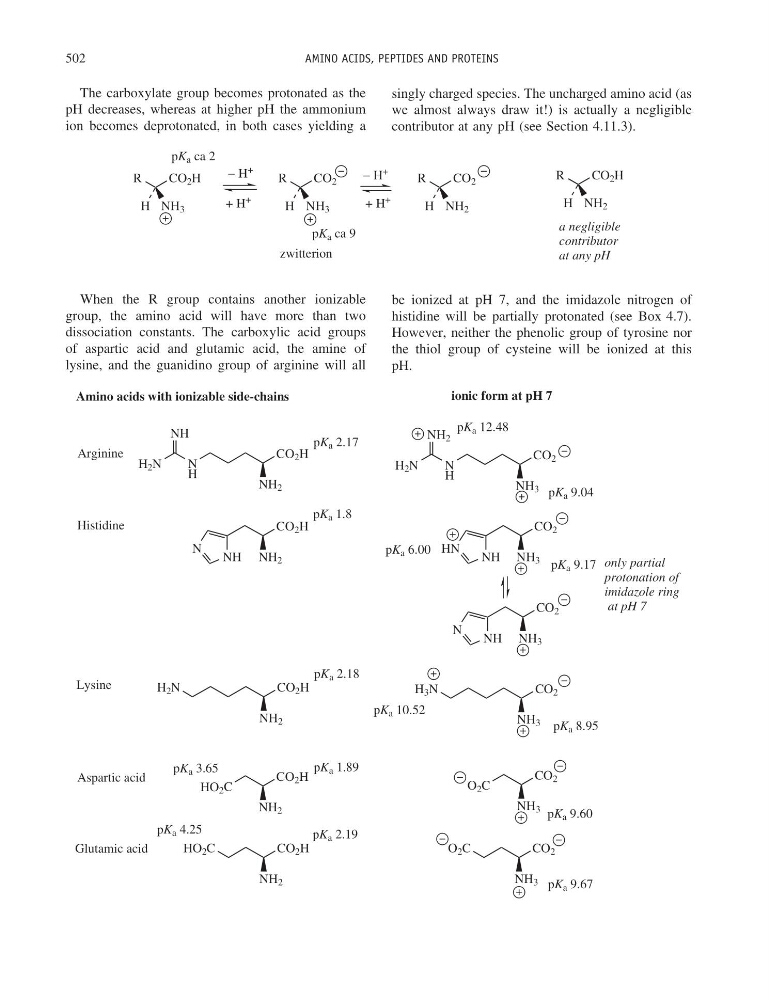
The carboxylate group becomes protonated as the
pH decreases, whereas at higher pH the ammonium
ion becomes deprotonated, in both cases yielding a
singly charged species. The uncharged amino acid (as
we almost always draw it!) is actually a negligible
contributor at any pH (see Section 4.11.3).
R
CO 2 H
H NH 3
R
CO 2
H NH 2
R
CO 2
H NH 3
− H
+
+ H
+
pK a ca 9
pK a ca 2
zwitterion
a negligible
contributor
at any pH
R
CO 2 H
H NH 2
− H
+
+ H
+
When the R group contains another ionizable
group, the amino acid will have more than two
dissociation constants. The carboxylic acid groups
of aspartic acid and glutamic acid, the amine of
lysine, and the guanidino group of arginine will all
be ionized at pH 7, and the imidazole nitrogen of
histidine will be partially protonated (see Box 4.7).
However, neither the phenolic group of tyrosine nor
the thiol group of cysteine will be ionized at this
pH.
H 2 N
N
H
CO 2 H
NH 2
NH
Arginine
HO 2 C
CO 2 H
NH 2
Aspartic acid
HO 2 C
CO 2 H
NH 2
Glutamic acid
CO 2 H
NH 2
N
NH
Histidine
CO 2 H
NH 2
H 2 N
Lysine
pK a 9.04
pK a 2.17
pK a 12.48
pK a 6.00
pK a 1.8
pK a 9.17
pK a 2.18
pK a 8.95
pK a 10.52
pK a 1.89
pK a 9.60
pK a 3.65
pK a 2.19
pK a 9.67
pK a 4.25
ionic form at pH 7
H 2 N
N
H
CO 2
NH 3
NH 2
O 2 C
CO 2
NH 3
O 2 C
CO 2
NH 3
CO 2
NH 3
HN
NH
CO 2
NH 3
H 3 N
only partial
protonation of
imidazole ring
at pH 7
CO 2
NH 3
N
NH
Amino acids with ionizable side-chains
AMINO ACIDS, PEPTIDES AND PROTEINS
The carboxylate group becomes protonated as the
pH decreases, whereas at higher pH the ammonium
ion becomes deprotonated, in both cases yielding a
singly charged species. The uncharged amino acid (as
we almost always draw it!) is actually a negligible
contributor at any pH (see Section 4.11.3).
R
CO 2 H
H NH 3
R
CO 2
H NH 2
R
CO 2
H NH 3
− H
+
+ H
+
pK a ca 9
pK a ca 2
zwitterion
a negligible
contributor
at any pH
R
CO 2 H
H NH 2
− H
+
+ H
+
When the R group contains another ionizable
group, the amino acid will have more than two
dissociation constants. The carboxylic acid groups
of aspartic acid and glutamic acid, the amine of
lysine, and the guanidino group of arginine will all
be ionized at pH 7, and the imidazole nitrogen of
histidine will be partially protonated (see Box 4.7).
However, neither the phenolic group of tyrosine nor
the thiol group of cysteine will be ionized at this
pH.
H 2 N
N
H
CO 2 H
NH 2
NH
Arginine
HO 2 C
CO 2 H
NH 2
Aspartic acid
HO 2 C
CO 2 H
NH 2
Glutamic acid
CO 2 H
NH 2
N
NH
Histidine
CO 2 H
NH 2
H 2 N
Lysine
pK a 9.04
pK a 2.17
pK a 12.48
pK a 6.00
pK a 1.8
pK a 9.17
pK a 2.18
pK a 8.95
pK a 10.52
pK a 1.89
pK a 9.60
pK a 3.65
pK a 2.19
pK a 9.67
pK a 4.25
ionic form at pH 7
H 2 N
N
H
CO 2
NH 3
NH 2
O 2 C
CO 2
NH 3
O 2 C
CO 2
NH 3
CO 2
NH 3
HN
NH
CO 2
NH 3
H 3 N
only partial
protonation of
imidazole ring
at pH 7
CO 2
NH 3
N
NH
Amino acids with ionizable side-chains