

AMINO ACIDS
501
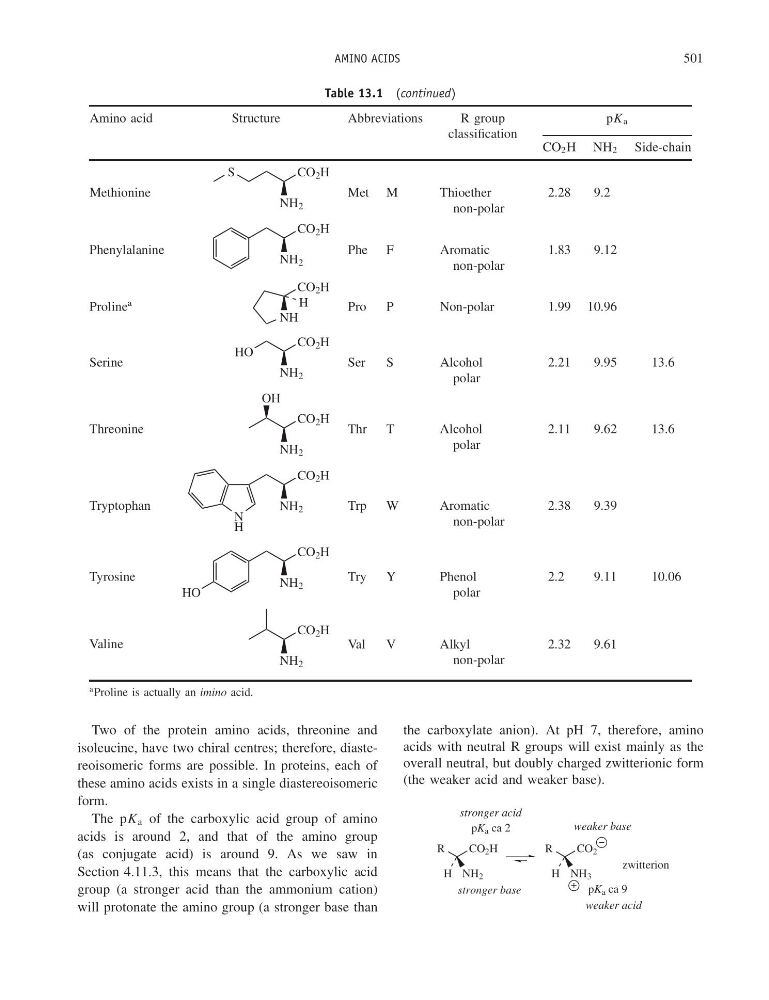
Table 13.1 (continued)
Amino acid
Structure
Abbreviations
R group
classification
pK a
CO 2 H NH 2 Side-chain
Methionine
S
CO 2 H
NH 2
Met M
Thioether
non-polar
2.28
9.2
Phenylalanine
CO 2 H
NH 2
Phe F
Aromatic
non-polar
1.83
9.12
Proline
a
CO 2 H
NH
H
Pro
P
Non-polar
1.99 10.96
Serine
HO
CO 2 H
NH 2
Ser
S
Alcohol
polar
2.21
9.95
13.6
Threonine
CO 2 H
NH 2
OH
Thr T
Alcohol
polar
2.11
9.62
13.6
Tryptophan
CO 2 H
NH 2
N
H
Trp W
Aromatic
non-polar
2.38
9.39
Tyrosine
CO 2 H
NH 2
HO
Try Y
Phenol
polar
2.2
9.11
10.06
Valine
CO 2 H
NH 2
Val
V
Alkyl
non-polar
2.32
9.61
a Proline is actually an imino acid.
Two of the protein amino acids, threonine and
isoleucine, have two chiral centres; therefore, diastereoisomeric forms are possible. In proteins, each of
these amino acids exists in a single diastereoisomeric
form.
The pK a of the carboxylic acid group of amino
acids is around 2, and that of the amino group
(as conjugate acid) is around 9. As we saw in
Section 4.11.3, this means that the carboxylic acid
group (a stronger acid than the ammonium cation)
will protonate the amino group (a stronger base than
the carboxylate anion). At pH 7, therefore, amino
acids with neutral R groups will exist mainly as the
overall neutral, but doubly charged zwitterionic form
(the weaker acid and weaker base).
R
CO 2 H
H NH 2
stronger acid
weaker acid
stronger base
weaker base
R
CO 2
H NH 3
zwitterion
pK a ca 9
pK a ca 2
501
Table 13.1 (continued)
Amino acid
Structure
Abbreviations
R group
classification
pK a
CO 2 H NH 2 Side-chain
Methionine
S
CO 2 H
NH 2
Met M
Thioether
non-polar
2.28
9.2
Phenylalanine
CO 2 H
NH 2
Phe F
Aromatic
non-polar
1.83
9.12
Proline
a
CO 2 H
NH
H
Pro
P
Non-polar
1.99 10.96
Serine
HO
CO 2 H
NH 2
Ser
S
Alcohol
polar
2.21
9.95
13.6
Threonine
CO 2 H
NH 2
OH
Thr T
Alcohol
polar
2.11
9.62
13.6
Tryptophan
CO 2 H
NH 2
N
H
Trp W
Aromatic
non-polar
2.38
9.39
Tyrosine
CO 2 H
NH 2
HO
Try Y
Phenol
polar
2.2
9.11
10.06
Valine
CO 2 H
NH 2
Val
V
Alkyl
non-polar
2.32
9.61
a Proline is actually an imino acid.
Two of the protein amino acids, threonine and
isoleucine, have two chiral centres; therefore, diastereoisomeric forms are possible. In proteins, each of
these amino acids exists in a single diastereoisomeric
form.
The pK a of the carboxylic acid group of amino
acids is around 2, and that of the amino group
(as conjugate acid) is around 9. As we saw in
Section 4.11.3, this means that the carboxylic acid
group (a stronger acid than the ammonium cation)
will protonate the amino group (a stronger base than
the carboxylate anion). At pH 7, therefore, amino
acids with neutral R groups will exist mainly as the
overall neutral, but doubly charged zwitterionic form
(the weaker acid and weaker base).
R
CO 2 H
H NH 2
stronger acid
weaker acid
stronger base
weaker base
R
CO 2
H NH 3
zwitterion
pK a ca 9
pK a ca 2