

506
AMINO ACIDS, PEPTIDES AND PROTEINS
in names, it is usual practice to differentiate them
in speech by pronouncing cysteine as sis-tay-een,
whereas cystine is pronounced sis-teen. The disulfide
bridge is easily formed, and is just as easily
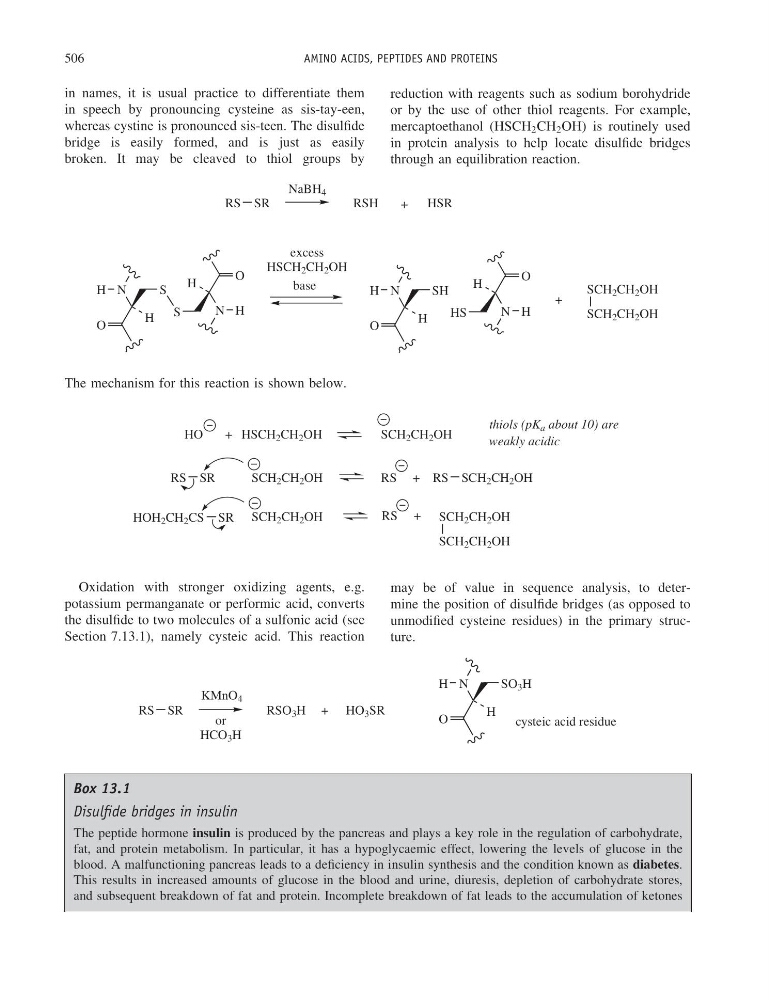
broken. It may be cleaved to thiol groups by
reduction with reagents such as sodium borohydride
or by the use of other thiol reagents. For example,
mercaptoethanol (HSCH 2 CH 2 OH) is routinely used
in protein analysis to help locate disulfide bridges
through an equilibration reaction.
N
N
H
O
O
H
H
H
S
S
N
N
H
O
O
H
H
H
SH
HS
SCH 2 CH 2 OH
SCH 2 CH 2 OH
+
excess
HSCH 2 CH 2 OH
base
RS SR
NaBH 4
RSH
HSR
+
The mechanism for this reaction is shown below.
SCH 2 CH 2 OH
RS SR
RS
RS SCH 2 CH 2 OH
+
HSCH 2 CH 2 OH
SCH 2 CH 2 OH
HO
+
thiols (pK a about 10) are
weakly acidic
SR
HOH 2 CH 2 CS
SCH 2 CH 2 OH
RS + SCH 2 CH 2 OH
SCH 2 CH 2 OH
Oxidation with stronger oxidizing agents, e.g.
potassium permanganate or performic acid, converts
the disulfide to two molecules of a sulfonic acid (see
Section 7.13.1), namely cysteic acid. This reaction
may be of value in sequence analysis, to determine the position of disulfide bridges (as opposed to
unmodified cysteine residues) in the primary structure.
RS SR
RSO 3 H
H O 3 SR
+
N
H
O
H
SO 3 H
cysteic acid residue
KMnO 4
or
HCO 3 H
Box 13.1
Disulfide bridges in insulin
The peptide hormone insulin is produced by the pancreas and plays a key role in the regulation of carbohydrate,
fat, and protein metabolism. In particular, it has a hypoglycaemic effect, lowering the levels of glucose in the
blood. A malfunctioning pancreas leads to a deficiency in insulin synthesis and the condition known as diabetes.
This results in increased amounts of glucose in the blood and urine, diuresis, depletion of carbohydrate stores,
and subsequent breakdown of fat and protein. Incomplete breakdown of fat leads to the accumulation of ketones
AMINO ACIDS, PEPTIDES AND PROTEINS
in names, it is usual practice to differentiate them
in speech by pronouncing cysteine as sis-tay-een,
whereas cystine is pronounced sis-teen. The disulfide
bridge is easily formed, and is just as easily
broken. It may be cleaved to thiol groups by
reduction with reagents such as sodium borohydride
or by the use of other thiol reagents. For example,
mercaptoethanol (HSCH 2 CH 2 OH) is routinely used
in protein analysis to help locate disulfide bridges
through an equilibration reaction.
N
N
H
O
O
H
H
H
S
S
N
N
H
O
O
H
H
H
SH
HS
SCH 2 CH 2 OH
SCH 2 CH 2 OH
+
excess
HSCH 2 CH 2 OH
base
RS SR
NaBH 4
RSH
HSR
+
The mechanism for this reaction is shown below.
SCH 2 CH 2 OH
RS SR
RS
RS SCH 2 CH 2 OH
+
HSCH 2 CH 2 OH
SCH 2 CH 2 OH
HO
+
thiols (pK a about 10) are
weakly acidic
SR
HOH 2 CH 2 CS
SCH 2 CH 2 OH
RS + SCH 2 CH 2 OH
SCH 2 CH 2 OH
Oxidation with stronger oxidizing agents, e.g.
potassium permanganate or performic acid, converts
the disulfide to two molecules of a sulfonic acid (see
Section 7.13.1), namely cysteic acid. This reaction
may be of value in sequence analysis, to determine the position of disulfide bridges (as opposed to
unmodified cysteine residues) in the primary structure.
RS SR
RSO 3 H
H O 3 SR
+
N
H
O
H
SO 3 H
cysteic acid residue
KMnO 4
or
HCO 3 H
Box 13.1
Disulfide bridges in insulin
The peptide hormone insulin is produced by the pancreas and plays a key role in the regulation of carbohydrate,
fat, and protein metabolism. In particular, it has a hypoglycaemic effect, lowering the levels of glucose in the
blood. A malfunctioning pancreas leads to a deficiency in insulin synthesis and the condition known as diabetes.
This results in increased amounts of glucose in the blood and urine, diuresis, depletion of carbohydrate stores,
and subsequent breakdown of fat and protein. Incomplete breakdown of fat leads to the accumulation of ketones