

POLYMERS CONTAINING AMINOSUGARS
495
12.10 Polymers containing
aminosugars
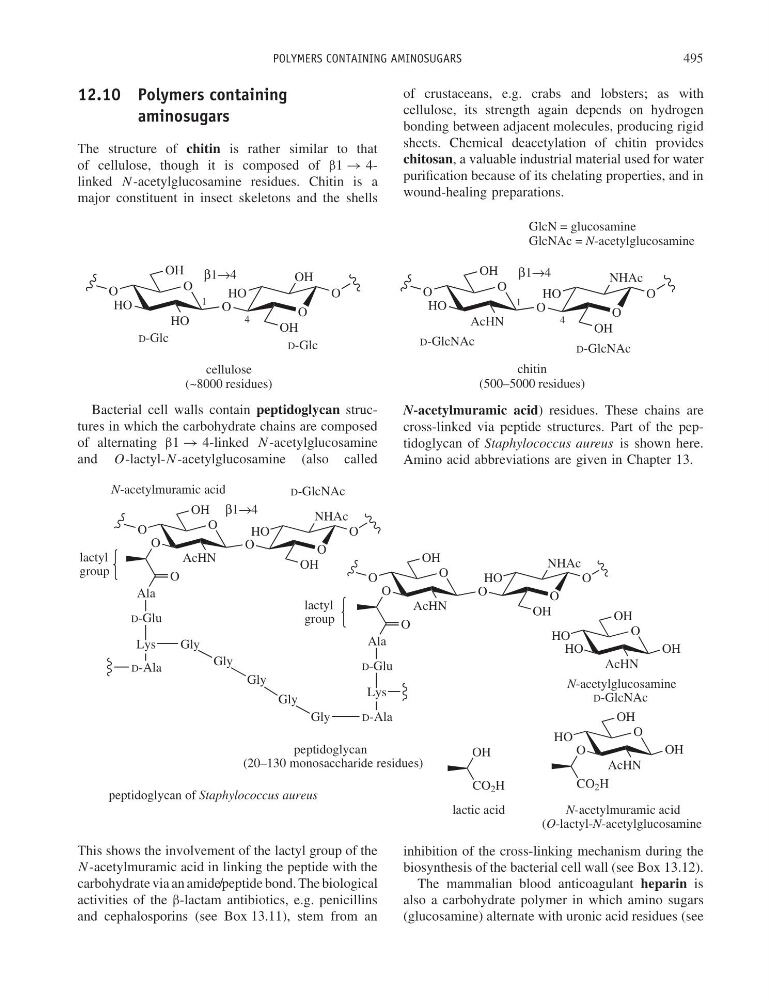
The structure of chitin is rather similar to that
of cellulose, though it is composed of β1 → 4linked N -acetylglucosamine residues. Chitin is a
major constituent in insect skeletons and the shells
of crustaceans, e.g. crabs and lobsters; as with
cellulose, its strength again depends on hydrogen
bonding between adjacent molecules, producing rigid
sheets. Chemical deacetylation of chitin provides
chitosan, a valuable industrial material used for water
purification because of its chelating properties, and in
wound-healing preparations.
O
HO
OH
HO
O
O
HO
OH
OH
O
O
O
HO
OH
AcHN
O
O
HO
OH
NHAc
O
O
1
1
4
chitin
(500–5000 residues)
4
cellulose
(~8000 residues)
β1→4
D-Glc
D-Glc
β1→4
D-GlcNAc
D-GlcNAc
GlcN = glucosamine
GlcNAc = N-acetylglucosamine
Bacterial cell walls contain peptidoglycan structures in which the carbohydrate chains are composed
of alternating β1 → 4-linked N -acetylglucosamine
and O-lactyl-N -acetylglucosamine (also called
N-acetylmuramic acid) residues. These chains are
cross-linked via peptide structures. Part of the peptidoglycan of Staphylococcus aureus is shown here.
Amino acid abbreviations are given in Chapter 13.
O
O
OH
AcHN
O
O
HO
OH
NHAc
O
O
O
Ala
D-Glu
Lys
D-Ala
Gly
O
O
OH
AcHN
O
O
HO
OH
NHAc
O
O
O
Ala
D-Glu
Lys
Gly
Gly
Gly
Gly
D-Ala
peptidoglycan
(20–130 monosaccharide residues)
β1→4
N-acetylmuramic acid
(O-lactyl-N-acetylglucosamine
N-acetylglucosamine
D-GlcNAc
O
OH
AcHN
OH
HO
O
CO 2 H
D-GlcNAc
N-acetylmuramic acid
OH
CO 2 H
lactic acid
O
OH
AcHN
OH
HO
HO
lactyl
group
lactyl
group
peptidoglycan of Staphylococcus aureus
This shows the involvement of the lactyl group of the
N -acetylmuramic acid in linking the peptide with the
carbohydrate via an amide/peptide bond. The biological
activities of the β-lactam antibiotics, e.g. penicillins
and cephalosporins (see Box 13.11), stem from an
inhibition of the cross-linking mechanism during the
biosynthesis of the bacterial cell wall (see Box 13.12).
The mammalian blood anticoagulant heparin is
also a carbohydrate polymer in which amino sugars
(glucosamine) alternate with uronic acid residues (see
495
12.10 Polymers containing
aminosugars
The structure of chitin is rather similar to that
of cellulose, though it is composed of β1 → 4linked N -acetylglucosamine residues. Chitin is a
major constituent in insect skeletons and the shells
of crustaceans, e.g. crabs and lobsters; as with
cellulose, its strength again depends on hydrogen
bonding between adjacent molecules, producing rigid
sheets. Chemical deacetylation of chitin provides
chitosan, a valuable industrial material used for water
purification because of its chelating properties, and in
wound-healing preparations.
O
HO
OH
HO
O
O
HO
OH
OH
O
O
O
HO
OH
AcHN
O
O
HO
OH
NHAc
O
O
1
1
4
chitin
(500–5000 residues)
4
cellulose
(~8000 residues)
β1→4
D-Glc
D-Glc
β1→4
D-GlcNAc
D-GlcNAc
GlcN = glucosamine
GlcNAc = N-acetylglucosamine
Bacterial cell walls contain peptidoglycan structures in which the carbohydrate chains are composed
of alternating β1 → 4-linked N -acetylglucosamine
and O-lactyl-N -acetylglucosamine (also called
N-acetylmuramic acid) residues. These chains are
cross-linked via peptide structures. Part of the peptidoglycan of Staphylococcus aureus is shown here.
Amino acid abbreviations are given in Chapter 13.
O
O
OH
AcHN
O
O
HO
OH
NHAc
O
O
O
Ala
D-Glu
Lys
D-Ala
Gly
O
O
OH
AcHN
O
O
HO
OH
NHAc
O
O
O
Ala
D-Glu
Lys
Gly
Gly
Gly
Gly
D-Ala
peptidoglycan
(20–130 monosaccharide residues)
β1→4
N-acetylmuramic acid
(O-lactyl-N-acetylglucosamine
N-acetylglucosamine
D-GlcNAc
O
OH
AcHN
OH
HO
O
CO 2 H
D-GlcNAc
N-acetylmuramic acid
OH
CO 2 H
lactic acid
O
OH
AcHN
OH
HO
HO
lactyl
group
lactyl
group
peptidoglycan of Staphylococcus aureus
This shows the involvement of the lactyl group of the
N -acetylmuramic acid in linking the peptide with the
carbohydrate via an amide/peptide bond. The biological
activities of the β-lactam antibiotics, e.g. penicillins
and cephalosporins (see Box 13.11), stem from an
inhibition of the cross-linking mechanism during the
biosynthesis of the bacterial cell wall (see Box 13.12).
The mammalian blood anticoagulant heparin is
also a carbohydrate polymer in which amino sugars
(glucosamine) alternate with uronic acid residues (see