

496
CARBOHYDRATES
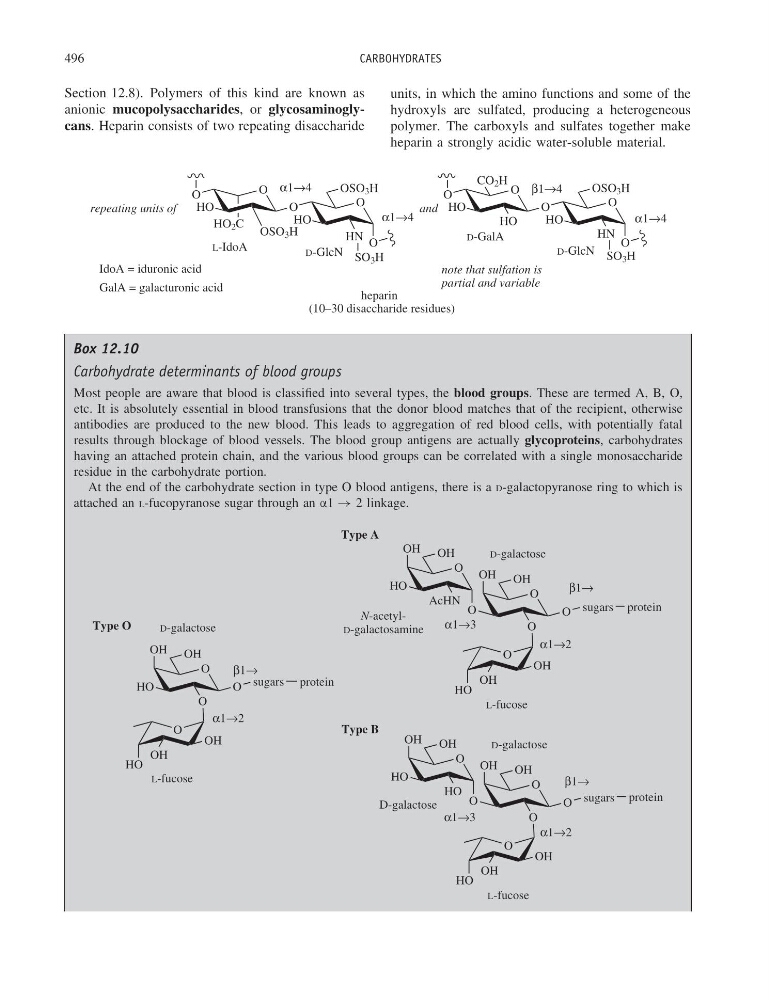
Section 12.8). Polymers of this kind are known as
anionic mucopolysaccharides, or glycosaminoglycans. Heparin consists of two repeating disaccharide
units, in which the amino functions and some of the
hydroxyls are sulfated, producing a heterogeneous
polymer. The carboxyls and sulfates together make
heparin a strongly acidic water-soluble material.
O
HO
OSO 3 H
O
O
HO
OSO 3 H
HN
O
HO
CO 2 H
HO
O
O
HO
OSO 3 H
HN
O
O
SO 3 H
HO 2 C
O
O
SO 3 H
repeating units of
and
β1→4
α1→4
heparin
(10–30 disaccharide residues)
note that sulfation is
partial and variable
α1→4
α1→4
L-IdoA
IdoA = iduronic acid
D-GlcN
D-GalA
D-GlcN
GalA = galacturonic acid
Box 12.10
Carbohydrate determinants of blood groups
Most people are aware that blood is classified into several types, the blood groups. These are termed A, B, O,
etc. It is absolutely essential in blood transfusions that the donor blood matches that of the recipient, otherwise
antibodies are produced to the new blood. This leads to aggregation of red blood cells, with potentially fatal
results through blockage of blood vessels. The blood group antigens are actually glycoproteins, carbohydrates
having an attached protein chain, and the various blood groups can be correlated with a single monosaccharide
residue in the carbohydrate portion.
At the end of the carbohydrate section in type O blood antigens, there is a D-galactopyranose ring to which is
attached an L-fucopyranose sugar through an α1 → 2 linkage.
O
OH
HO
L-fucose
O
HO
OH
O
O
OH
D-galactose
OH
Type O
Type B
O
OH
HO
L-fucose
O
OH
O
OH
D-galactose
OH
O
HO
OH
HO
OH
D-galactose
O
α1→3
α1→2
α1→2
sugars
β1→
β1→
protein
O sugars protein
Type A
N-acetylD-galactosamine
O
OH
HO
L-fucose
O
OH
O
OH
D-galactose
OH
O
HO
OH
AcHN
OH
O
α1→3
α1→2
β1→
O sugars protein
CARBOHYDRATES
Section 12.8). Polymers of this kind are known as
anionic mucopolysaccharides, or glycosaminoglycans. Heparin consists of two repeating disaccharide
units, in which the amino functions and some of the
hydroxyls are sulfated, producing a heterogeneous
polymer. The carboxyls and sulfates together make
heparin a strongly acidic water-soluble material.
O
HO
OSO 3 H
O
O
HO
OSO 3 H
HN
O
HO
CO 2 H
HO
O
O
HO
OSO 3 H
HN
O
O
SO 3 H
HO 2 C
O
O
SO 3 H
repeating units of
and
β1→4
α1→4
heparin
(10–30 disaccharide residues)
note that sulfation is
partial and variable
α1→4
α1→4
L-IdoA
IdoA = iduronic acid
D-GlcN
D-GalA
D-GlcN
GalA = galacturonic acid
Box 12.10
Carbohydrate determinants of blood groups
Most people are aware that blood is classified into several types, the blood groups. These are termed A, B, O,
etc. It is absolutely essential in blood transfusions that the donor blood matches that of the recipient, otherwise
antibodies are produced to the new blood. This leads to aggregation of red blood cells, with potentially fatal
results through blockage of blood vessels. The blood group antigens are actually glycoproteins, carbohydrates
having an attached protein chain, and the various blood groups can be correlated with a single monosaccharide
residue in the carbohydrate portion.
At the end of the carbohydrate section in type O blood antigens, there is a D-galactopyranose ring to which is
attached an L-fucopyranose sugar through an α1 → 2 linkage.
O
OH
HO
L-fucose
O
HO
OH
O
O
OH
D-galactose
OH
Type O
Type B
O
OH
HO
L-fucose
O
OH
O
OH
D-galactose
OH
O
HO
OH
HO
OH
D-galactose
O
α1→3
α1→2
α1→2
sugars
β1→
β1→
protein
O sugars protein
Type A
N-acetylD-galactosamine
O
OH
HO
L-fucose
O
OH
O
OH
D-galactose
OH
O
HO
OH
AcHN
OH
O
α1→3
α1→2
β1→
O sugars protein