

494
CARBOHYDRATES
Box 12.9 (continued)
H 2 N
HO
NH 2
O
Me
MeHN
OH
HO
O
O
O
H 2 N
NHMe
Me
L-garosamine
2-deoxystreptamine
D-purpurosamine
1
2
3
4
5
6
2′
2″
4′
3′
5″
6′
4″
3″
5′
1″
1′
gentamicin C 1
H 2 N
HO
NH 2
HO
OH
1
2
3
4
5
6
NH 2
OH
OH
H 2 N
1
2
3
4
5
6
2-deoxystreptamine
HO
≡
120º
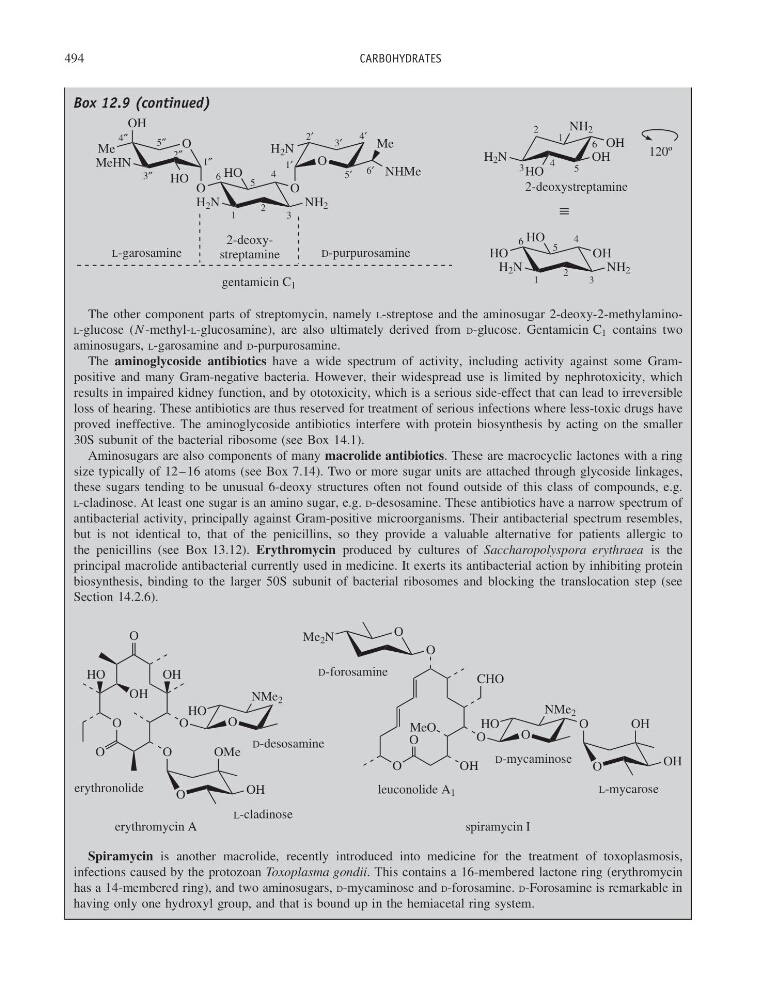
The other component parts of streptomycin, namely L-streptose and the aminosugar 2-deoxy-2-methylaminoL-glucose (N-methyl-L-glucosamine), are also ultimately derived from D-glucose. Gentamicin C 1 contains two
aminosugars, L-garosamine and D-purpurosamine.
The aminoglycoside antibiotics have a wide spectrum of activity, including activity against some Grampositive and many Gram-negative bacteria. However, their widespread use is limited by nephrotoxicity, which
results in impaired kidney function, and by ototoxicity, which is a serious side-effect that can lead to irreversible
loss of hearing. These antibiotics are thus reserved for treatment of serious infections where less-toxic drugs have
proved ineffective. The aminoglycoside antibiotics interfere with protein biosynthesis by acting on the smaller
30S subunit of the bacterial ribosome (see Box 14.1).
Aminosugars are also components of many macrolide antibiotics. These are macrocyclic lactones with a ring
size typically of 12–16 atoms (see Box 7.14). Two or more sugar units are attached through glycoside linkages,
these sugars tending to be unusual 6-deoxy structures often not found outside of this class of compounds, e.g.
L-cladinose. At least one sugar is an amino sugar, e.g. D-desosamine. These antibiotics have a narrow spectrum of
antibacterial activity, principally against Gram-positive microorganisms. Their antibacterial spectrum resembles,
but is not identical to, that of the penicillins, so they provide a valuable alternative for patients allergic to
the penicillins (see Box 13.12). Erythromycin produced by cultures of Saccharopolyspora erythraea is the
principal macrolide antibacterial currently used in medicine. It exerts its antibacterial action by inhibiting protein
biosynthesis, binding to the larger 50S subunit of bacterial ribosomes and blocking the translocation step (see
Section 14.2.6).
OH
O
O
O
HO
OH
O
O
NMe 2
HO
O
O
OMe
OH
erythronolide
D-desosamine
L-cladinose
erythromycin A
O
MeO
O
OH
CHO
O
O
O
Me 2 N
O
HO
O
NMe 2
O
OH
OH
D-forosamine
D-mycaminose
L-mycarose
spiramycin I
leuconolide A 1
Spiramycin is another macrolide, recently introduced into medicine for the treatment of toxoplasmosis,
infections caused by the protozoan Toxoplasma gondii. This contains a 16-membered lactone ring (erythromycin
has a 14-membered ring), and two aminosugars, D-mycaminose and D-forosamine. D-Forosamine is remarkable in
having only one hydroxyl group, and that is bound up in the hemiacetal ring system.
CARBOHYDRATES
Box 12.9 (continued)
H 2 N
HO
NH 2
O
Me
MeHN
OH
HO
O
O
O
H 2 N
NHMe
Me
L-garosamine
2-deoxystreptamine
D-purpurosamine
1
2
3
4
5
6
2′
2″
4′
3′
5″
6′
4″
3″
5′
1″
1′
gentamicin C 1
H 2 N
HO
NH 2
HO
OH
1
2
3
4
5
6
NH 2
OH
OH
H 2 N
1
2
3
4
5
6
2-deoxystreptamine
HO
≡
120º
The other component parts of streptomycin, namely L-streptose and the aminosugar 2-deoxy-2-methylaminoL-glucose (N-methyl-L-glucosamine), are also ultimately derived from D-glucose. Gentamicin C 1 contains two
aminosugars, L-garosamine and D-purpurosamine.
The aminoglycoside antibiotics have a wide spectrum of activity, including activity against some Grampositive and many Gram-negative bacteria. However, their widespread use is limited by nephrotoxicity, which
results in impaired kidney function, and by ototoxicity, which is a serious side-effect that can lead to irreversible
loss of hearing. These antibiotics are thus reserved for treatment of serious infections where less-toxic drugs have
proved ineffective. The aminoglycoside antibiotics interfere with protein biosynthesis by acting on the smaller
30S subunit of the bacterial ribosome (see Box 14.1).
Aminosugars are also components of many macrolide antibiotics. These are macrocyclic lactones with a ring
size typically of 12–16 atoms (see Box 7.14). Two or more sugar units are attached through glycoside linkages,
these sugars tending to be unusual 6-deoxy structures often not found outside of this class of compounds, e.g.
L-cladinose. At least one sugar is an amino sugar, e.g. D-desosamine. These antibiotics have a narrow spectrum of
antibacterial activity, principally against Gram-positive microorganisms. Their antibacterial spectrum resembles,
but is not identical to, that of the penicillins, so they provide a valuable alternative for patients allergic to
the penicillins (see Box 13.12). Erythromycin produced by cultures of Saccharopolyspora erythraea is the
principal macrolide antibacterial currently used in medicine. It exerts its antibacterial action by inhibiting protein
biosynthesis, binding to the larger 50S subunit of bacterial ribosomes and blocking the translocation step (see
Section 14.2.6).
OH
O
O
O
HO
OH
O
O
NMe 2
HO
O
O
OMe
OH
erythronolide
D-desosamine
L-cladinose
erythromycin A
O
MeO
O
OH
CHO
O
O
O
Me 2 N
O
HO
O
NMe 2
O
OH
OH
D-forosamine
D-mycaminose
L-mycarose
spiramycin I
leuconolide A 1
Spiramycin is another macrolide, recently introduced into medicine for the treatment of toxoplasmosis,
infections caused by the protozoan Toxoplasma gondii. This contains a 16-membered lactone ring (erythromycin
has a 14-membered ring), and two aminosugars, D-mycaminose and D-forosamine. D-Forosamine is remarkable in
having only one hydroxyl group, and that is bound up in the hemiacetal ring system.