

AMINOSUGARS
493
HO
H
H
OH
H
OH
CH 2 OH
H
NH 2
CN
HO
H
H
OH
H
OH
CH 2 OH
H 2 N
H
CN
+
H
+
HO
H
H
OH
H
OH
CH 2 OH
H
NH 2
CO 2 H
HO
H
H
OH
H
OH
CH 2 OH
H 2 N
H
CO 2 H
+
nucleophilic addition of cyanide to
either face of intermediate imine
produces epimeric cyanohydrins
hydrolysis of nitrile group
yields carboxylic acid
heat
O
HO
NH 2
O
HO
formation of
γ-lactone
O
O
NH 2
HOH 2 C
HOH 2 C
OH
OH
+
Na−Hg
HO
H
H
OH
H
OH
CH 2 OH
H
NH 2
CHO
HO
H
H
OH
H
OH
CH 2 OH
H 2 N
H
CHO
+
D-glucosamine
D-mannosamine
HO
H
H
OH
H
OH
CH 2 OH
NH
HO
H
H
OH
H
OH
CH 2 OH
D-arabinose
CHO
NH 3
HCN
lactone
reduction
Box 12.9
Aminosugars and aminoglycoside antibiotics
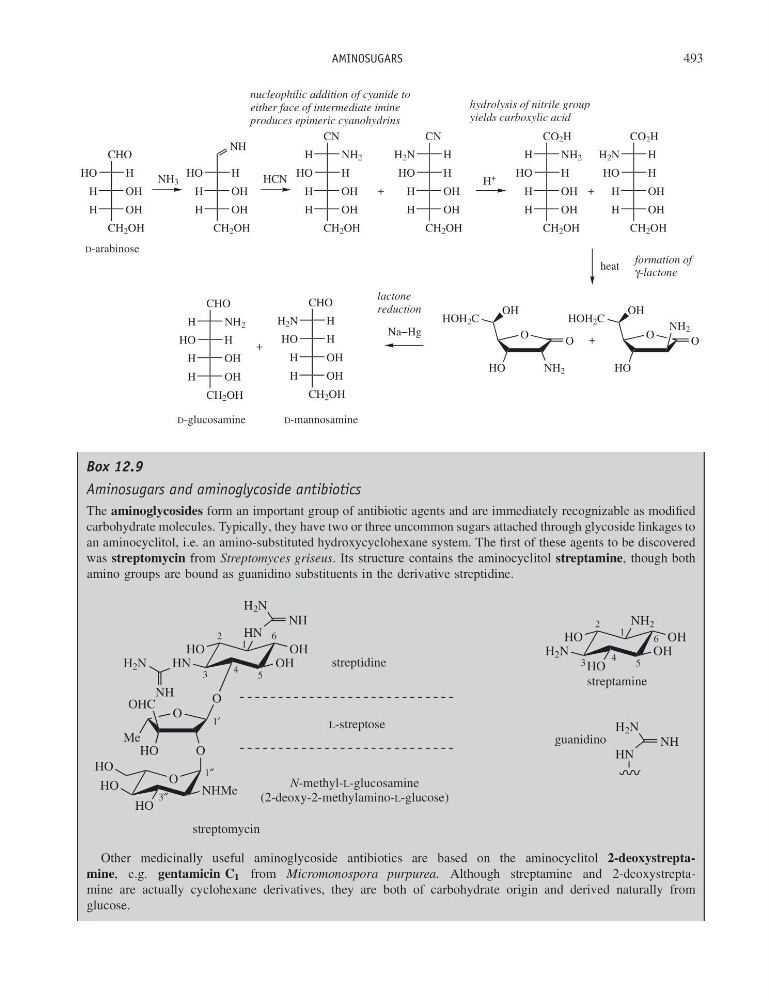
The aminoglycosides form an important group of antibiotic agents and are immediately recognizable as modified
carbohydrate molecules. Typically, they have two or three uncommon sugars attached through glycoside linkages to
an aminocyclitol, i.e. an amino-substituted hydroxycyclohexane system. The first of these agents to be discovered
was streptomycin from Streptomyces griseus. Its structure contains the aminocyclitol streptamine, though both
amino groups are bound as guanidino substituents in the derivative streptidine.
HN
OH
OH
HN
HO
H 2 N
NH
NH
H 2 N
O
O
Me
OHC
HO
O
NHMe
O
HO
HO
HO
streptidine
L-streptose
N-methyl-L-glucosamine
(2-deoxy-2-methylamino-L-glucose)
streptomycin
1
2
3
4
5
6
1″
1′
3″
HN
NH
H 2 N
guanidino
NH 2
OH
OH
H 2 N
HO
1
2
3
4
5
6
streptamine
HO
Other medicinally useful aminoglycoside antibiotics are based on the aminocyclitol 2-deoxystreptamine, e.g. gentamicin C 1 from Micromonospora purpurea. Although streptamine and 2-deoxystreptamine are actually cyclohexane derivatives, they are both of carbohydrate origin and derived naturally from
glucose.
493
HO
H
H
OH
H
OH
CH 2 OH
H
NH 2
CN
HO
H
H
OH
H
OH
CH 2 OH
H 2 N
H
CN
+
H
+
HO
H
H
OH
H
OH
CH 2 OH
H
NH 2
CO 2 H
HO
H
H
OH
H
OH
CH 2 OH
H 2 N
H
CO 2 H
+
nucleophilic addition of cyanide to
either face of intermediate imine
produces epimeric cyanohydrins
hydrolysis of nitrile group
yields carboxylic acid
heat
O
HO
NH 2
O
HO
formation of
γ-lactone
O
O
NH 2
HOH 2 C
HOH 2 C
OH
OH
+
Na−Hg
HO
H
H
OH
H
OH
CH 2 OH
H
NH 2
CHO
HO
H
H
OH
H
OH
CH 2 OH
H 2 N
H
CHO
+
D-glucosamine
D-mannosamine
HO
H
H
OH
H
OH
CH 2 OH
NH
HO
H
H
OH
H
OH
CH 2 OH
D-arabinose
CHO
NH 3
HCN
lactone
reduction
Box 12.9
Aminosugars and aminoglycoside antibiotics
The aminoglycosides form an important group of antibiotic agents and are immediately recognizable as modified
carbohydrate molecules. Typically, they have two or three uncommon sugars attached through glycoside linkages to
an aminocyclitol, i.e. an amino-substituted hydroxycyclohexane system. The first of these agents to be discovered
was streptomycin from Streptomyces griseus. Its structure contains the aminocyclitol streptamine, though both
amino groups are bound as guanidino substituents in the derivative streptidine.
HN
OH
OH
HN
HO
H 2 N
NH
NH
H 2 N
O
O
Me
OHC
HO
O
NHMe
O
HO
HO
HO
streptidine
L-streptose
N-methyl-L-glucosamine
(2-deoxy-2-methylamino-L-glucose)
streptomycin
1
2
3
4
5
6
1″
1′
3″
HN
NH
H 2 N
guanidino
NH 2
OH
OH
H 2 N
HO
1
2
3
4
5
6
streptamine
HO
Other medicinally useful aminoglycoside antibiotics are based on the aminocyclitol 2-deoxystreptamine, e.g. gentamicin C 1 from Micromonospora purpurea. Although streptamine and 2-deoxystreptamine are actually cyclohexane derivatives, they are both of carbohydrate origin and derived naturally from
glucose.