

492
CARBOHYDRATES
12.9 Aminosugars
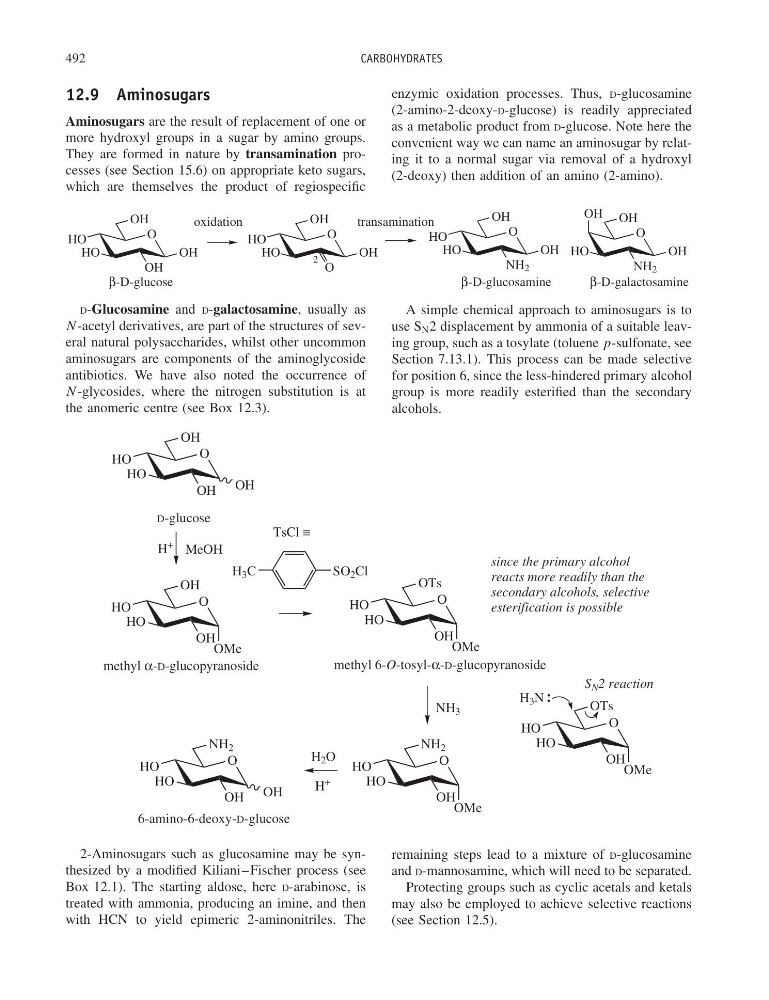
Aminosugars are the result of replacement of one or
more hydroxyl groups in a sugar by amino groups.
They are formed in nature by transamination processes (see Section 15.6) on appropriate keto sugars,
which are themselves the product of regiospecific
enzymic oxidation processes. Thus, D-glucosamine
(2-amino-2-deoxy-D-glucose) is readily appreciated
as a metabolic product from D-glucose. Note here the
convenient way we can name an aminosugar by relating it to a normal sugar via removal of a hydroxyl
(2-deoxy) then addition of an amino (2-amino).
O
HO
OH
NH 2
OH
OH
O
HO
HO
OH
OH
OH
O
HO
HO
OH
O
OH
O
HO
HO
OH
NH 2
OH
transamination
β-D-glucose
β-D-galactosamine
β-D-glucosamine
oxidation
2
D-Glucosamine and D-galactosamine, usually as
N -acetyl derivatives, are part of the structures of several natural polysaccharides, whilst other uncommon
aminosugars are components of the aminoglycoside
antibiotics. We have also noted the occurrence of
N -glycosides, where the nitrogen substitution is at
the anomeric centre (see Box 12.3).
A simple chemical approach to aminosugars is to
use S N 2 displacement by ammonia of a suitable leaving group, such as a tosylate (toluene p-sulfonate, see
Section 7.13.1). This process can be made selective
for position 6, since the less-hindered primary alcohol
group is more readily esterified than the secondary
alcohols.
O
HO
HO
OH
OH
O
HO
HO
OH
OH
OMe
O
HO
HO
OTs
OH
OMe
H 3 C
SO 2 Cl
TsCl ≡
since the primary alcohol
reacts more readily than the
secondary alcohols, selective
esterification is possible
methyl α-D-glucopyranoside
MeOH
H +
D-glucose
methyl 6-O-tosyl-α-D-glucopyranoside
NH 3
O
HO
HO
NH 2
OH
OMe
O
HO
HO
OTs
OH
OMe
H 3 N
S N 2 reaction
H
+
H 2 O
O
HO
HO
NH 2
OH OH
6-amino-6-deoxy-D-glucose
OH
2-Aminosugars such as glucosamine may be synthesized by a modified Kiliani–Fischer process (see
Box 12.1). The starting aldose, here D-arabinose, is
treated with ammonia, producing an imine, and then
with HCN to yield epimeric 2-aminonitriles. The
remaining steps lead to a mixture of D-glucosamine
and D-mannosamine, which will need to be separated.
Protecting groups such as cyclic acetals and ketals
may also be employed to achieve selective reactions
(see Section 12.5).
CARBOHYDRATES
12.9 Aminosugars
Aminosugars are the result of replacement of one or
more hydroxyl groups in a sugar by amino groups.
They are formed in nature by transamination processes (see Section 15.6) on appropriate keto sugars,
which are themselves the product of regiospecific
enzymic oxidation processes. Thus, D-glucosamine
(2-amino-2-deoxy-D-glucose) is readily appreciated
as a metabolic product from D-glucose. Note here the
convenient way we can name an aminosugar by relating it to a normal sugar via removal of a hydroxyl
(2-deoxy) then addition of an amino (2-amino).
O
HO
OH
NH 2
OH
OH
O
HO
HO
OH
OH
OH
O
HO
HO
OH
O
OH
O
HO
HO
OH
NH 2
OH
transamination
β-D-glucose
β-D-galactosamine
β-D-glucosamine
oxidation
2
D-Glucosamine and D-galactosamine, usually as
N -acetyl derivatives, are part of the structures of several natural polysaccharides, whilst other uncommon
aminosugars are components of the aminoglycoside
antibiotics. We have also noted the occurrence of
N -glycosides, where the nitrogen substitution is at
the anomeric centre (see Box 12.3).
A simple chemical approach to aminosugars is to
use S N 2 displacement by ammonia of a suitable leaving group, such as a tosylate (toluene p-sulfonate, see
Section 7.13.1). This process can be made selective
for position 6, since the less-hindered primary alcohol
group is more readily esterified than the secondary
alcohols.
O
HO
HO
OH
OH
O
HO
HO
OH
OH
OMe
O
HO
HO
OTs
OH
OMe
H 3 C
SO 2 Cl
TsCl ≡
since the primary alcohol
reacts more readily than the
secondary alcohols, selective
esterification is possible
methyl α-D-glucopyranoside
MeOH
H +
D-glucose
methyl 6-O-tosyl-α-D-glucopyranoside
NH 3
O
HO
HO
NH 2
OH
OMe
O
HO
HO
OTs
OH
OMe
H 3 N
S N 2 reaction
H
+
H 2 O
O
HO
HO
NH 2
OH OH
6-amino-6-deoxy-D-glucose
OH
2-Aminosugars such as glucosamine may be synthesized by a modified Kiliani–Fischer process (see
Box 12.1). The starting aldose, here D-arabinose, is
treated with ammonia, producing an imine, and then
with HCN to yield epimeric 2-aminonitriles. The
remaining steps lead to a mixture of D-glucosamine
and D-mannosamine, which will need to be separated.
Protecting groups such as cyclic acetals and ketals
may also be employed to achieve selective reactions
(see Section 12.5).