

OXIDATION OF SUGARS: URONIC ACIDS
491
O
HO
HO
OH
OH
OH
O
HO 2 C
HO
HO
OH
OH
OH
HO 2 C
HO
HO
OH OH
D-glucose
D-glucuronic acid
L-gulonic acid
CH 2 OH
OH
H
H
HO
OH
H
OH
H
CO 2 H
reduction of open-chain aldehyde
form to primary alcohol
lactone formation between
carboxyl and 4-hydroxyl (note
that gulonic acid is numbered
differently from glucuronic acid)
oxidation of primary
alcohol to acid
1
4
1
4
O
O
OH
OH
O
O
OH
O
O
O
OH
HO
L-gulonolactone
2-oxogulonolactone
oxidation
L-ascorbic acid
(vitamin C)
enolization
HO
OH
H
HO
OH
H
HO
OH
H
NAD +
NADH
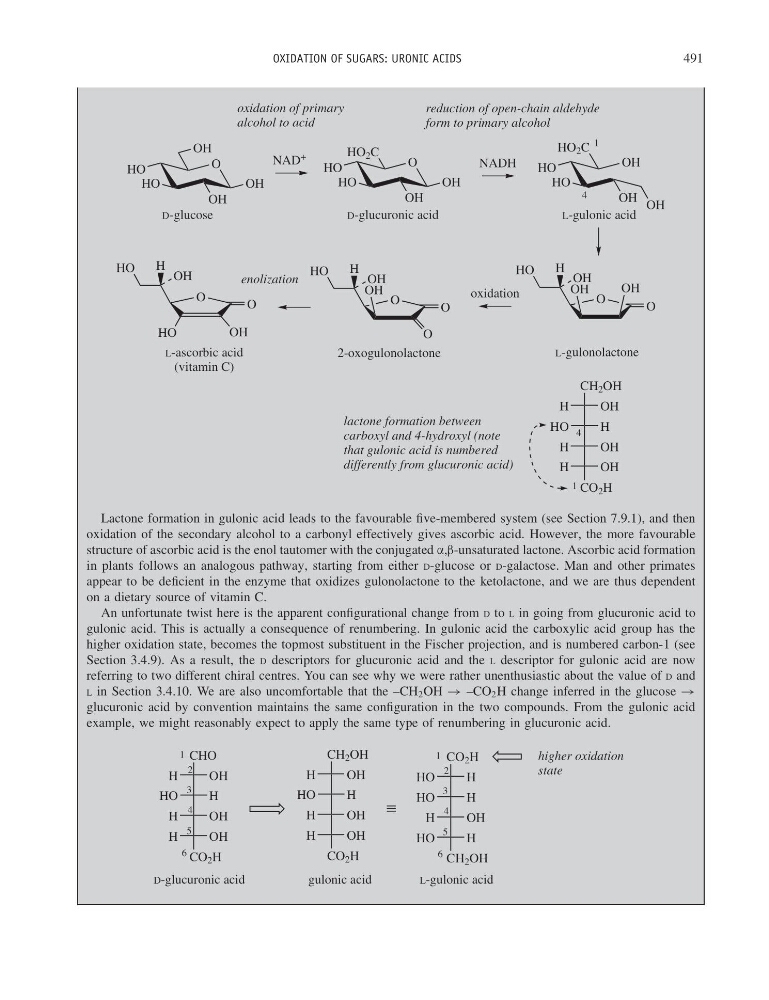
Lactone formation in gulonic acid leads to the favourable five-membered system (see Section 7.9.1), and then
oxidation of the secondary alcohol to a carbonyl effectively gives ascorbic acid. However, the more favourable
structure of ascorbic acid is the enol tautomer with the conjugated α,β-unsaturated lactone. Ascorbic acid formation
in plants follows an analogous pathway, starting from either D-glucose or D-galactose. Man and other primates
appear to be deficient in the enzyme that oxidizes gulonolactone to the ketolactone, and we are thus dependent
on a dietary source of vitamin C.
An unfortunate twist here is the apparent configurational change from D to L in going from glucuronic acid to
gulonic acid. This is actually a consequence of renumbering. In gulonic acid the carboxylic acid group has the
higher oxidation state, becomes the topmost substituent in the Fischer projection, and is numbered carbon-1 (see
Section 3.4.9). As a result, the D descriptors for glucuronic acid and the L descriptor for gulonic acid are now
referring to two different chiral centres. You can see why we were rather unenthusiastic about the value of D and
L in Section 3.4.10. We are also uncomfortable that the –CH 2 OH → –CO 2 H change inferred in the glucose →
glucuronic acid by convention maintains the same configuration in the two compounds. From the gulonic acid
example, we might reasonably expect to apply the same type of renumbering in glucuronic acid.
HO
H
H
OH
H
OH
CO 2 H
H
OH
CHO
D-glucuronic acid
1
2
3
4
5
6
HO
H
H
OH
H
OH
CO 2 H
H
OH
CH 2 OH
gulonic acid
OH
H
H
HO
H
HO
CO 2 H
H
HO
CH 2 OH
L-gulonic acid
1
2
3
4
5
6
≡
higher oxidation
state
491
O
HO
HO
OH
OH
OH
O
HO 2 C
HO
HO
OH
OH
OH
HO 2 C
HO
HO
OH OH
D-glucose
D-glucuronic acid
L-gulonic acid
CH 2 OH
OH
H
H
HO
OH
H
OH
H
CO 2 H
reduction of open-chain aldehyde
form to primary alcohol
lactone formation between
carboxyl and 4-hydroxyl (note
that gulonic acid is numbered
differently from glucuronic acid)
oxidation of primary
alcohol to acid
1
4
1
4
O
O
OH
OH
O
O
OH
O
O
O
OH
HO
L-gulonolactone
2-oxogulonolactone
oxidation
L-ascorbic acid
(vitamin C)
enolization
HO
OH
H
HO
OH
H
HO
OH
H
NAD +
NADH
Lactone formation in gulonic acid leads to the favourable five-membered system (see Section 7.9.1), and then
oxidation of the secondary alcohol to a carbonyl effectively gives ascorbic acid. However, the more favourable
structure of ascorbic acid is the enol tautomer with the conjugated α,β-unsaturated lactone. Ascorbic acid formation
in plants follows an analogous pathway, starting from either D-glucose or D-galactose. Man and other primates
appear to be deficient in the enzyme that oxidizes gulonolactone to the ketolactone, and we are thus dependent
on a dietary source of vitamin C.
An unfortunate twist here is the apparent configurational change from D to L in going from glucuronic acid to
gulonic acid. This is actually a consequence of renumbering. In gulonic acid the carboxylic acid group has the
higher oxidation state, becomes the topmost substituent in the Fischer projection, and is numbered carbon-1 (see
Section 3.4.9). As a result, the D descriptors for glucuronic acid and the L descriptor for gulonic acid are now
referring to two different chiral centres. You can see why we were rather unenthusiastic about the value of D and
L in Section 3.4.10. We are also uncomfortable that the –CH 2 OH → –CO 2 H change inferred in the glucose →
glucuronic acid by convention maintains the same configuration in the two compounds. From the gulonic acid
example, we might reasonably expect to apply the same type of renumbering in glucuronic acid.
HO
H
H
OH
H
OH
CO 2 H
H
OH
CHO
D-glucuronic acid
1
2
3
4
5
6
HO
H
H
OH
H
OH
CO 2 H
H
OH
CH 2 OH
gulonic acid
OH
H
H
HO
H
HO
CO 2 H
H
HO
CH 2 OH
L-gulonic acid
1
2
3
4
5
6
≡
higher oxidation
state