

490
CARBOHYDRATES
Box 12.7 (continued)
HO
O
H
NMe
H
O
HO 2 C
HO
HO
OH
O
morphine 6-O-glucuronide
3
6
O
H
NMe
H
HO
morphine 3-O-glucuronide
3
6
O
HO 2 C
HO
HO
OH
O
O
H
NMe
H
HO
3
6
HO
morphine
Box 12.8
Vitamin C
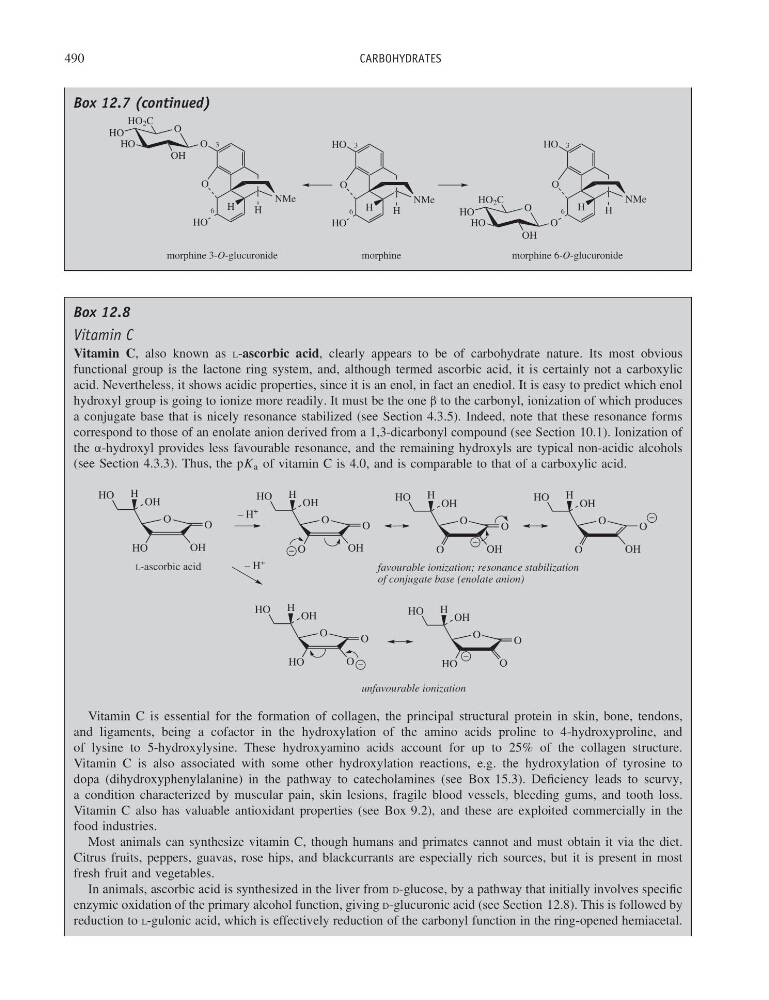
Vitamin C, also known as L-ascorbic acid, clearly appears to be of carbohydrate nature. Its most obvious
functional group is the lactone ring system, and, although termed ascorbic acid, it is certainly not a carboxylic
acid. Nevertheless, it shows acidic properties, since it is an enol, in fact an enediol. It is easy to predict which enol
hydroxyl group is going to ionize more readily. It must be the one β to the carbonyl, ionization of which produces
a conjugate base that is nicely resonance stabilized (see Section 4.3.5). Indeed, note that these resonance forms
correspond to those of an enolate anion derived from a 1,3-dicarbonyl compound (see Section 10.1). Ionization of
the α-hydroxyl provides less favourable resonance, and the remaining hydroxyls are typical non-acidic alcohols
(see Section 4.3.3). Thus, the pK a of vitamin C is 4.0, and is comparable to that of a carboxylic acid.
L-ascorbic acid
– H
+
favourable ionization; resonance stabilization
of conjugate base (enolate anion)
– H +
unfavourable ionization
O
O
OH
HO
HO
OH
H
O
O
OH
O
HO
OH
H
O
O
OH
O
HO
OH
H
O
O
OH
O
HO
OH
H
O
O
O
HO
HO
OH
H
O
O
O
HO
HO
OH
H
Vitamin C is essential for the formation of collagen, the principal structural protein in skin, bone, tendons,
and ligaments, being a cofactor in the hydroxylation of the amino acids proline to 4-hydroxyproline, and
of lysine to 5-hydroxylysine. These hydroxyamino acids account for up to 25% of the collagen structure.
Vitamin C is also associated with some other hydroxylation reactions, e.g. the hydroxylation of tyrosine to
dopa (dihydroxyphenylalanine) in the pathway to catecholamines (see Box 15.3). Deficiency leads to scurvy,
a condition characterized by muscular pain, skin lesions, fragile blood vessels, bleeding gums, and tooth loss.
Vitamin C also has valuable antioxidant properties (see Box 9.2), and these are exploited commercially in the
food industries.
Most animals can synthesize vitamin C, though humans and primates cannot and must obtain it via the diet.
Citrus fruits, peppers, guavas, rose hips, and blackcurrants are especially rich sources, but it is present in most
fresh fruit and vegetables.
In animals, ascorbic acid is synthesized in the liver from D-glucose, by a pathway that initially involves specific
enzymic oxidation of the primary alcohol function, giving D-glucuronic acid (see Section 12.8). This is followed by
reduction to L-gulonic acid, which is effectively reduction of the carbonyl function in the ring-opened hemiacetal.
CARBOHYDRATES
Box 12.7 (continued)
HO
O
H
NMe
H
O
HO 2 C
HO
HO
OH
O
morphine 6-O-glucuronide
3
6
O
H
NMe
H
HO
morphine 3-O-glucuronide
3
6
O
HO 2 C
HO
HO
OH
O
O
H
NMe
H
HO
3
6
HO
morphine
Box 12.8
Vitamin C
Vitamin C, also known as L-ascorbic acid, clearly appears to be of carbohydrate nature. Its most obvious
functional group is the lactone ring system, and, although termed ascorbic acid, it is certainly not a carboxylic
acid. Nevertheless, it shows acidic properties, since it is an enol, in fact an enediol. It is easy to predict which enol
hydroxyl group is going to ionize more readily. It must be the one β to the carbonyl, ionization of which produces
a conjugate base that is nicely resonance stabilized (see Section 4.3.5). Indeed, note that these resonance forms
correspond to those of an enolate anion derived from a 1,3-dicarbonyl compound (see Section 10.1). Ionization of
the α-hydroxyl provides less favourable resonance, and the remaining hydroxyls are typical non-acidic alcohols
(see Section 4.3.3). Thus, the pK a of vitamin C is 4.0, and is comparable to that of a carboxylic acid.
L-ascorbic acid
– H
+
favourable ionization; resonance stabilization
of conjugate base (enolate anion)
– H +
unfavourable ionization
O
O
OH
HO
HO
OH
H
O
O
OH
O
HO
OH
H
O
O
OH
O
HO
OH
H
O
O
OH
O
HO
OH
H
O
O
O
HO
HO
OH
H
O
O
O
HO
HO
OH
H
Vitamin C is essential for the formation of collagen, the principal structural protein in skin, bone, tendons,
and ligaments, being a cofactor in the hydroxylation of the amino acids proline to 4-hydroxyproline, and
of lysine to 5-hydroxylysine. These hydroxyamino acids account for up to 25% of the collagen structure.
Vitamin C is also associated with some other hydroxylation reactions, e.g. the hydroxylation of tyrosine to
dopa (dihydroxyphenylalanine) in the pathway to catecholamines (see Box 15.3). Deficiency leads to scurvy,
a condition characterized by muscular pain, skin lesions, fragile blood vessels, bleeding gums, and tooth loss.
Vitamin C also has valuable antioxidant properties (see Box 9.2), and these are exploited commercially in the
food industries.
Most animals can synthesize vitamin C, though humans and primates cannot and must obtain it via the diet.
Citrus fruits, peppers, guavas, rose hips, and blackcurrants are especially rich sources, but it is present in most
fresh fruit and vegetables.
In animals, ascorbic acid is synthesized in the liver from D-glucose, by a pathway that initially involves specific
enzymic oxidation of the primary alcohol function, giving D-glucuronic acid (see Section 12.8). This is followed by
reduction to L-gulonic acid, which is effectively reduction of the carbonyl function in the ring-opened hemiacetal.