

OXIDATION OF SUGARS: URONIC ACIDS
487
acid utilizing molecular oxygen as oxidant, but
detection of the process is dependent upon the
simultaneous production of hydrogen peroxide.
glucose + O 2
glucose oxidase
gluconic acid + H 2 O 2
Hydrogen peroxide may be detected by exploiting a secondary chemical reaction that produces a
coloured product; this is compared with a standard
colour chart to indicate the colour intensity and,
therefore, give a measure of the glucose concentration. Alternatively, it may be scanned in a
colorimeter to give a more accurate assay. Even more
accuracy can be obtained by using a voltammetric
sensor, in which the hydrogen peroxide is oxidized
to oxygen on an electrode surface, thus generating an
electrical current that is directly proportional to the
glucose concentration.
H 2 O 2 +
O 2 + H 2 O + 2 e
−
2 HO
−
The method is highly specific for glucose. Related
sugars, such as mannose, xylose and galactose, are
not oxidized by this enzyme, or react only in trace
amounts.
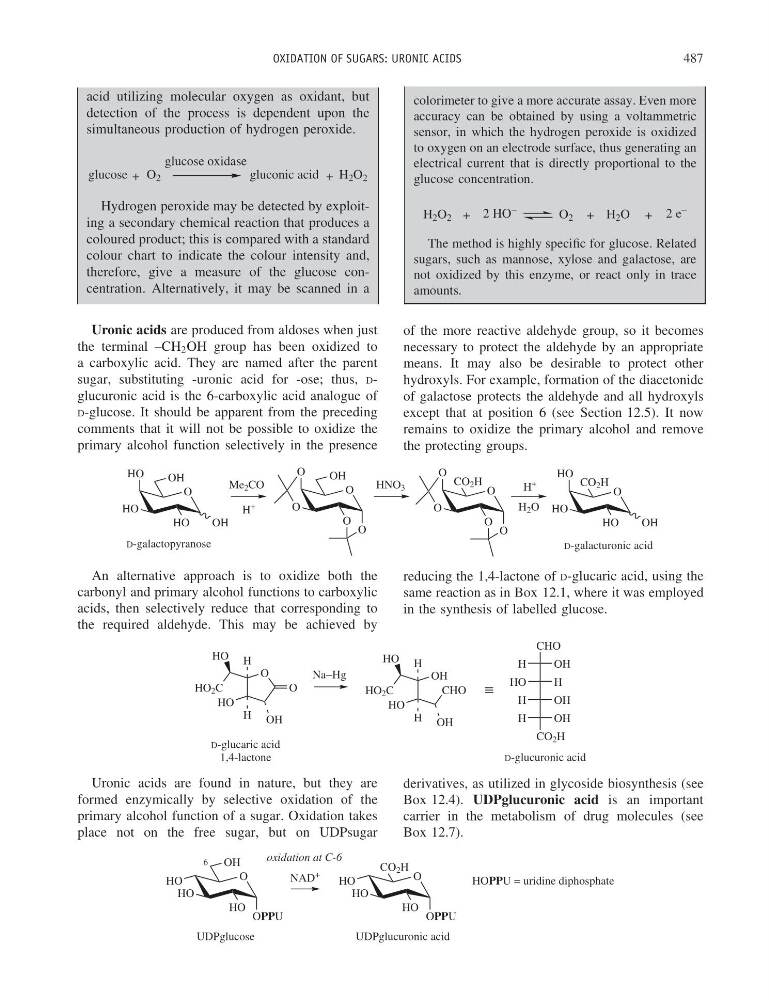
Uronic acids are produced from aldoses when just
the terminal –CH 2 OH group has been oxidized to
a carboxylic acid. They are named after the parent
sugar, substituting -uronic acid for -ose; thus, Dglucuronic acid is the 6-carboxylic acid analogue of
D-glucose. It should be apparent from the preceding
comments that it will not be possible to oxidize the
primary alcohol function selectively in the presence
of the more reactive aldehyde group, so it becomes
necessary to protect the aldehyde by an appropriate
means. It may also be desirable to protect other
hydroxyls. For example, formation of the diacetonide
of galactose protects the aldehyde and all hydroxyls
except that at position 6 (see Section 12.5). It now
remains to oxidize the primary alcohol and remove
the protecting groups.
O
HO
HO
OH
D-galactopyranose
O
O
O
O
OH
HO
OH
O
Me 2 CO
H
+
HNO 3
H
+
H 2 O
O
O
CO 2 H
O
O
O
O
HO
CO 2 H
HO
OH
HO
D-galacturonic acid
An alternative approach is to oxidize both the
carbonyl and primary alcohol functions to carboxylic
acids, then selectively reduce that corresponding to
the required aldehyde. This may be achieved by
reducing the 1,4-lactone of D-glucaric acid, using the
same reaction as in Box 12.1, where it was employed
in the synthesis of labelled glucose.
O
HO 2 C
HO
O
HO
OH
H
H
D-glucaric acid
1,4-lactone
Na−Hg
CHO
OH
HO 2 C
HO
HO
OH
H
H
HO
H
H
OH
H
OH
CO 2 H
H
OH
CHO
D-glucuronic acid
≡
Uronic acids are found in nature, but they are
formed enzymically by selective oxidation of the
primary alcohol function of a sugar. Oxidation takes
place not on the free sugar, but on UDPsugar
derivatives, as utilized in glycoside biosynthesis (see
Box 12.4). UDPglucuronic acid is an important
carrier in the metabolism of drug molecules (see
Box 12.7).
O
HO
HO
OH
OPPU
HO
O
HO
HO
CO 2 H
OPPU
HO
UDPglucuronic acid
UDPglucose
6
oxidation at C-6
HOPPU = uridine diphosphate
NAD
+
487
acid utilizing molecular oxygen as oxidant, but
detection of the process is dependent upon the
simultaneous production of hydrogen peroxide.
glucose + O 2
glucose oxidase
gluconic acid + H 2 O 2
Hydrogen peroxide may be detected by exploiting a secondary chemical reaction that produces a
coloured product; this is compared with a standard
colour chart to indicate the colour intensity and,
therefore, give a measure of the glucose concentration. Alternatively, it may be scanned in a
colorimeter to give a more accurate assay. Even more
accuracy can be obtained by using a voltammetric
sensor, in which the hydrogen peroxide is oxidized
to oxygen on an electrode surface, thus generating an
electrical current that is directly proportional to the
glucose concentration.
H 2 O 2 +
O 2 + H 2 O + 2 e
−
2 HO
−
The method is highly specific for glucose. Related
sugars, such as mannose, xylose and galactose, are
not oxidized by this enzyme, or react only in trace
amounts.
Uronic acids are produced from aldoses when just
the terminal –CH 2 OH group has been oxidized to
a carboxylic acid. They are named after the parent
sugar, substituting -uronic acid for -ose; thus, Dglucuronic acid is the 6-carboxylic acid analogue of
D-glucose. It should be apparent from the preceding
comments that it will not be possible to oxidize the
primary alcohol function selectively in the presence
of the more reactive aldehyde group, so it becomes
necessary to protect the aldehyde by an appropriate
means. It may also be desirable to protect other
hydroxyls. For example, formation of the diacetonide
of galactose protects the aldehyde and all hydroxyls
except that at position 6 (see Section 12.5). It now
remains to oxidize the primary alcohol and remove
the protecting groups.
O
HO
HO
OH
D-galactopyranose
O
O
O
O
OH
HO
OH
O
Me 2 CO
H
+
HNO 3
H
+
H 2 O
O
O
CO 2 H
O
O
O
O
HO
CO 2 H
HO
OH
HO
D-galacturonic acid
An alternative approach is to oxidize both the
carbonyl and primary alcohol functions to carboxylic
acids, then selectively reduce that corresponding to
the required aldehyde. This may be achieved by
reducing the 1,4-lactone of D-glucaric acid, using the
same reaction as in Box 12.1, where it was employed
in the synthesis of labelled glucose.
O
HO 2 C
HO
O
HO
OH
H
H
D-glucaric acid
1,4-lactone
Na−Hg
CHO
OH
HO 2 C
HO
HO
OH
H
H
HO
H
H
OH
H
OH
CO 2 H
H
OH
CHO
D-glucuronic acid
≡
Uronic acids are found in nature, but they are
formed enzymically by selective oxidation of the
primary alcohol function of a sugar. Oxidation takes
place not on the free sugar, but on UDPsugar
derivatives, as utilized in glycoside biosynthesis (see
Box 12.4). UDPglucuronic acid is an important
carrier in the metabolism of drug molecules (see
Box 12.7).
O
HO
HO
OH
OPPU
HO
O
HO
HO
CO 2 H
OPPU
HO
UDPglucuronic acid
UDPglucose
6
oxidation at C-6
HOPPU = uridine diphosphate
NAD
+