

486
CARBOHYDRATES
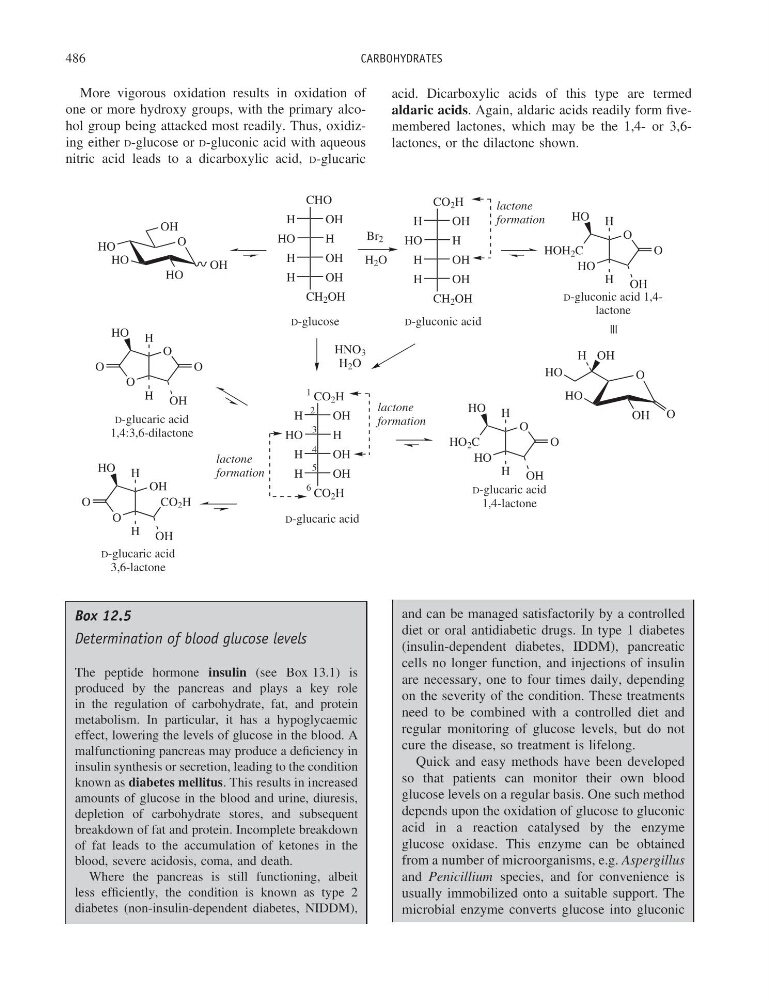
More vigorous oxidation results in oxidation of
one or more hydroxy groups, with the primary alcohol group being attacked most readily. Thus, oxidizing either D-glucose or D-gluconic acid with aqueous
nitric acid leads to a dicarboxylic acid, D-glucaric
acid. Dicarboxylic acids of this type are termed
aldaric acids. Again, aldaric acids readily form fivemembered lactones, which may be the 1,4- or 3,6lactones, or the dilactone shown.
HO
H
H
OH
H
OH
CH 2 OH
H
OH
CHO
D-glucose
O
HO
HO
OH
HO
OH
Br 2
H 2 O
HO
H
H
OH
H
OH
CH 2 OH
H
OH
CO 2 H
D-gluconic acid
O
HO
HO
OH O
OH
H
D-gluconic acid 1,4lactone
HO
H
H
OH
H
OH
CO 2 H
H
OH
CO 2 H
D-glucaric acid
HNO 3
H 2 O
O
O
O
O
HO
OH
H
H
D-glucaric acid
1,4:3,6-dilactone
lactone
formation
lactone
formation
lactone
formation
O
HO 2 C
HO
O
HO
OH
H
H
CO 2 H
OH
O
O
HO
OH
H
H
D-glucaric acid
1,4-lactone
D-glucaric acid
3,6-lactone
O
HOH 2 C
HO
O
HO
OH
H
H
≡
1
2
3
4
5
6
Box 12.5
Determination of blood glucose levels
The peptide hormone insulin (see Box 13.1) is
produced by the pancreas and plays a key role
in the regulation of carbohydrate, fat, and protein
metabolism. In particular, it has a hypoglycaemic
effect, lowering the levels of glucose in the blood. A
malfunctioning pancreas may produce a deficiency in
insulin synthesis or secretion, leading to the condition
known as diabetes mellitus. This results in increased
amounts of glucose in the blood and urine, diuresis,
depletion of carbohydrate stores, and subsequent
breakdown of fat and protein. Incomplete breakdown
of fat leads to the accumulation of ketones in the
blood, severe acidosis, coma, and death.
Where the pancreas is still functioning, albeit
less efficiently, the condition is known as type 2
diabetes (non-insulin-dependent diabetes, NIDDM),
and can be managed satisfactorily by a controlled
diet or oral antidiabetic drugs. In type 1 diabetes
(insulin-dependent diabetes, IDDM), pancreatic
cells no longer function, and injections of insulin
are necessary, one to four times daily, depending
on the severity of the condition. These treatments
need to be combined with a controlled diet and
regular monitoring of glucose levels, but do not
cure the disease, so treatment is lifelong.
Quick and easy methods have been developed
so that patients can monitor their own blood
glucose levels on a regular basis. One such method
depends upon the oxidation of glucose to gluconic
acid in a reaction catalysed by the enzyme
glucose oxidase. This enzyme can be obtained
from a number of microorganisms, e.g. Aspergillus
and Penicillium species, and for convenience is
usually immobilized onto a suitable support. The
microbial enzyme converts glucose into gluconic
CARBOHYDRATES
More vigorous oxidation results in oxidation of
one or more hydroxy groups, with the primary alcohol group being attacked most readily. Thus, oxidizing either D-glucose or D-gluconic acid with aqueous
nitric acid leads to a dicarboxylic acid, D-glucaric
acid. Dicarboxylic acids of this type are termed
aldaric acids. Again, aldaric acids readily form fivemembered lactones, which may be the 1,4- or 3,6lactones, or the dilactone shown.
HO
H
H
OH
H
OH
CH 2 OH
H
OH
CHO
D-glucose
O
HO
HO
OH
HO
OH
Br 2
H 2 O
HO
H
H
OH
H
OH
CH 2 OH
H
OH
CO 2 H
D-gluconic acid
O
HO
HO
OH O
OH
H
D-gluconic acid 1,4lactone
HO
H
H
OH
H
OH
CO 2 H
H
OH
CO 2 H
D-glucaric acid
HNO 3
H 2 O
O
O
O
O
HO
OH
H
H
D-glucaric acid
1,4:3,6-dilactone
lactone
formation
lactone
formation
lactone
formation
O
HO 2 C
HO
O
HO
OH
H
H
CO 2 H
OH
O
O
HO
OH
H
H
D-glucaric acid
1,4-lactone
D-glucaric acid
3,6-lactone
O
HOH 2 C
HO
O
HO
OH
H
H
≡
1
2
3
4
5
6
Box 12.5
Determination of blood glucose levels
The peptide hormone insulin (see Box 13.1) is
produced by the pancreas and plays a key role
in the regulation of carbohydrate, fat, and protein
metabolism. In particular, it has a hypoglycaemic
effect, lowering the levels of glucose in the blood. A
malfunctioning pancreas may produce a deficiency in
insulin synthesis or secretion, leading to the condition
known as diabetes mellitus. This results in increased
amounts of glucose in the blood and urine, diuresis,
depletion of carbohydrate stores, and subsequent
breakdown of fat and protein. Incomplete breakdown
of fat leads to the accumulation of ketones in the
blood, severe acidosis, coma, and death.
Where the pancreas is still functioning, albeit
less efficiently, the condition is known as type 2
diabetes (non-insulin-dependent diabetes, NIDDM),
and can be managed satisfactorily by a controlled
diet or oral antidiabetic drugs. In type 1 diabetes
(insulin-dependent diabetes, IDDM), pancreatic
cells no longer function, and injections of insulin
are necessary, one to four times daily, depending
on the severity of the condition. These treatments
need to be combined with a controlled diet and
regular monitoring of glucose levels, but do not
cure the disease, so treatment is lifelong.
Quick and easy methods have been developed
so that patients can monitor their own blood
glucose levels on a regular basis. One such method
depends upon the oxidation of glucose to gluconic
acid in a reaction catalysed by the enzyme
glucose oxidase. This enzyme can be obtained
from a number of microorganisms, e.g. Aspergillus
and Penicillium species, and for convenience is
usually immobilized onto a suitable support. The
microbial enzyme converts glucose into gluconic