

OXIDATION OF SUGARS: URONIC ACIDS
485
O
HO
HO O
HO
O
HO
HO
HO
O
O
1
2
inulin
(30–35 residues)
2
β2→1
D-Fru
D-Fru
O
HO
OH
HO
O
O
HO
OH
OH
O
O
1
4
cellulose
(~8000 residues)
β1→4
D-Glc
D-Glc
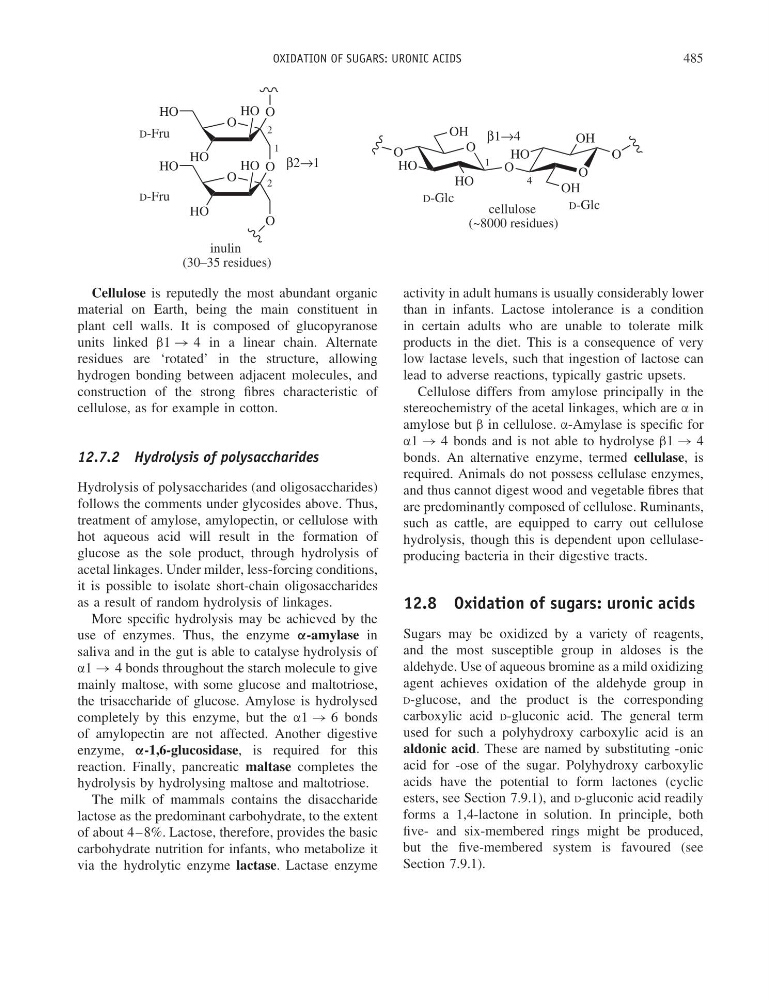
Cellulose is reputedly the most abundant organic
material on Earth, being the main constituent in
plant cell walls. It is composed of glucopyranose
units linked β1 → 4 in a linear chain. Alternate
residues are ‘rotated’ in the structure, allowing
hydrogen bonding between adjacent molecules, and
construction of the strong fibres characteristic of
cellulose, as for example in cotton.
12.7.2 Hydrolysis of polysaccharides
Hydrolysis of polysaccharides (and oligosaccharides)
follows the comments under glycosides above. Thus,
treatment of amylose, amylopectin, or cellulose with
hot aqueous acid will result in the formation of
glucose as the sole product, through hydrolysis of
acetal linkages. Under milder, less-forcing conditions,
it is possible to isolate short-chain oligosaccharides
as a result of random hydrolysis of linkages.
More specific hydrolysis may be achieved by the
use of enzymes. Thus, the enzyme α-amylase in
saliva and in the gut is able to catalyse hydrolysis of
α1 → 4 bonds throughout the starch molecule to give
mainly maltose, with some glucose and maltotriose,
the trisaccharide of glucose. Amylose is hydrolysed
completely by this enzyme, but the α1 → 6 bonds
of amylopectin are not affected. Another digestive
enzyme, α-1,6-glucosidase, is required for this
reaction. Finally, pancreatic maltase completes the
hydrolysis by hydrolysing maltose and maltotriose.
The milk of mammals contains the disaccharide
lactose as the predominant carbohydrate, to the extent
of about 4–8%. Lactose, therefore, provides the basic
carbohydrate nutrition for infants, who metabolize it
via the hydrolytic enzyme lactase. Lactase enzyme
activity in adult humans is usually considerably lower
than in infants. Lactose intolerance is a condition
in certain adults who are unable to tolerate milk
products in the diet. This is a consequence of very
low lactase levels, such that ingestion of lactose can
lead to adverse reactions, typically gastric upsets.
Cellulose differs from amylose principally in the
stereochemistry of the acetal linkages, which are α in
amylose but β in cellulose. α-Amylase is specific for
α1 → 4 bonds and is not able to hydrolyse β1 → 4
bonds. An alternative enzyme, termed cellulase, is
required. Animals do not possess cellulase enzymes,
and thus cannot digest wood and vegetable fibres that
are predominantly composed of cellulose. Ruminants,
such as cattle, are equipped to carry out cellulose
hydrolysis, though this is dependent upon cellulaseproducing bacteria in their digestive tracts.
12.8 Oxidation of sugars: uronic acids
Sugars may be oxidized by a variety of reagents,
and the most susceptible group in aldoses is the
aldehyde. Use of aqueous bromine as a mild oxidizing
agent achieves oxidation of the aldehyde group in
D-glucose, and the product is the corresponding
carboxylic acid D-gluconic acid. The general term
used for such a polyhydroxy carboxylic acid is an
aldonic acid. These are named by substituting -onic
acid for -ose of the sugar. Polyhydroxy carboxylic
acids have the potential to form lactones (cyclic
esters, see Section 7.9.1), and D-gluconic acid readily
forms a 1,4-lactone in solution. In principle, both
five- and six-membered rings might be produced,
but the five-membered system is favoured (see
Section 7.9.1).
485
O
HO
HO O
HO
O
HO
HO
HO
O
O
1
2
inulin
(30–35 residues)
2
β2→1
D-Fru
D-Fru
O
HO
OH
HO
O
O
HO
OH
OH
O
O
1
4
cellulose
(~8000 residues)
β1→4
D-Glc
D-Glc
Cellulose is reputedly the most abundant organic
material on Earth, being the main constituent in
plant cell walls. It is composed of glucopyranose
units linked β1 → 4 in a linear chain. Alternate
residues are ‘rotated’ in the structure, allowing
hydrogen bonding between adjacent molecules, and
construction of the strong fibres characteristic of
cellulose, as for example in cotton.
12.7.2 Hydrolysis of polysaccharides
Hydrolysis of polysaccharides (and oligosaccharides)
follows the comments under glycosides above. Thus,
treatment of amylose, amylopectin, or cellulose with
hot aqueous acid will result in the formation of
glucose as the sole product, through hydrolysis of
acetal linkages. Under milder, less-forcing conditions,
it is possible to isolate short-chain oligosaccharides
as a result of random hydrolysis of linkages.
More specific hydrolysis may be achieved by the
use of enzymes. Thus, the enzyme α-amylase in
saliva and in the gut is able to catalyse hydrolysis of
α1 → 4 bonds throughout the starch molecule to give
mainly maltose, with some glucose and maltotriose,
the trisaccharide of glucose. Amylose is hydrolysed
completely by this enzyme, but the α1 → 6 bonds
of amylopectin are not affected. Another digestive
enzyme, α-1,6-glucosidase, is required for this
reaction. Finally, pancreatic maltase completes the
hydrolysis by hydrolysing maltose and maltotriose.
The milk of mammals contains the disaccharide
lactose as the predominant carbohydrate, to the extent
of about 4–8%. Lactose, therefore, provides the basic
carbohydrate nutrition for infants, who metabolize it
via the hydrolytic enzyme lactase. Lactase enzyme
activity in adult humans is usually considerably lower
than in infants. Lactose intolerance is a condition
in certain adults who are unable to tolerate milk
products in the diet. This is a consequence of very
low lactase levels, such that ingestion of lactose can
lead to adverse reactions, typically gastric upsets.
Cellulose differs from amylose principally in the
stereochemistry of the acetal linkages, which are α in
amylose but β in cellulose. α-Amylase is specific for
α1 → 4 bonds and is not able to hydrolyse β1 → 4
bonds. An alternative enzyme, termed cellulase, is
required. Animals do not possess cellulase enzymes,
and thus cannot digest wood and vegetable fibres that
are predominantly composed of cellulose. Ruminants,
such as cattle, are equipped to carry out cellulose
hydrolysis, though this is dependent upon cellulaseproducing bacteria in their digestive tracts.
12.8 Oxidation of sugars: uronic acids
Sugars may be oxidized by a variety of reagents,
and the most susceptible group in aldoses is the
aldehyde. Use of aqueous bromine as a mild oxidizing
agent achieves oxidation of the aldehyde group in
D-glucose, and the product is the corresponding
carboxylic acid D-gluconic acid. The general term
used for such a polyhydroxy carboxylic acid is an
aldonic acid. These are named by substituting -onic
acid for -ose of the sugar. Polyhydroxy carboxylic
acids have the potential to form lactones (cyclic
esters, see Section 7.9.1), and D-gluconic acid readily
forms a 1,4-lactone in solution. In principle, both
five- and six-membered rings might be produced,
but the five-membered system is favoured (see
Section 7.9.1).